
Journalist Mark Williamson has started a new blog – and in his latest post he’s rightly critical of the state of our city
You can read what he says here
Mark starts off quoting Syd Barrett of Pink Floyd – someone who lived in recluse not far from where I spent most of my life here in Cambridge. (You can read Chris Rand’s article on the band’s Cambridge days here). As a teenager working in the local Budgen’s (now Co-op), I would be completely oblivious to his presence in the shop – even on a checkout serving him, because by that time he didn’t look anything like the 1960s rockstar he was some three decades before.
The reason for mentioning this is to highlight the huge changes that the city has been through since the 1960s – as Kenneth Robinson’s documentary on Cambridge in 1964 shows. And yet the promoters of growth want even more growth even though our city is showing the symptoms of having grown far beyond what our civic, social, transport, housing, governance, and environmental infrastructure can carry. Furthermore, I remain to be convinced that what ministers are proposing for reformed local government will provide what our towns and cities need in terms of new powers and resources. Ministers have already been called out over tourism taxation. Not that a visitors levy will raise nearly enough revenue to alleviate/mitigate the damage that mass tourism causes – and not just to Cambridge. In anycase, we’re still waiting for the new ‘destination management plan‘. Even if it is published in the near future (or even if it has been published in the past few months – which I’ve missed/forgotten!), chances are that it’ll have to be revamped when ministers publish their vision for Cambridge.
I remain of the view that HM Treasury is the weak link in the Government’s plans
I wrote about it last December (2024) here. I don’t see any merit in adding to this unless/until the Chancellor announces a seismic change in policy the likes of which have not been seen since before Thatcher came to power.
I have also commented on the impact of the extractive business practices
In particular the impact that extractive and speculative property activities have on the ability for the city to provide the sorts of facilities that can only be provided from land/premises that charge low rents. Hard to do in the midst of a speculative sci-tech property and housing bubbles. The same goes for the lack of high quality open green space in property developments. I stumbled across Richard Taylor’s old blogpost from the controversial Cambridge Station redevelopment when the first plans (pre-Brookgate) were approved in 2008.
“Cllr Blencowe indicated first and summarised his reasons for voting against [included] The open space / recreation space falling well short of what was required by the local plan (2006)”
This was referenced from a monster thread on the old G-Groups from October 2008 on the station redevelopment. Might be worth comparing what the participants said in the mid-late 2000s with what we’ve got today. And how does the street scene of Cambridge in that era compare with today? Have a look at the video below from some Cambridge students nearly two decades ago.
Above – a song about FB when it was only available to students in 2006
Will Cambridge University’s Community Knowledge Working Group persuade the decision-makers in the ivory towers to stand up for local government against ministers?
For those of you that want to take part in the group, see here. In late October we’re expecting a report from a research exercise the University commissioned on how it can improve its work with local residential communities. This also follows on from an independent report by Claire Adler in 2023 which I wrote about here. Claire has since become the Chair of the Queen Edith’s Community Forum.
The Coleridge Dragon needs a clean
It’s not just the city centre – it’s also the lack of funds for basic maintenance that also shows in our parks and suburbs.

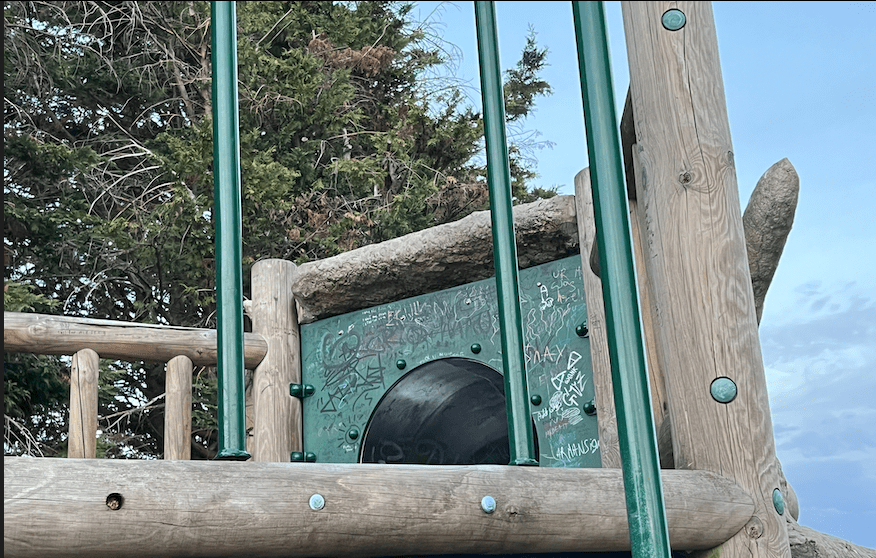
Above – the Coleridge Dragon slide at Coleridge Rec’s ‘Dragon Park’ – needs a clean!
Another sign of the long term decline of Cambridge’s civic realm is the empty notice boards which, in happier times used to be full of posters of events and visiting/touring attractions.

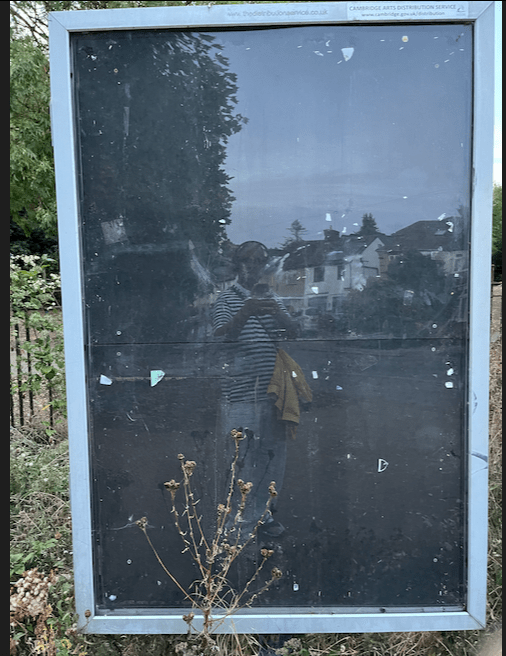
Above – Coleridge Rec 26 Aug 2025
But then no local council could have coped much better given what successive Conservative Chancellors imposed on it.

Above – the cuts in funding from Whitehall to Cambridge City Council 2015-2022 (House of Commons Library).
As I wrote back in early 2023, senior ministers underestimated the essential links between community groups and their local councils. The irony being that David Cameron’s policies turned out to be the biggest threat/obstacle to David Cameron achieving his vision for whatever Big Society was meant to be.
As I’ve mentioned in previous posts, Cambridge is approaching a major decision point in our shared collective history. Ultimately ministers will have to decide what sort of municipal/local government we will get. If all we get is the equivalent of what Peterborough City Council got in the late 1990s through unitarisation at the end of a significant period of housing growth (as a third generation new town – you can read the history and what they learnt here), ministers will have failed. The Chancellor must come up with a formula and structure that enables places like Cambridge to tax the excess wealth generated here to pay for much needed infrastructure & civic improvements that ministers won’t fund through central funds, while at the same time ensuring there is some ‘top-slicing’ of revenues from areas of very extreme wealth to support areas unable to raise revenues locally.
If you are interested in the longer term future of Cambridge, and on what happens at the local democracy meetings where decisions are made, feel free to:
- Follow me on BSky
- Spot me on LinkedIn
- Like my Facebook page
- Consider a small donation to help fund my continued research and reporting on local democracy in and around Cambridge.

 The Cambridge Town Owl