Organised by Real Estate Balance, I thought **Bold Move by Bidwells** given the number of controversial developments in/around Cambridge that their clients have instructed them on. Which means representatives of Bidwells often come face-to-face with community groups opposing said planning applications.
At the same time, I wanted to get a sense of where the sector was on community inclusion, what their expectations were, and what problems they thought they were having in trying to respond to Cambridge’s chronic inequality that is becoming a significant political/economic risk* – especially when you look at the electoral gains from both TeamNigel and from the Cambridge Green Party at the recent county council elections.
[*By ‘political/economic risk I mean that both parties have policies that, if elected to positions of power, could require significant changes in business practices for the firms involved – i.e. it would almost compel a response instead of ‘doing nothing’. It’s not a value judgement]
Furthermore, given the advertising of the event was mainly in business-related circles and social media sites, I wondered how many people in a similar situation to me i.e. reliant primarily on Universal Credit for income due to chronic illness (hence inviting people to subscribe here), and with very, very limited mobility for the same reason, were going to attend. All too often the people who are the subject of conferences (esp in public policy) are conspicuous by their absence.
Before I start, a reminder about accessibility of venues. If you want a diverse audience (especially on incomes) to take part, don’t select a location that has poor public transport – especially in the evening! The woeful evening bus service meant that it took me 90 minutes to get home!)
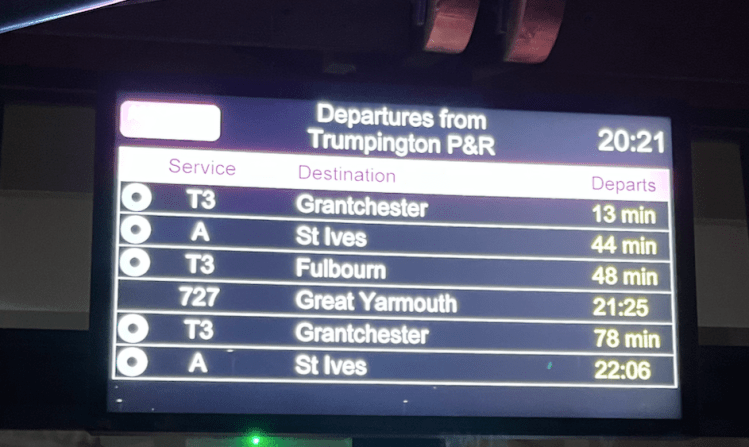
Above – at Trumpington P&R where on the other side of the building people were having an argument. And then it started pouring down!
Anyway:
Big takeaways
The property sector struggles with the sort of community engagement that doesn’t involve a financial transaction.
Two reasons come to mind:
- Ultimately the paymaster calls the tune. The communities affected do not. Push comes to shove, property professionals have to do as instructed (unless it breaches professional/legal duties) even if those decisions infuriate local communities affected.
- There’s no other loss to property professionals of the type that elected politicians face – i.e. elections and the loss of political power. With the rise of sub-contracting of community engagement functions to distant consultants who may know nothing of the people and communities involved (eg due to being based elsewhere eg London), the lack of local/civic knowledge means the system all too often bypasses communities by design. (This came up in the debate on supply chains)
The property sectors within local economies do not have the capacity or expertise to maintain the sorts of community and civic networks that used to be maintained by local government and civic society
Pro-free-market politicians historically have argued that the state is inefficient and the private sector is the opposite. But with over 40 years worth of experience behind us, we’ve since learnt that those arguments from the 1980s & 1990s that markets require complex and nuanced legal systems (eg to enforce the law on contracts), structures (eg institutions such as a courts service) and conventions (bonds of trust between actors) in order to function efficiently. In the bonfire of public services in the late 20th Century, we have since found that the enfeeblement of the entire adult education and lifelong learning sector was little short of a catastrophe – with firms complaining repeatedly about skills shortages. Hence during my intervention I asked everyone about skills and lifelong learning – and why Cambridge no longer had a lifelong learning college.
The decline of local government and of the voluntary and community services sector since 2010, combined with the catastrophe that hit local and regional newspaper publishers has made it harder to do community engagement well – even for those firms willing to put the time, effort and resources in. Some of our city-based firms are employing community engagement specialists (I met some of them) but they need local council opposites, and the latter simply do not have the funding to employ the staff who can meet them as equal partners.
The market ‘likes Cambridge’ in spite of, not because of its messy governance structures
Have a listen to Alex Notay, Catriona Riddell, and Jackie Sade on Planning After Dark here from 15mins in. They say what local people trying to engage with the system have been saying for years about the over-complicated governance structures. Can’t blame me – I opposed the establishment of the Combined Authority in the run up to it being established in 2016 – have a listen to Dotty McCleod of BBC Cambridgeshire interviewing me following a media debate at Newmarket Racecourse here. If powerful ministers are going to insist on establishing new institutions for party political purposes (in this case, the Conservatives trying to take control of Cambridge without having to win an election – a city and seat they once called their own until the incredible collapse of the 1980s/1990s)), then expect business sectors to take a hit.
Business sectors need to regain the confidence of being willing to discuss good governance and civic responsibility – something that business leaders of previous ages took as a given
- Cyril Ridgeon
- Charles Kelsey Kerridge
- Sir David Robinson
They may have been scoundrels but at least you had heard of them! (to paraphrase Ben Elton commenting on Margaret Thatcher’s final Cabinet verses her first one!)
Or rather in the case of the above, they made their fortunes but they reinvested both time and wealth into the greater good of our city. The case of Sir David Robinson who funded Robinson College and The Rosie Maternity Hospital is fairly well-known. While the sports centre that looks onto Parker’s Piece is more than familiar, the man behind it has been sadly forgotten about.

Above – C Kelsey Kerridge – who represented Cambridgeshire at county level in a number of sports including football and boxing (note the size of those hands!) 03 July 1972 (Cambridge Evening News, Cambridgeshire Collection featured in my Lost Cambridge blog)
Kelsey Kerridge was insistent that our city needed a new very large indoor multisports centre. Which of you would have been brave enough to argue with him that it was a waste of money – or that there were going to be delays in getting it built?
“My wife and I are both living on borrowed time” he admits. “We know that”. But he is resolved: “When I start anything, I want to finish it. I don’t like giving in. All I want to do is to see the first brick built there. I shall know then that it’s going to be finished. Then I can have some peace and quiet.”
Above – C Kelsey Kerridge, 03 July 1972 to Deryck Harvey
Kerridge got his way, and we named the sports centre after him.
Both Kerridge and Cyril Ridgeon were elected councillors. They bridged the gap between the local business sectors and local government. I don’t get the sense that the collective knowledge of local government functions within the business sector (or even within Cambridge University) is anything like what it needs to be. In the case of the latter, I have run a couple of workshops for Cambridge University students, as well as being a sponsor for a number of student-led community engagement projects that enabled them to learn about the essentials of local government and how it interfaces with the local community sector. Far easier for decision-makers within the old institution to get onto the phone to an alumni in ministerial office (or the senior civil service) in our over-centralised system than to have to wade through the treacle of local governance structures.
One of the things I spoke to a number of participants about was the Government’s proposals on overhauling local government nationwide. (For anyone in/around Cambridge interested, get in touch with the Cambs Unitaries Campaign). What was clear from their comments was that they took ‘politics’ and ministerial decisions as a given, and worked with or around them.
“We’re now onto our third mayor – who I met recently. I’m not sure that he has any significant powers to deal with [Cambridge’s challenges]
In the latter part of the Q&A session, participants tried to discuss political issues without mentioning ‘politics’.
Furthermore, many of the people in the audience did not come from a background of community development, so were not equipped with the knowledge or experience to contribute towards the community inclusion issues. The participants that did – either through their professional knowledge, through life experiences, or both (and more) called out the panel on this.
One of the participants told me that things are changing within industry and that more firms are employing people with community development expertise *and* are creating new roles within their organisations. The problem remains that local government and the Cambridge CVS and members simply do not have the administrative capacity to meet them half-way to enable our city to become greater than the sum of its parts.
I gave them another example of a service run on a shoe string that the local property sector relies heavily on at planning and consultation stage:
Property professionals – especially those in the early stages of their careers, can sometimes be found in the Collection going through old maps as they draw up their site history reports for clients. But few people realise how much work for so few members of staff (i.e. Mary and Jacqui). Hence I mentioned that comparisons between Cambridge UK and Cambridge MA are ‘irrelevant’ when it comes to what local government should do because in the UK our councils don’t have anywhere near the revenue-raising powers needed to pay for the things that our US counterparts take for granted.
“References to the local impacts of tech clusters in other countries can be very misleading, due to differences in taxation regimes and local government arrangements”
Above – Sam Davies MBE (former Independent Councillor for Queen Edith’s Ward) 10 July 2022
“Can Bidwells co-host a future event about the future boundaries and powers (incl tax raising) that the new unitary council for Greater Cambridge needs?”
I put this question to Nick Pettit of Bidwells (one of the senior partners) because so many of the points that came up from the panel were linked to the lack of powers, resources, and competencies in local government.
There were several reasons for asking him this:
- His sector has the resources to organise/host such an event
- The scale of the challenges mean that interest from beyond the property sector will emerge
- If we got the format right, it would enable a critical mass of people from both local government *and* the voluntary sector to provide a much-need critical challenge to the property sector but framed in the context of trying to solve a shared problem
- Workshops could provide participants with just enough essential information of core public policy and governance concepts to spark meaningful conversations between/within/across different sectors on how Cambridge should be governed
- It might also provide an emerging shared space to discuss problems that no one has ownership of – eg ‘How should the people and institutions of Cambridge communicate with each other when shaping our shared future?” (i.e. taking on the problem of the declining local media presence)
And finally…
On that last point, a bit of local history. In the 1990s the old Cambridge Evening News used to publish an in-depth ‘What’s on’ guide every week.

Above – 20 pages of previews, reviews, and schedules covering arts, music, and entertainment. Cambridge Evening News, 27 Aug 1998 in the British Newspaper Archive
Where is the equivalent of the above today, all in one place?

Above – Cambridge Evening News 27 Aug 1998 in the British Newspaper Archive
Furthermore, at the very end the listings as above were published in such a way as to equalise everything and everyone. For example, December 1994 – spot any big names?

Above – did you spot Oasis at the Corn Exchange on the Sunday night (followed by Eternal the day after?)
And on the same day in the same font at a different venue to Oasis was… MJ Trayner’s Tribute to Elvis!
(Within three years of the above being published, I ended up seeing ***Both Oasis, and MJ Trayner*** [Earl’s Court London, and The Rathmore on Cherry Hinton Road respectively] which I think is kinda cool!)
But how many of those venues are still around today?
Because since the early 1990s when I started secondary school here, our population within our 1935-era municipal boundaries has risen from just over 100,000 to just over 150,000. Combine that with the huge growth in tourism, language student numbers, and private/cram college students and you’d expect our night life and leisure offer to be far, far greater today.
Is it? If not, why not? And what are we as a city going to do about it?
Food for thought?
If you are interested in the longer term future of Cambridge, and on what happens at the local democracy meetings where decisions are made, feel free to:
- Follow me on BSky
- Spot me on LinkedIn
- Like my Facebook page
- Consider a small donation to help fund my continued research and reporting on local democracy in and around Cambridge

 The Cambridge Town Owl