
I made my way to the Cambridge Biomedical Campus’s Hub on what was the last chance to say something on the proposed new conference centre being planned for the site
TL/DR? See the consultation page here
“What does the building look like?”
Like this below – only I don’t like the way developers hide their buildings behind green trees and foliage. Too much bad design can be hidden behind it. (See RailPen with their views of their proposed Beehive redevelopment and their sight lines deliberately obscured by trees to hide the effect of bulky tall buildings)
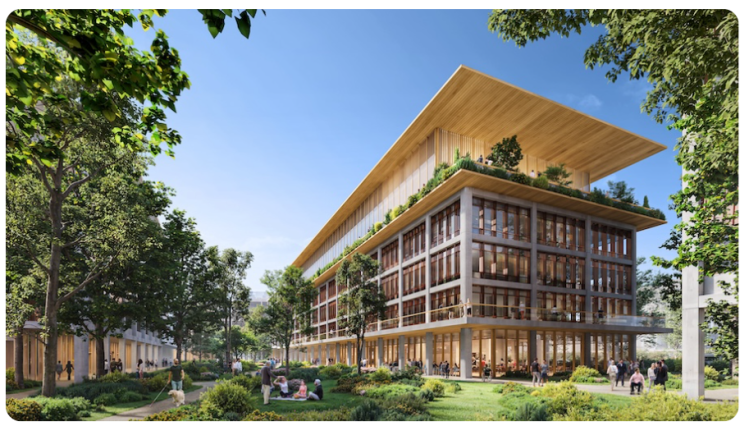
Above – AstraZeneca’s proposed new conferencing centre
“Seems alright from here”
That’s part of the problem – we’ve had far too much of ‘alright’ (and worse), and not enough awe-inspiring, wonderful, beautiful, and outstanding buildings that people would choose to go out of their way to visit.
“Why would anyone want to visit a science park for its architecture?”
Because this is Cambridge and we’re meant to have higher standards, right? Actually, there’s a much more serious point that I raised with both AZ and CBC representatives, earlier, and with Bidwells and colleagues earlier in the week. And that is the emerging research from Dr Cleo Valentine (Ph.D Cantab) and colleagues in the field of neuroarchitecture.
Visual discomfort in the built environment – Dr Cleo Valentine and neuroarchitecture
I took along multiple copies of the abstract of Dr Valentine’s co-researched recent paper: Visual Discomfort in the Built Environment.
“The results revealed that façades with regularly spaced elements at approximately three cycles per degree exhibited the highest stress metrics, particularly when combined with high contrast ratios and consistent repetition. Vertical wooden slats and vertical metal screening elements produced the most pronounced indicators of visual stress, while more varied geometric compositions demonstrated substantially lower stress metrics.”
Above – Valentine, C et al (2025) Abstract
There was a really sobering point in one of the conversations I had with one of the staff there when they read out aloud the words in bold in the quotation above from Dr Valentine. Because when we looked out through the large windows of the hub, the presence of box-like buildings with vertical wooden slats, vertical metal screening elements…exactly. And yet this is supposed to be a site full of hospitals where people like me are meant to recover! (I was in Addenbrookes only six or so weeks ago).


Above – Carbuncle-tastic CGIs from buildings on the Cambridge Biomedical Campus.
Dr Valentine’s next steps – using AI and VR
I wrote about this back in June – fascinated by Dr Valentine’s creative thinking in using AI to create multiple different types of facade on the same building frame, and then using Virtual Reality to measure the impact that being in that simulated environment has on our brain chemistry and mental/physical distress.
One of the things that developers on the biomedical campus could do is commission Dr Valentine and colleagues to come up with something that allows their architects to test out various different building exteriors both qualitatively and quantitatively with local residents and employees – i.e. the people who have to walk past the buildings on a reqular basis.
Truth be told, I didn’t really have that much to say about the AstraZeneca building.
The past 15 years have shown me that by the time you get to this stage, it’s very rare that a design of this detail will be pulped as a result of public consultation. And because there didn’t seem to be vast hordes of us coming to the consultation, it’s unlikely that the developers will be moved by the complaints of just a few of us. Which in one sense is how it should be. i.e. not having big developments held up by a stubborn few – even if one of them might be me! Recall the controversy at the opposite end with the Flying Pig pub which had 15,000 signatures opposing it – only for the Conservative Government to overturn the refusal from Cambridge City Council on recommendation of a planning inspector, enabling the developer to sell off the site to RailPen and bank the planning uplift. (I covered this in a blogpost from Sept 2023 here – also we’re long overdue an update on the Romsey Labour Club which has been derelict for ages).
My main interest as I mentioned to Dr Kristin-Anne Rutter of the CBC was to find out what community benefits were likely to become available for local residents in Queen Edith’s ward/division. In reality it was far, far too early in the process to say – these things come out in the wash later on down the line once quantity surveyors and other property professionals have quantified the vital statistics on costs, number of employees likely to use/visit the site, and things like transport impacts. So I ended up spending half of my time there discussing how to solve Cambridge’s long term problems with Dr Rutter instead – trying to make the case for a new lifelong learning centre on site. The big case being that there’s very little for adults who want to retrain in the technical/level 3/A-level roles that Cambridge has a chronic shortage of. (Hence bringing along an old copy of basic science education for adults from 1981 published by a quango ultimately scrapped by Margaret Thatcher)

Above – feel free to browse through the report here
Then ask why despite years of complaining to politicians we still do not have suitable provision for educating adults
Interestingly, the skills shortage did not appear to be as much of a problem for AstraZeneca as for other employers
Their representatives did not see the urgency that I did – and then I clocked that as one of the biggest pharma companies in the world, they could afford to pay higher-than-market salaries. Cross over to the other side of the campus at Addenbrooke’s where I was six weeks ago and the chronic staff shortages there are off the scale. Which is why the evidence bases in the reports for the Combined Authority on the state of the region here are ever so important.
Pushback from AstraZeneca representatives on lifelong learning support
I’m kind of glad they did this because it helped set a boundary in my mind following the previous day’s event at Bidwells on what is the responsibility of private sector firms, and what is the responsibility and competency of the public sector – and in particular, local and central government.
Ultimately it is up to the Minister for Further and Higher Education (Baroness Jacqui Smith) to decide whether Cambridge gets a new lifelong learning centre. This is because John Major’s Government passed a law empowering the Education Secretary (and disempowering everyone else!) from establishing such institutions. I had this confirmed by a government minister a few years ago after Cambridge MP Daniel Zeichner wrote to the Department for Education on my behalf.
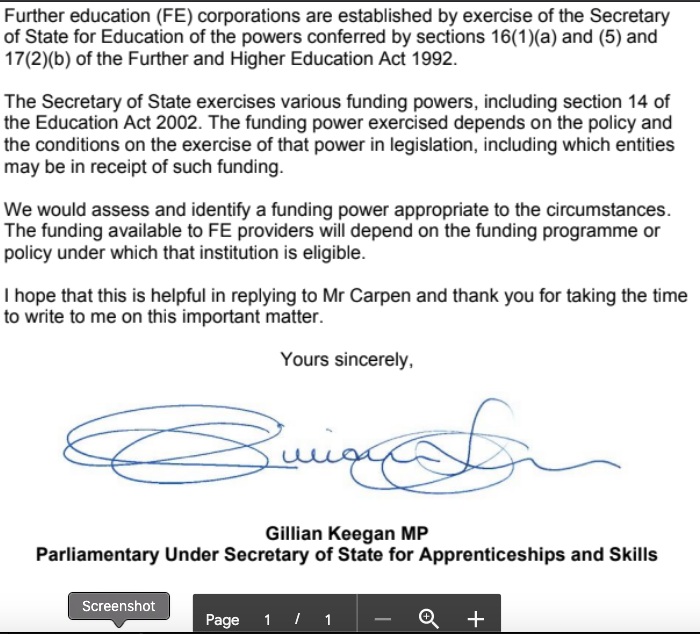
Above – Gillian Keegan MP to Daniel Zeichner MP, 13 Aug 2021 in CTO here
This also means that the Mayor of the Combined Authority – Mr Bristow, does not have the powers to establish such institutions even though he is nominally responsible for adult education. The reality given the funding models and legal structures is that the Combined Authority is simply the delivery agent for central government. Ministers provide the funding and the tight conditions that go with it, and the CPCA committees simply oversee a tendering process to decide who gets what. There’s very little ‘politics’ or flexibility for ‘community engagement’ in that model. It would be *very different* if mayors and local councils had independent revenue-raising powers. But they don’t. Because Parliament has not granted them the powers and Parliament is Sovereign.
The cycle-ride over pot-holed roads past over-crowded further education institutions was not lost on me
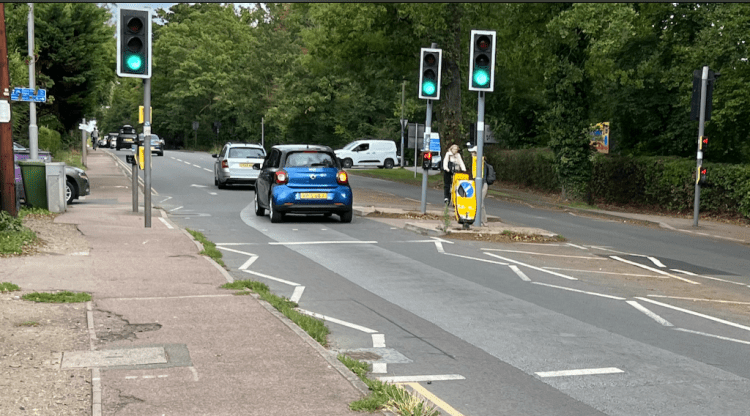
Above – the state of the staggered junction on Long Road between Sedley Taylor Road (named after the man who funded Cambridge’s first state-run dental clinic) and Robinson Way (named after the man who funded the Rosie Maternity Hospital, Sir David Robinson)
It’s a death trap for the thousands of teenagers attending Long Road, CAST, and The Perse that have to use it with the multiple heavy vehicles (eg buses) exiting Robinson Way. Yet as Dr Andy Williams (formerly of AZ) told the Queen Edith’s Community Forum several years ago, the housing and business growth has not been accompanied by the infrastructure needed to underpin it, nor has it been accompanied by funding for basic street maintenance. And that ultimately is a Political decision – one where politicians really needed to push back on the wealthy business interests lobbying for Cambridge to say: “Okay, but we’re going to tax you more to pay for this”
And here for me is the root of the problem…
Our labour market has over-specialised to the extent that we don’t have a critical mass of residents who know the basics of what other sectors do for the good of our city.
- Civil servants who have never worked in local government tend not to know how local government functions/malfunctions
- Local government officers with no experience of Whitehall and Westminster are unlikely to know of the pressures, departmental turf wars, and lobbyists that buzz around ministries
- Private sector representatives may be more than familiar with business practices, but legal restrictions and the sheer complexity of public policy-making (alongside the pressures of democratic accountability) are something they may not appreciate
- If you left school at 16 and live in a part of the city suffering from poverty and multiple deprivation vs the more affluent parts of the city, all of the above may well be unfamiliar to you even though you might be the target demographic for their actions on poverty alleviation.
- The shoe-string that Cambridge’s voluntary and community groups run on can often mean they do not have the capacity to engage with the events put on where their participation could make a big difference.
- While academia can do very deep dives into public policy issues, many early career researchers won’t have the awareness of things like corporate structures, cultures, systems, and processes – especially if they have not had the work placements, secondments, and internships. (Which inevitably means those with the most affluence and connections are the ones most likely to be in a better position on paper to get the academic places, even though the lived experience on social policy research can be worth its weight in…exactly)
Which is why over the next few months, Cambridge (and the CPCA area) needs to have a united voice on the new unitary councils we are going to get. That means telling ministers that we want an empowered, influential, and dynamic municipal council that has the legal and democratic authority to take the sorts of decisions that our current and recent past generations of institutions have been too enfeebled to take.

Above: Enfeebled – the city council’s declining budgets imposed by successive Conservative Chancellors.
That also means private businesses in wealthy sectors being willing to make the case for paying additional taxes to generate the revenue needed for local infrastructure maintenance and investment. That means the rest of us acknowledging the democratic legitimacy and competencies of the new unitary council (looking at you Cambridge University and wealthy colleges like you Trinity College!) when it comes to using its influence of convening. i.e. inviting influential and interested parties from across our city and beyond to meet and solve shared problems/challenges.
That’s why in the much longer term we need to establish not only the formal structures and institutions, but also the informal ones that can bring people together and have those conversations about our changing city and county. That doesn’t mean organising formal meetings. It could be as simple as information boards at major bus stops.

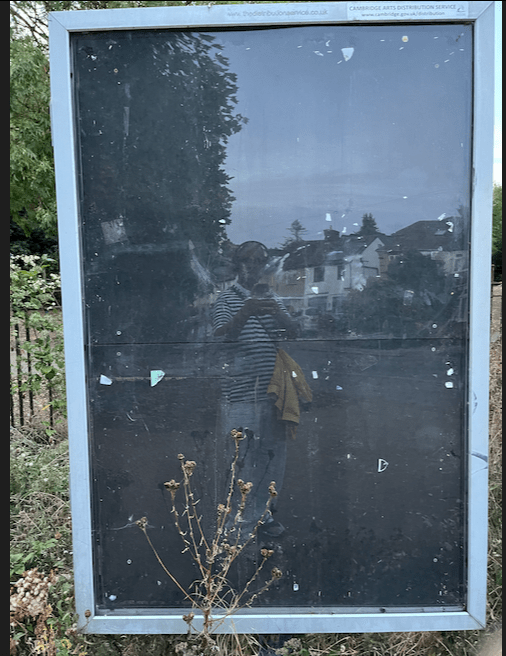
Above – empty park notice boards at Coleridge Rec, Cambridge.
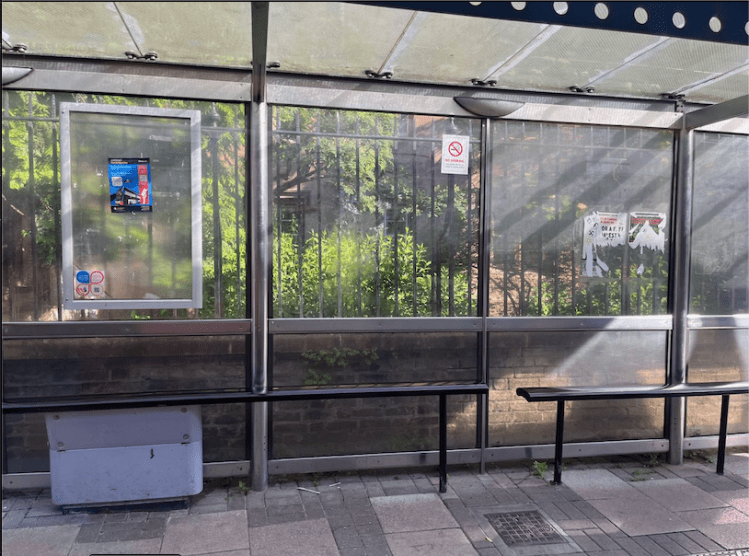
Above – Emmanuel Street bus stops that take passengers to the railway station, Addenbrooke’s, and beyond. What information/discussion boards could you put up here about the future of our city?
Only I asked similar back in April 2024 and didn’t get very far
As a city we must demand better from ministers and Parliament. Then it’s up to us.
Food for thought?
If you are interested in the longer term future of Cambridge, and on what happens at the local democracy meetings where decisions are made, feel free to:
- Follow me on BSky
- Spot me on LinkedIn
- Like my Facebook page
- Consider a small donation to help fund my continued research and reporting on local democracy in and around Cambridge.

 The Cambridge Town Owl