
…says Innovate Cambridge. So why isn’t it?
On my way to/from a health check up in Cambridge yesterday…
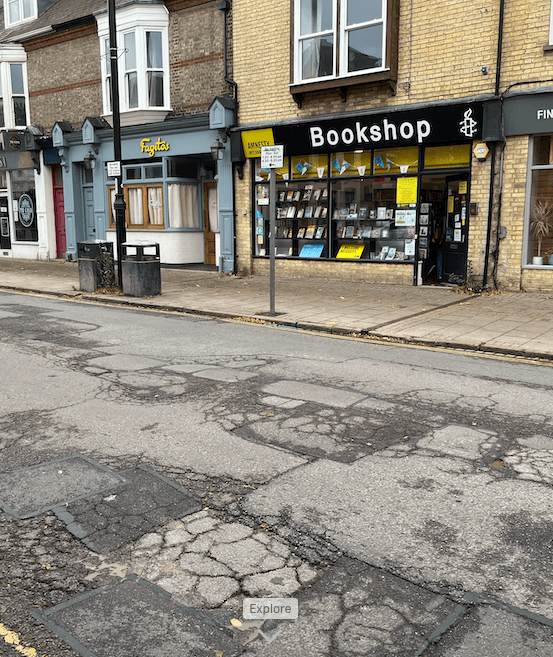
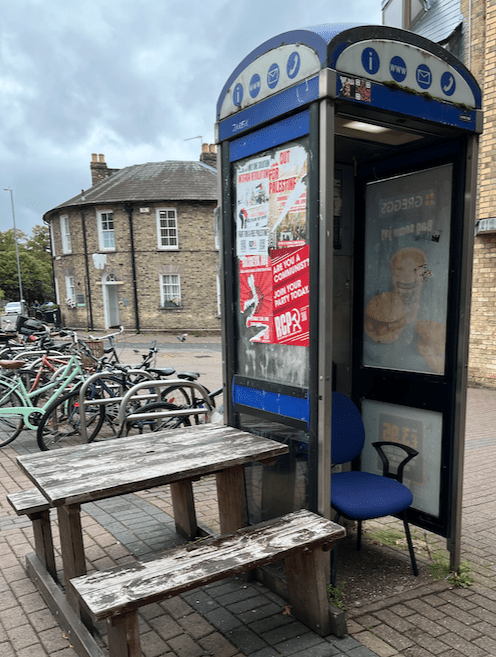

Above L-R: 1) State of Mill Road’s surface (reflecting high traffic volumes & poor maintenance plus lack of alternatives, 2) Public infrastructure from a previous millennium, now abandoned to the fly-posters from the local communist movement, 3) random early afternoon traffic jams forming (in this case due to big electricity infrastructure upgrades
When you compare them to the house prices…exactly. Public squalor vs private wealth.
“What did Innovate Cambridge have to say?”
Have a read of their LinkedIn post here which reads as follows:
“Innovation needs infrastructure. Growth must benefit all.
Cambridge’s ideas are world-leading, but real progress takes more than breakthroughs. It takes bold partnerships.
To unlock the next wave of innovation, we’re working with local and national government to invest in what really matters:
🔹 Homes for families and talent [Can this include a visitor levy covering short term lets?]
🔹 Infrastructure that scales with ambition [Does this include social infrastructure?]
🔹 Jobs that build prosperity across the region [Where does Rail Future East fit in?]
Because an innovation economy can’t thrive in isolation – it must be grounded in place, community, and purpose.
In Cambridge, we believe growth must be inclusive, sustainable, and shared by all.
That’s how we turn brilliance into lasting benefit.”
The problem is…
Broken governance structures – and I remain to be convinced that what The Government has lined up for Cambridge will meet the needs of our city and surrounding districts.
Anyone who has followed local politics in and around Cambridge has known that our governance structures have been a mess for some time
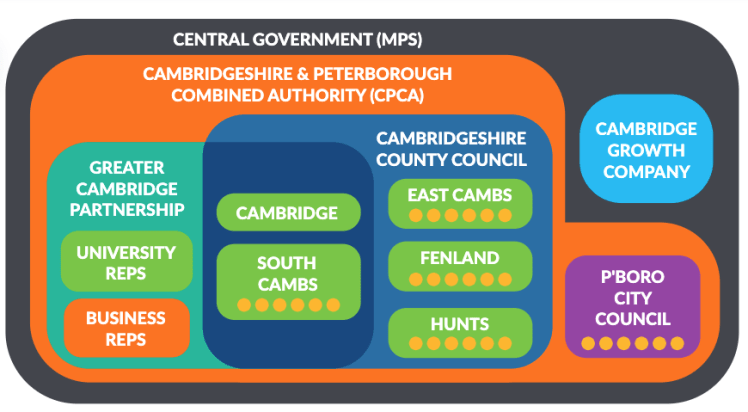
Above – from CamCycle
“Have a listen to Alex Notay, Catriona Riddell, and Jackie Sade on Planning After Dark here from 15mins in. They say what local people trying to engage with the system have been saying for years about the over-complicated governance structures. “
Above – From my blogpost about the recent Bidwells event on balancing growth with community inclusion
I was opposed from the Cambridgeshire and Peterborough Combined Authority from the start – here’s me being interviewed by BBC Cambridgeshire’s Dotty McLeod in March 2016 (nearly a decade ago!). Fast forward to today and we find that the CPCA is currently working on the fourth transport plan in a decade. Which is great money if you are a transport consultant.
Does the business sector need to go on a democracy and politics course?
Or rather, does a critical mass of our residential population (irrespective of occupation/sectors) need to become educated in citizenship/civics and active in shaping our collective future? If you look at Qasir Shah’s paper for University College London in 2020 here, the answer is clearly Yes.
The problem is that we don’t have anywhere in/around our city willing to make provisions for this. The Combined Authority won’t because ministers haven’t given them the funds (and it’s not a priority for them – irrespective of political parties in power). The city and county councils won’t do it either, despite the warm words from councillors. Which is why I’m concerned that the consultations on the new unitary councils from Cambridge City Council (with South Cambs District) here, and from Cambridgeshire County Council here, will only resonate with a minority of the residential population.
Given the huge length of time that the growth of Cambridge is due to take, it’s not like everything needs to be delivered at once. There’s enough time to provide either a series of workshops or evening classes (which could be CPD-accredited or college-accredited certificates for those needing it) to cover the essentials of central and local government, local history, and shaping the future direction of our local area.
“Why local history?”
Because our unstable city is losing its collective memory.

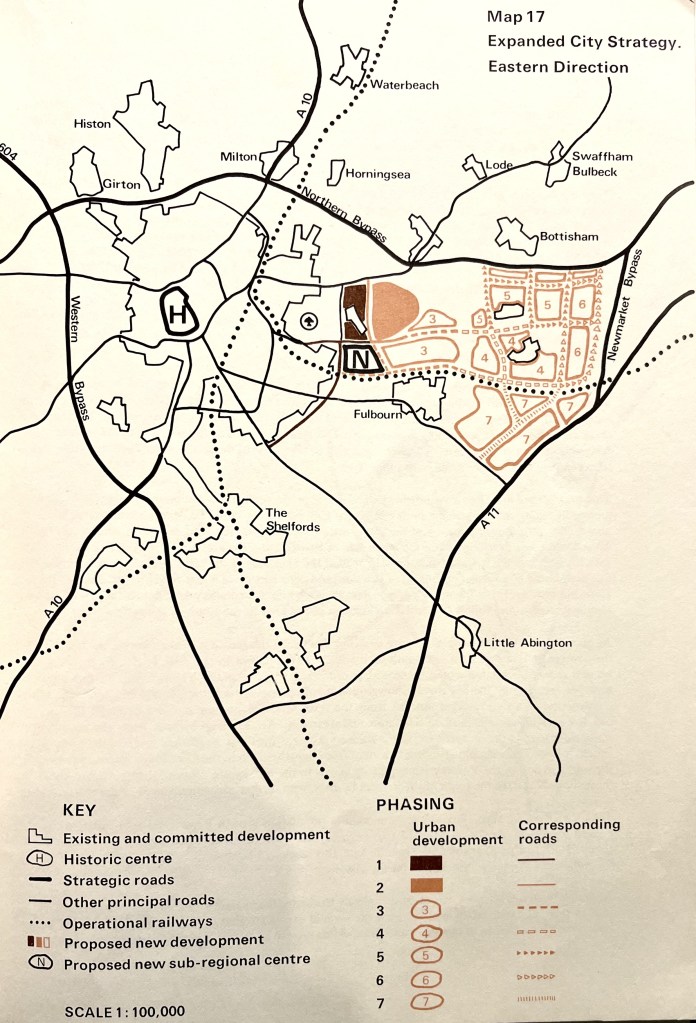
Above – who can remember who proposed the above-two options for Cambridge, when, why they got rejected?
Above-left is a proposal for a unitary council for what was and still is Cambridge’s economic sub-region. Above-right is a proposal (one of two) for the doubling of the size of the city of Cambridge, which had it been approved would have created a city of a similar size to what Peterborough is now.
The Bidwells event earlier this month showed to me how the property sector lacked that collective wider knowledge of both how political decisions are made in local and central government, and of social policy on the ground.
That’s not to say they are not making any efforts. From the Q&A session alone it is clear that some firms are employing people who specialise in community and social policy and employing them in people-facing roles. Yet from what I heard and learnt, the sector relies in local government to undertake a whole series of things that are vital to their own business functions – especially community engagement for consultations on large planning applications.
There are however two big challenges:
The first is that communities have a very limited capacity when it comes to responding to consultations – especially schools given their limited space in the curriculum. Furthermore, there’s no financial incentive for the schools compared with the developers who can make fortunes from developments. (Could someone work up a solution to ensure co-ordination of consultations – even doing multiple ones at the same time? Furthermore, could common templates be used for consultations in the same geographical area so that children become familiar with what’s being asked of them in responses?)
The second problem is that local government in Cambridge barely has a functioning community development service left after a decade-and-a-half of austerity. While austerity was a decision for central government, the party in government that imposed it received significant donations from the construction industry. Now that a different party is in government, the same risks of institutional capture apply as lobbyists inevitably head towards those with the power, not those that have just lost it.
“So, how do we move forward?”
For a start, it cannot involve doing the same things in the same places with the same people.
“How does the Cambridge Pledge look?”

A good start – but now here comes a really challenging bit that will make some of you feel a little bit uncomfortable at the thought of doing this.
Share the problem-solving tasks with the people you say you are trying to help – and do so on their terms and in their communities.
And don’t make it a ‘one off’ either.
For example, the Cambridge Science Park has given a splendid case study of how not to do this: By holding two community open days on their premises in the heart of their own estate rather than in the middle of the neighbouring council estates which happen to be two of the most economically-deprived in the whole of Cambridgeshire. (Arbury and King’s Hedges).
Organise and fund events in residential areas. Publicise them properly and in good time. Give residents positive reasons for engaging. What’s in it for them? Especially those that don’t normally participate.
We’ve found out the hard way what happens when officials and politicians try to drive ahead with plans that do not command the consent of the people.
“…the electorate of Cambridge has already demonstrated it has the influence to bring down major transport proposals developed by poorly-designed partnerships and committees.”
Above – on the abandoned road user charge
Interestingly, Oxford is going through similar problems with its proposed congestion charge, but at least they didn’t have to deal with the challenge of explaining what a GCP (or Greater Oxford Partnership) was, and who gave it what powers. Furthermore, the proposals in Oxford are also facing a legal challenge. Had ministers created a system of building the infrastructure *first* before bringing in any new charging regime, there might have been less opposition.
If you are interested in the longer term future of Cambridge, and on what happens at the local democracy meetings where decisions are made, feel free to:
- Follow me on BSky
- Spot me on LinkedIn
- Like my Facebook page
- Consider a small donation to help fund my continued research and reporting on local democracy in and around Cambridge

 The Cambridge Town Owl