The problem with the latter? They’re just not legal ones. Not yet anyway.
- If you want to listen to Mr Freeman’s full spoken evidence, see the video here from the GCP
- To see Mr Freeman’s written evidence for the Cambridge Growth Company, see here and scroll to the bottom of the page
Cambridgeshire Police confiscated a number of privately-owned E-scooters from students at Impington Village College a couple of weeks ago. I picked up on it in this week’s Cambridge Independent, and it was also featured on the Histon and Impington community website the HI-Hub.
“Police confiscated five e-scooters in Impington this week – including those belonging to IVC students – as part of a wider crackdown on their unlawful use.”
A symptom of Cambridge’s failed governance structures?
And of central government which should have prioritised enough civil service resources to develop a comprehensive policy on privately-owned e-scooters, and to have had the Transport Secretary table the legislation in Parliament to get the policy written into law.
Above – from Electroheads at 5m35s reminding everyone that privately-owned e-scooters are not legal to ride on public roads
“How are other countries doing?“
See how EU countries are doing here – noting that what often happens in the EU on the regulation of consumer goods will eventually apply here. The reason being the EU being a much larger market will be able to set the standards that products (Eg e-scooters) are manufactured to. If the EU prohibits the use of e-scooters that go beyond a given speed limit, that limit is what manufacturers will be working towards. What that won’t do is stop individuals (or even criminal gangs) ‘hacking’ the electronic systems that limit the speed of the e-vehicles concerned. Online there are a number of examples of such vehicles that have been modified to enable riders to go at frighteningly fast speeds – beyond those that the frames and components are designed to cope with. Hence it becoming a public health issue as well as a law enforcement and criminal justice issue.
One other thing that has not been considered are quadracycles – micro-e-cars
I’ll save this for another blogpost but given the pace of battery and electric engine technology, we’re now at the stage where for short journeys with limited volumes of packages, pooled vehicles at neighbourhood level have surely become viable.
Above – Electroheads featuring the Citroen Ami, which doesn’t have the same licensing requirements that normal motor cars have due to its significantly-limited maximum speed
One thing that Mr Freeman and colleagues may want to consider is what new neighbourhoods could look like with pooled micro-e-cars / quadracycles as alternatives to privately-owned petrol/diesel cars that are being phased out anyway.
Peter Freeman at the hearing
You can read his written submission here, His spoken evidence to the hearing is here
‘If C2C busway doesn’t go ahead it will be shooting Cambridge and government in the foot’. Says Peter Freeman
This was the line picked by by LRD Hannah Brown.
‘There are 22 full time staff currently working for the Cambridge Growth Company’
See their website at https://thecgc.org.uk/index.php
Mr Freeman gave the figure at the hearing. With the company now up and running, I really think it should be much more public-facing so that residents of the city and county can influence scoping the challenges and problems at design stage.
From 2h17m Mr Freeman spoke about our transport infrastructure problems
“When you hear of investors whether firms or individuals, taking 50 minutes to get from Kings Cross to Cambridge, getting there, then finding it takes another 50 minutes to get to the Cambridge Biomedical Campus or the West Campus…these are stories that are frequent”
Above – Peter Freeman CBE to the Cambourne to Cambridge Busway Public Inquiry. 18 Sept 2025
Don’t blame me – I backed the Cambridge Connect proposals from day 1. And that was around a decade ago.
Had the officers and politicians listened and worked with Dr Colin Harris and colleagues constructively from the very start, we might have already solved the problems that Mr Freeman spoke about. Which is why I repeatedly go on about Cambridge’s broken governance structures: I’ve spent the past decade-and-a-half getting tangled up in them.
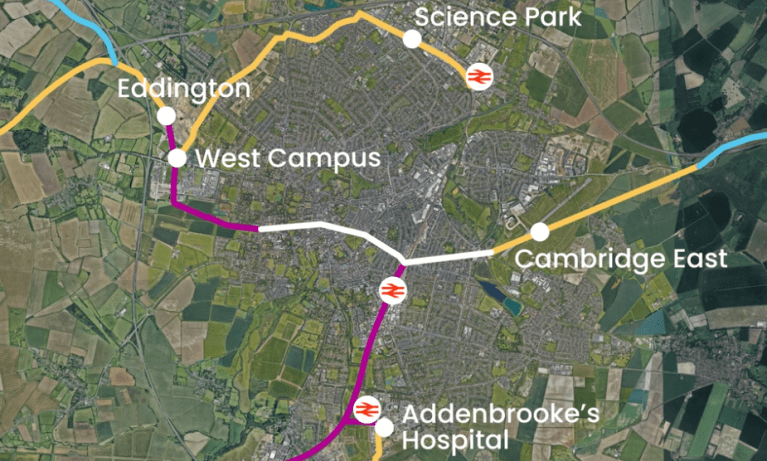
Above – a detail of the latest iteration from Cambridge Connect from their video which I wrote about in August 2024 – the different colours of the lines representing different phases of construction.
Mr Freeman was asked why the Cambourne-Cambridge busway matters given his remit
“The Cambourne-Cambridge busway won’t solve all of Cambridge’s problems. It’s one of a number of busways proposed, some of which were implemented. Partly because of the cost of housing in the centre of Cambridge. Not everyone wants to live in the centre of Cambridge. One of the biggest growth areas is the University’s West Campus which has 4million Square Feet for development.”
One of the big areas of concern for residents in West Cambridge was that it was the University of Cambridge and the land-owning colleges that were driving the busway proposals.
Mr Freeman also stated that East West Rail supports C2C. Furthermore he said that the pulling of the scheme undermines the confidence of investors.
“It would be a very poor outlook if this didn’t go ahead.”
Interestingly he also mentioned the supply-chain consultancy work that the additional investment brings.
Some of the questions from the planning inspectors felt a little loaded
Have a listen to the exchanges from 2h20m45s here.
Mr Freeman said that the Buro Happold research study which will include timelines and proposed new ‘transport interventions’ will be ready early next year. (See the press release from 14 May 2025 here).
These exchanges were called out by Sam Davies MBE – the former Queen Edith’s Independent councillor.
“Never mind whether the scheme offers good value for money (it doesn’t) or terminates in a sensible place (it doesn’t) or results in unnecessary environmental harm (it does). No, the only criteria which matters are the optics and investor confidence. Of course they are. And if the investors have been paying attention to the govt’s change of mind about the sewage works relocation, and AZ’s change of mind about their biomed campus build, they’ll already be aware that the Cambridge ‘project’ is fraying at the seams
Above – Sam Davies MBE on Birdsite, 19 Sept 2025
It will be interesting to see what balance they give to the issues raised by Ms Davies vs the ‘investor confidence’ issues. But given the willingness of ministers to override the recommendations of planning inspectors when they recommend refusal, I wouldn’t be surprised if the Transport Secretary simply looked at the big picture through a ‘growth is good’ lens and rubber-stamped the approval – similar to what the Energy Secretary did with some of the solar farm developments in the early days of the current government.
“Is the GCP talking guided busways or a road with a few road signs and legal restrictions attached to what vehicles can/cannot use it?”
That’s one thing I think they should be much more clear on. Because the concrete busway has degraded far faster than was modelled – resulting in some unexpectedly high maintenance costs since it opened. (£30m maintenance costs in 2014) Furthermore, all sorts of accusations were traded between the main contractor, the main consultants, and the county council (See here from 2012) before the case was finally settled out of court in 2023.
The questions from the old Smarter Cambridge Transport campaign still apply.
In the meantime…
Rail Future East has a new newsletter

Their next meeting is in Norwich on 27 September, followed by their annual meeting in Cambridge on Sat 06 December. See details here. The more new people we can get involved in scrutinising the decisions made (and the evidence bases behind them), the better the chances are of getting better infrastructure and strengthening our democracy. Which is looking a little fragile after last weekend’s protests.
If you are interested in the longer term future of Cambridge, and on what happens at the local democracy meetings where decisions are made, feel free to:
- Follow me on BSky
- Spot me on LinkedIn
- Like my Facebook page
- Consider a small donation to help fund my continued research and reporting on local democracy in and around Cambridge

 The Cambridge Town Owl