
AKA Addenbrooke’s 3…which rest on a series of pillars outside of the control and maintenance of the CUH NHS Trust. You can find out more on Addenbrooke’s 3 here
This follows on from the CBC Open Forum from June 2025 which I wrote about here
The Cambridge Biomedical Campus Vision 2050 hinted at a new acute hospital to replace the ageing existing hospital that was built in the 1970s. At today’s CBC Open Forum (sign up here if you want advance notice of the next one)
Dr Sian Coggle, Clinical Director for Acute Care Strategy, Cambridge University Hospitals NHS Foundation Trust gave a presentation which updated us on progress on a new acute hospital to replace the existing Addenbrooke’s, itself branded as ‘New Addenbrooke’s’ and The Hospital in a Park when it began construction in the 1960s. (I’m old enough to remember the road signs on Hills Road directing motorists to ‘New Addenbrooke’s’ in the 1980s – because the ‘Old Addenbrooke’s was still a thing in those days – at that time Andrew Duff, later an MEP for the East of England, lobbied unsuccessfully to get the Old Addenbrooke’s opposite the Fitzwilliam Museum turned into an arts centre.
Addenbrooke’s 3 proposed
Cllr Lorna Dupre first mentioned this in her blogpost in December 2020 here. My most recent look at this was in last June’s open forum blogpost.
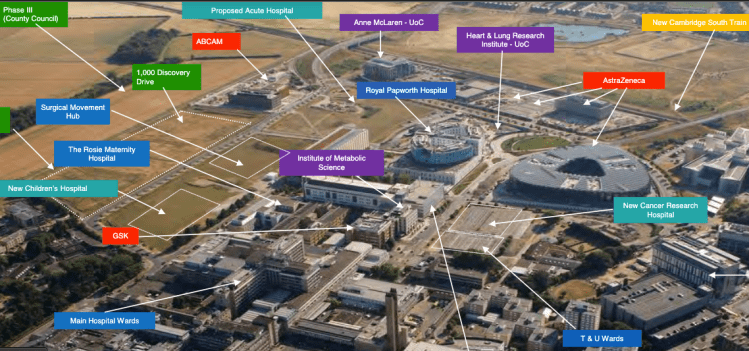
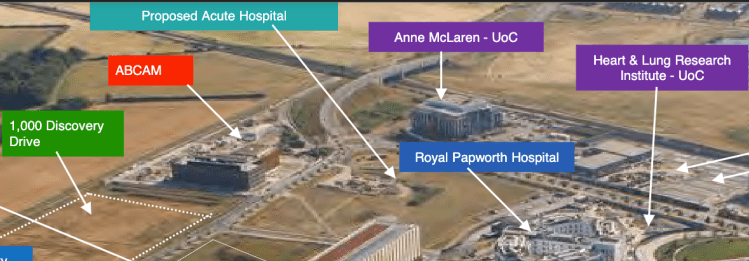
Above – via a report to Foxton Parish Council, slide 47.
Neighbourhood Health Services as one of the pillars
Just before the summer recess in July 2025, The Government announced a new series of pilots to deliver neighbourhood health services. The thinking behind this is that patients’ feedback has highlighted that patients prefer being treated at home and want to avoid being in hospital unless absolutely necessary. As I found out the hard way again not long after. Parts of Northern Cambridgeshire are included in a Peterborough-led pilot.
“How bad are things at Addenbrooke’s?”
This notice was back up last weekend.
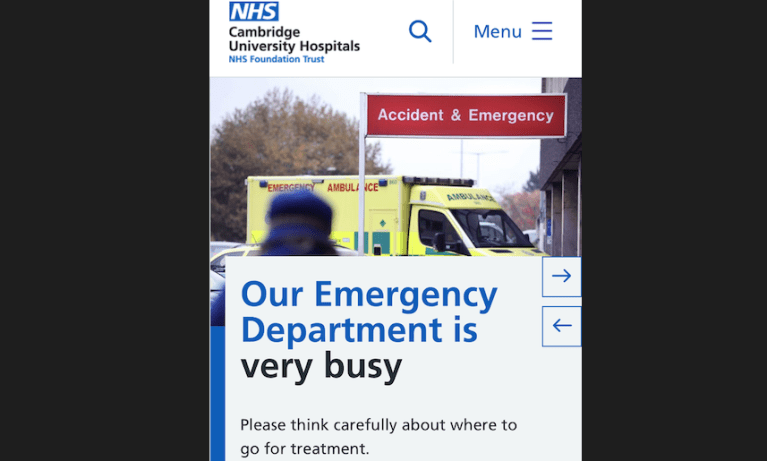
Above – hence placing responsibility at the desk of The Chancellor. (And the blame at those of her predecessors and of past health secretaries, including the former Conservative MP for South Cambs 1997-2015)

Above – from the slides that Dr Coggle used. The CBC will be uploading them soon
- High population growth over the past decade vs rest of UK
- Growing need due to an ageing population
- Ageing buildings – 70% of the acute estate (what I generally understand as to be ‘The Hospital’ bit) is in ‘Bad Condition’.
- Successive governments refusing to fund a new Accidence and Emergency Unit 2010-24
Building neighbourhood health services while council-funded community development services are running on vapours
This was a useful slide that Dr Coggle brought with her as it illustrated the structural risks to building the new hospital that are outside of her institution’s control.
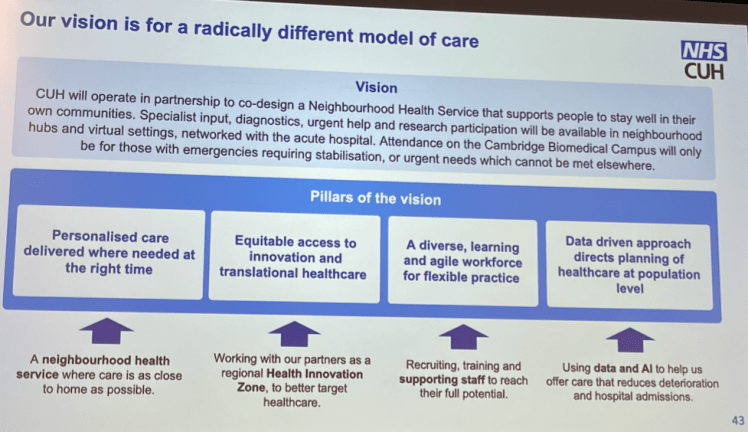
Above – from Dr Sian Coggle of CUH NHS
- Neighbourhood Health Service – dependent on local government for a whole host of related facilities and services
- Functioning as a Regional Health Innovation Zone – dependent on the private sector, charities, and voluntary organisations (mindful of Astra Zeneca’s ‘pause’)
- Recruiting, training, and supporting staff to reach their full potential – we have no lifelong learning college for adults wanting to switch careers. Less of an issue for direct healthcare training, but a huge challenge for support services (eg laboratory technicians – those blood tests don’t return in quick time 24/7 without the technicians working through the night).
- Using data and AI to help offer care that reduces deterioration and hospital admissions – that requires a data and AI-literate population. That lifelong learning centre – or lack of, strikes again.
“Where should these new neighbourhood health centres be located?”
Dr Coggle mentioned a some of the settlements surrounding Cambridge, but in reality we need to go into the detail. By that I mean getting out the maps and identifying where existing community assets are, where existing transport infrastructure is, and figure out what could be co-located and where.
During my civil service days working on the former New Deal for Communities programme, I fought tooth-and-nail to ensure one of the most economically-deprived communities in Greater Manchester could re-use capital receipts to pay for a a new neighbourhood centre that would also support the construction of a new health centre funded by the NHS. Construction of the latter was conditional on construction of the former – which is why I didn’t want this to fall through. Hence after I left I was glad to hear that both the neighbourhood centre, and the health centre both got built. Which then enables things like this. The challenge today is how to do things like this without relying on a central government programme to oversee it.
Pleading with CUH NHS to lobby politicians for the local government to have the legal powers to tax the wealth Cambridge is generating to pay for the new and improved facilities
Dr Coggle identified the financial constraints. In the Q&A session I said that there was no point in asking ministers for extra money. The impression the rest of the country has is that Cambridge’s streets are paved with metaphorical gold. But they are not – as my recent photography spree showed. Ministers will inevitably get more criticism if they are seen to give Cambridge more money at the expense of elsewhere.
Hence suggesting to Dr Coggle that instead of asking for central government funding (which can easily be taken away by a successor government), ask for the legal powers to tax the excess wealth generated here, and ask for those to be independent of The Treasury. i.e. no ‘rate capping’ or equivalent. That way, ministers can focus central funds on those areas unable to raise the revenues locally.
“Won’t taxes drive away investment?!?”
That’s the line the Tories and sympathisers will throw. But as Cambridge Growth Company Chair Peter Freeman has said repeatedly, if Cambridge doesn’t get the investment in public infrastructure, ministers cannot hope to meet their own growth targets. We’ll simply end up with more private wealth and public squalor as the city with a globally-famous name continues to crumble in the face of its market-town-sized governance structures.
Moving to a new model with more care provided for at home means fewer beds needed
That’s what the chart Dr Coggle showed below said.
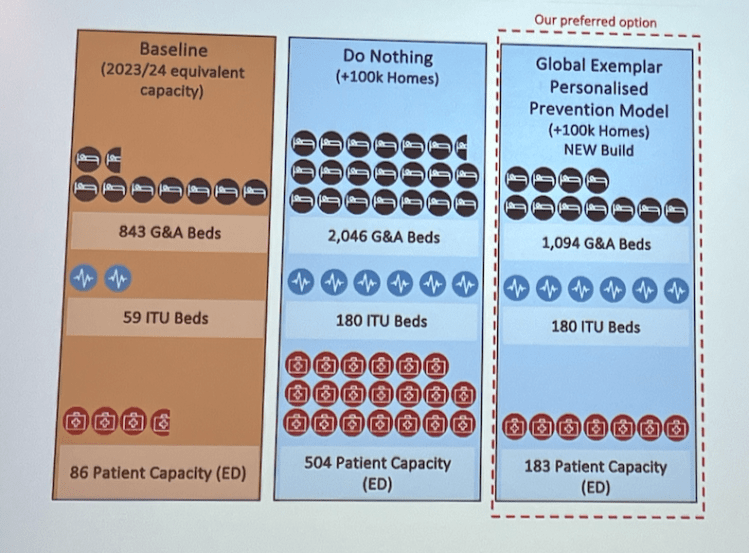
Above – 1000 General and Acute beds, or 2000? The difference is measured in the £billions
You can see how overwhelmed the Accident and Emergency Unit at Addenbrooke’s gets – a capacity of just 86 for a catchment area that extends beyond Cambridge and South Cambridgeshire – so that’s far beyond 300,000 people. The legacy of 15 years of Conservative Chancellors and Health Secretaries – the irony being that with the exception of the City of Cambridge, the parliamentary constituencies have repeatedly elected Tory MPs. And despite the publicity photographs and hospital visits, those MPs have been responsible for voting through the miserable financial settlements that have brought us to this situation.
Place-based public services
This is something that former Labour Communities Secretary John Denham tried to bring in during his short-lived term in post before the 2010 General Election. I covered some of what he has written in this post on why Greater Cambridge needs a co-ordinated master plan that connects up the dots. For example:
- Locating your neighbourhood health centres close to areas likely to generate the greatest need
- Proving excellent active travel and public transport infrastructure
- Providing for other public, civic, and private sector services within walking distance to enable people to carry out multiple activities/tasks at the same time
- Identifying existing plots of land or buildings that can be retrofitted/renovated/densified to improve the use of new facilities as well as providing additional revenue streams
The problem is that no single institution is empowered to co-ordinate the work needed for this, and no one so far has the vision or influence to bring enough of the influential people in the institutions essential to its success together. And that’s before I’ve got to the lack of a lifelong learning centre or any provision of services to educate a critical mass of our residents in democracy, politics, and how our city functions.
It’s a very long road ahead.
If you are interested in the longer term future of Cambridge, and on what happens at the local democracy meetings where decisions are made, feel free to:
- Follow me on BSky
- Spot me on LinkedIn
- Like my Facebook page
- Consider a small donation to help fund my continued research and reporting on local democracy in and around Cambridge
Below – The Trials of Democracy is back – sign up for the new set of events in early October 2025!
The events are
- The Dazzle – a new play
- If You’re Not at the Table, You’re on the Menu
- Earth Democracy in Action – A Participatory Workshop
- Democracy Beyond Elections?
And on what democracy means to different people in and around Cambridge? Have a look at the playlist here
 The Cambridge Town Owl