Cambridge won’t see a penny of the £5billion in funding – but nor should it. Instead, ministers should follow up this announcement by enabling councils that have economies that generate more financial wealth to tax that wealth independently of The Treasury in order to fund the sorts of programmes that the P-in-P funding has been allocated for
“Is this New Deal for Communities all over again?”
It very much learns from the extensive (and expensive) evaluation – so that was money well spent. I wrote about how this might apply to the current Pride in Place policy back in March 2025 here.

Above – one of the evaluation reports from the NDC Programme 2000-2010
There are a host of things that civil servants will need to be aware of, mindful that this is not the Year 2000, but 2025.
“We are fortunate to be alive at this moment in history”
US President Clinton, State of the Union address Jan 2000 – have a watch.
Instead we have a series of challenges more than a few of which were unimaginable a quarter of a century ago.
Labour Ministers must us the opportunities provided by the huge level of funding to strengthen not only communities, but also their structures and systems of local government.
This point was fortuitously reinforced by an extended lecture given by France’s minister for Europe and Foreign Affairs, Jean-Noël Barrot in a lecture (in English) at Harvard in the US. It’s worth watching his lecture in full – you’ll notice how relevant it is to the UK’s struggle to defend democracy, and also realise how far behind we are in so many areas.
“Fixing democracy starts with fixing citizenship. Raising genuine citizens. Enlightened citizens able and willing to take responsibility for themselves and for others. How do we get there? With enlightenment, power and courage. Power to the people only works if people are properly informed. How can we have a debate if we cannot agree on facts? Enlightement starts in the classroom and continues here in universities. Today’s science is questioned, mistrusted, and politicised. Yet we need more science.”
Above – Barrot (2025) at Harvard
*The need for adult citizenship education – going beyond jobs and income success measures*
But it’s not just educating citizens. The French Foreign Minister also said that structures of the state – and of the economy need overhauling too. Which is why in some senses the UK is very fortunate to have the English Devolution Bill going through Parliament at this very moment.
“Start with a full reset of who does what [in society – irrespective of economic sector]. Public sector, private sector, federal [central] government, local government, government agencies. The guiding principle should be subsidiarity [which in principle underpins the European Union – but because few in the UK learnt about the EU, and because we have a principle of Parliamentary Sovereignty, this has passed us by]. He goes on.
“Allocate power where it is exercised most effectively. The goal should be to unleash energy. To give each person the means to stir their own life, open new paths forpassions and talent…People are craving to make their own decisions. People no longer want to vote on a platform every four/five years and have no say in between. Let them participate more actively in policy-making. France has experimented with Citizens Assemblies on Climate Change and end of life care. We need continuous citizen participation. They need to be active, not spectators.”
Above – Barrot (2025) at Harvard.
***Wow!*** Incredible to hear this from a senior politician from one of the UK’s closest allies.
And that for me poses a huge challenge to the British State, because we don’t currently have the structures, systems, processes or the institutional cultures to respond to M. Barrot’s call.
- The lack of citizenship education in schools – a policy choice by Michael Gove and his successors to cut back on it post-2010
- Generations of adults who learnt nothing about politics & democracy at school, college, or university – again a policy decision by the governments of Margaret Thatcher and John Major. Kind of strange given that the Cold War dominated half of the years the Conservatives were in power in the 1980s and 1990s.
- The lack of civic and democratic infrastructure and cultures in UK civic society
That’s not to say other places have got things substantially better than the UK in terms of say turnout. You only have to look at France to see the internal problems it has (see the English Language pages of France24) to see news of workers’ strikes through to the conviction of former President Sarkozy of France for criminal conspiracy – he now faces a five year jail term. Rewind back to 2008 and as a close ally of Gordon Brown (the two had worked together as Finance Minister and Chancellor some years before), the new French President was on the receiving end of negative headlines about his private life. Those headlines were swept away when Gordon Brown pulled out all of the stops to get a state visit hastily arranged – with all of the pomp and ceremony (plus political announcements that accompany such visits – and a visit to Arsenal FC. So many people from France had moved to the UK by that time that London was and still is one of the top ten French-speaking cities in the world)
Common existential threats – internal and external
What was striking about the 2008 State visit was how a UK Prime Minister had rolled out the red carpet to a French President to help get the latter out of a lot of media trouble domestically – especially given the frosty relationships that both Tony Blair and John Major had with President Chirac, and also that of De Gaulle and MacMillan in the early 1960s as the UK sought to join the EEC, later the EU.
One thing the UK can learn from France – how to build integrated public transport systems for towns and cities
The UK-based Tramways and Urban Transit magazine more often than not features case studies from France, Germany, and the rest of continental Europe more frequently than the UK. Which is why the slow pace of transport infrastructure planning is ever so frustrating.
Yet it’s more than that. From the continent-wide threat to Europe that has resulted in the integration of European/NATO armed forces at a far greater level than many could have expected in the year 2000, through to the threats to society from organised disinformation from hostile actors of whichever source, we have to strengthen our democratic and civic institutions, and make our societies much more resilient.
One of the reasons why I think it’s a significant challenge for the UK – and in particular England, is that for the majority of people ‘politics’ is a negative thing. The mindset of ‘letting the other party have a go if the party in government has messed up’ was something I hadn’t really picked up on until I left the civil service and started paying attention to local elections.
Hence I’m continually reminded of this slide commissioned by the old DCLG during my civil service days from The Henley Centre (now closed I think) which estimated that at most 11% of the population were likely to be engaged in what we call ‘politics.

That slide formed part of an evidence pack for the soon-to-be-abandoned Communities in Control White Paper (2008).
Those percentages will inevitably vary from place to place and time periods. For somewhere like Cambridge which is undergoing huge changes, how the political and civic institutions engage with residents – especially in an era of a high cost of living and high levels of population turnover, becomes critical to the city’s future. You can get some sense of our growing pains on the Reddit/Cambridge boards here.
When you look at the contents page in the pdf of the Pride In Place strategy and compare it to the subject boards, it’s clear that Cambridge has similar challenges to the areas selected for funding. That’s not to say ministers should provide funding for Cambridge. Rather, minsters should provide powers for local government to raise the revenues needed from a range of new and more effective forms of taxation (ones that could help reduce levels of National Insurance, and lower bands of income tax, and provide for an alternative to council tax) rather than waiting for central government all of the time.
I’m at the stage where I’m making this point to every local public sector leader who has the misfortune of bumping into me at meetings. Such as Dr Sian Coddle of CUH NHS when she outlined the plans for a replacement hospital for the ageing Addenbrooke’s acute hospital building yesterday. Because it’s much easier for ministers to pull funding with the stroke of a metaphorical pen than it is for ministers to remove taxation powers granted by Parliament in primary legislation.
Food for thought?
If you are interested in the longer term future of Cambridge, and on what happens at the local democracy meetings where decisions are made, feel free to:
- Follow me on BSky
- Spot me on LinkedIn
- Like my Facebook page
- Consider a small donation to help fund my continued research and reporting on local democracy in and around Cambridge
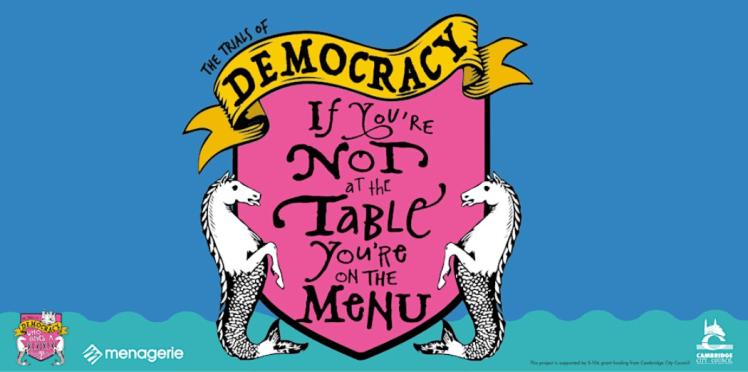
Below – The Trials of Democracy is back – sign up for the new set of events in early October 2025!
The events are
- The Dazzle – a new play
- If You’re Not at the Table, You’re on the Menu
- Earth Democracy in Action – A Participatory Workshop
- Democracy Beyond Elections?
And on what democracy means to different people in and around Cambridge? Have a look at the playlist here
 The Cambridge Town Owl