
The politicians and the pro-growth interests should be all over this and banging down doors in Whitehall. But how many of them even know that such a risk register exists, let alone know its contents? (Even though it is a public document). Plus some lessons to be learnt from Peterborough’s rapid expansion in the 1970s & 1980s where two new Pride in Place programmes are being launched.
“What’s a risk register?”
In a nutshell it is is the an institution’s assessment of the most serious risks that it faces to its existence and operations. Furthermore, it is not a ‘publish and forget’ document, but rather something that should be refreshed periodically. It should also contain measures for *how* those risks are being managed by the institution – and what impact those actions have on reducing both the likelihood and impact of those risks. For example the brief history of fire fighters as a profession provides examples of how society in different historical eras responded to the risk of fires breaking out and destroying lives, property, and businesses.
The UK National Risk Register
You can browse through it here

The Cambridge University Hospital NHS Trust Risk Register
It’s at Appendix 1 starting on p184 of the Board of Directors meeting papers of 10 Sept 2025
“How in the world is any member of the public meant to know…never mind!”
Just as importantly, the briefing to the Board on the contents of the Risk Register is at Agenda Item 15 which starts on p178.
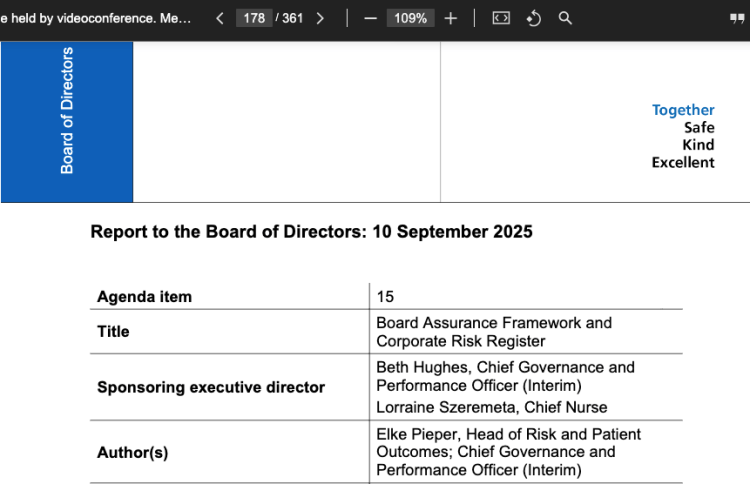
Above – the opening page of the papers covering risk management at the NHS Trust.
“Of the 14 current BAF risks, 11 are ‘Red’ rated at 15 or above as follows:
- Capacity and patient flow (20)
- Financial sustainability (20)
- Estates backlog maintenance and statutory compliance (20)
- Fire safety (16)
- Orthopaedic surgery incident (16)
- Equality, diversity and inclusion (16)
- Prioritisation of IT resources (16)
- Delivery of Cambridge Cancer Research Hospital and Cambridge
Children’s Hospital construction and transformation programmes (16) - Development and approval of wider Addenbrooke’s redevelopment plans (16)
- Environmental sustainability and carbon reduction (16)
- Integrated care (16)
Above – From paragraph 2.7, item 15, p182 of CUH NHS BoD Papers 10 Sept 2025
****Eeeeek!!!****
It looks even more alarming when you look at the table that has lots of cells highlighted in red.

Above – Appendix 1 on p184 – Corporate Risk Register Summary Aug 2025 – shortly after I was discharged from Addenbrooke’s
There are about three-and-a-half landscape pages of risks all lined up. All of which have an inherent risk rating of ‘Red’ – or ***Eeeek!!!*** prior to mitigation actions. (After which you assess the ‘residual risk’ and hope that is significantly lower.)
Further down the document at page 188 we see the Board Assurance Framework Overview, which describes a selection of key risks in more detail.
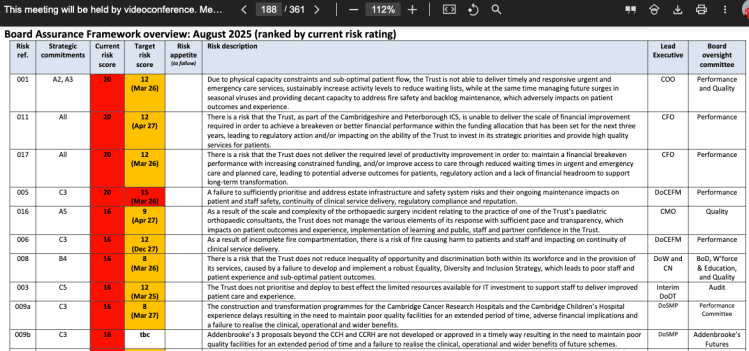
Above – Board Assurance Framework Overview From p188
Let’s take the top risk:
“Due to physical capacity constraints and sub-optimal patient flow, the Trust is not able to deliver timely and responsive urgent and emergency care services, sustainably increase activity levels to reduce waiting lists, while at the same time managing future surges in seasonal viruses and providing decant capacity to address fire safety and backlog maintenance, which adversely impacts on patient outcomes and experience”
These then have an individual ‘dashboard’ that shows the reader what is being done to manage each risk
Now, I like these dashboards. It makes it much easier for my neuro-diverse brain to engage with. There are others that prefer standard prose the sort of which you might see in a book selected for a secondary school literature exam. (No, I still have not forgiven John Major and Gillian Shepherd for the 1990s secondary school experiences that our cohort endured!)
So this dashboard below ***is really good***
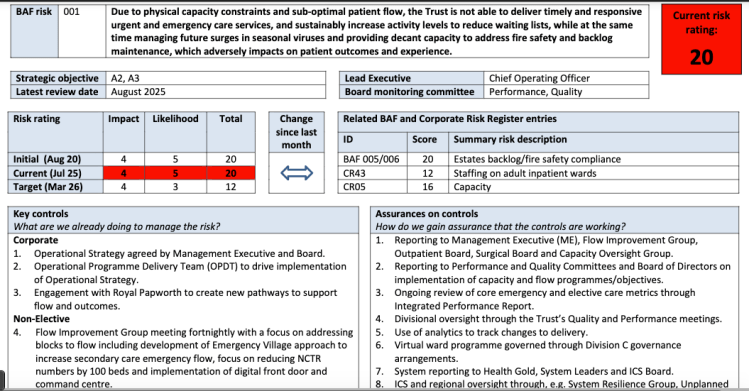
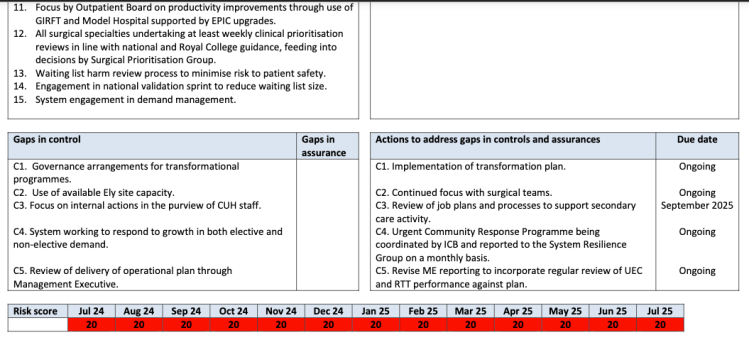
Above – this tells the reader / responsible directors the important stuff they need to know in as short a space of time as possible.
- What is the nature of the risk?
- What happens if that risk materialises?
- Has the risk gotten higher or lower since the last meeting?
- What are we currently doing to mitigate that risk?
- What are the additional things we would like to be doing to mitigate it further and why can’t we do them?
- What future things have we got lined up that might reduce the risk in the future?
The other main question that the Board of Directors should (In My Humble Opinion as a former relatively junior civil servant in a previous life working with more risk registers than I would like to remember!) be asking is:
“What actions can we take collectively on behalf of our staff presenting this report to reduce those risks?”
Which is why the final part of the officers report is disappointing. Because the only recommended action in paragraph 4, page 183, is:
“The Board of Directors is asked to receive and approve the current versions
of the Board Assurance Framework and the Corporate Risk Register.”
Which for me is a big missed opportunity.
The CUH NHS Board should sit down with their fellow senior public sector executives from partner organisations – *and* their Political executive office holders (such as the CPCA Mayor, the Leaders of each local council within the Addenbrooke’s catchment, and the Members of Parliament for each constituency within that same catchment – mindful that this also includes the Leader of the Opposition whose constituency is North West Essex, just over the county border with South Cambridgeshire District.
“Having sat down, then what?”
Then they should go through every major risk and identify which institutions – and which individuals within those institutions need to do what to get those risk ratings down.
*The failure to fund Addenbrooke’s A&E service – the buck stops at the Chancellor’s desk*
That was me back in July 2025 having just spent under a week at Addenbrooke’s following chest/arm pains (potential symptoms of a heart attack given my history) that involved spending all day in the A&E waiting room before spending the night on a reclining chair in a discharge lounge waiting for a bed to become available.
“I found the news of over 150 people still being in A&E in the early hours – far beyond the capacity of what it was designed for, to be utterly astonishing.”
“How many people is A&E in Addenbrooke’s designed for?”
86 people. I found that out a couple of days ago at the Cambridge Biomedical Campus’s open forum
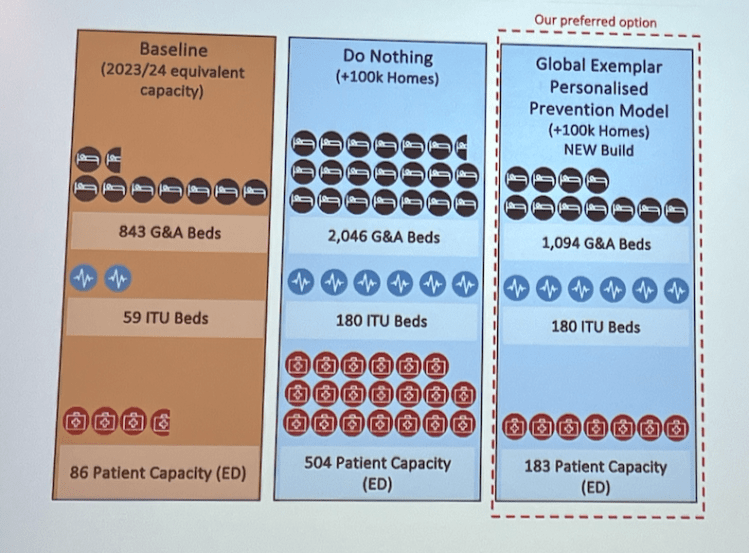
Local politicians also need to call out the sci-tech bubble and extractive industries such as the expensive property sector and tell them that the current situation is unsustainable.
Furthermore, the funds needed to deal with many of those risks are not going to come from Central Government. Why? Because much of the rest of the country has got things just as bad, if not worse. The wealth generated here means that at least a select proportion of the population can ‘buy its way out’ of the problems presented by underfunded public services. We know this because private schools and private healthcare plaster their adverts all over the buses that serve council estates. Which reflects the huge inequalities within our city and county – with the debate on the existence of both (and how they should be taxed and regulated) being firmly *a party political question*. Something we can save for that forum.
In the meantime, the pro-growth interests have a choice:
- Do nothing – it’s someone else’s problem. The private sector pro-growth people only have an interest in the short-medium term in making as much money as possible and meet their fiduciary duties to their owners/shareholders
- Have a discussion about what new taxes and levies that ministers could introduce via legislation empowering local or regional government so that locally we have independent (of Whitehall) revenue streams that can help us deal with these challenges locally.
There are many things that Cambridge could do with that sort of funding to improve our city – between £2-3million per year every year for a decade. But note that this is at neighbourhood/ward level only. So if Cambridge had been selected, it would have been for wards like Arbury, Abbey, and King’s Hedges. When you look at the research on poverty indices for Cambridgeshire and Peterborough from C&P Insight here, you can see from the data maps why two of Peterborough’s neighbourhoods were selected. Furthermore, there is a significant local history context with Peterborough’s award that Cambridge – and Huntingdonshire given its recent announcement, really need to learn from as they expand.
Peterborough as a third generation ‘New Town’ 1968-1988
Both Paston and Orton in Peterborough were build as residential neighbourhoods for ‘London Overspill’ in the plans put together by Tom Hancock. (Ash (1969) Regions of Tomorrow, p56). Half a century later and central government is having to intervene *again* because of the challenges of poverty and multiple deprivation.
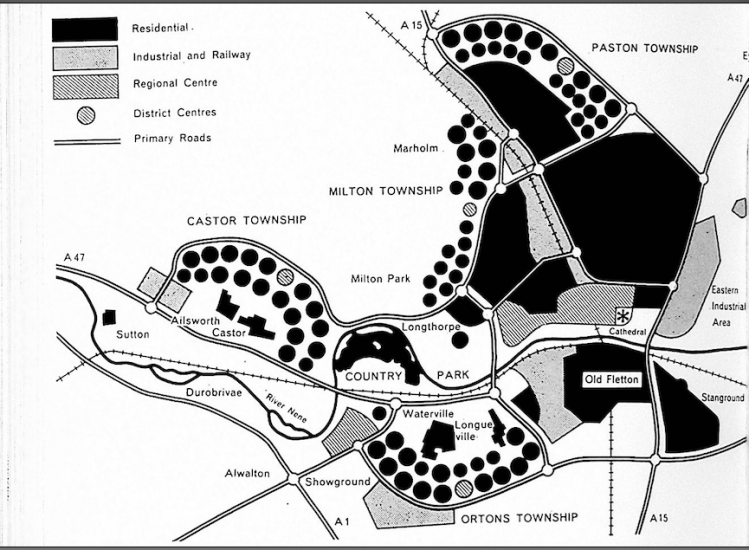
Above – the proposals for Peterborough’s massive expansion in 1969, Ash (1969) p57
Twenty years later and the old Peterborough Development Corporation published a history of the expansion – which you can browse through here.
The problems faced by the Orton neighbourhoods and the Paston neighbourhoods may not necessarily be due to the design selected by the planners.
Note this was also a time when Sir Edward Heath’s Government scrapped the carefully-prepared plans for a Greater Peterborough unitary authority. (You can read about the county reaction here). Think of what a vastly more empowered Peterborough Unitary that incorporated the southern Lincolnshire districts on its doorstep could have resulted in.

Above – Detail of the proposed Greater Cambridgeshire, and Greater Peterborough unitary councils from the proposals from Redcliffe Maud (1969) HMSO – see LostCambridge here
Then there are the policies that followed in the 1980s that inevitably affected the cathedral city even more, such as the decline of a number of industries including the railways which took out Peterborough East Station.
Which is why doing that historical policy evaluation is ever so important for a growing Cambridge
If you are interested in the longer term future of Cambridge, and on what happens at the local democracy meetings where decisions are made, feel free to:
- Follow me on BSky
- Spot me on LinkedIn
- Like my Facebook page
- Consider a small donation to help fund my continued research and reporting on local democracy in and around Cambridge

 The Cambridge Town Owl