
It’s not surprising that more voters are turning away from the top two parties – especially where they are not seen to be resolving the problems caused by their predecessors in government
Have a listen to Grace Blakeley here – it’s something that could apply to later generations too. The mindset is something that resonates with me because I lived it through my teenage years. It was only after I got to university in 1999 that I began to question it (and everything else) – the sort of experience that led to an existential crisis which in reality I’ve never been able to deal with.

Above: “You were sold a certain vision of the future” Grace Blakeley,
Basically if you:
- worked hard
- did well in your exams
- didn’t get into trouble
…then all of these nice things would come to you as an adult.
- ‘Good’ job
- House and car
- ‘2.4 children’ – a statistic that became a sitcom in the early 1990s about an average middle class family. (Here they are discussing this phenomenon called The Internet)
- Good pension
- Affluent life, possible early retirement.
And I bought that vision. Hook, line, and sinker.
Because amongst other things I didn’t know anything else. Facts were whatever was in the textbook, and ‘the truth’ was whatever a responsible adult told you was the truth. It’s easy to forget just how significant the social changes taking place in the 1990s-early 2000s were – although I didn’t realise it at the time. We weren’t taught anything about politics and were not encouraged to get involved in ‘democracy’ – even though voting in my first city council election felt like something of a milestone, tarred with a sense of disappointment that there wasn’t any opportunities to meet the candidates.
Furthermore, I didn’t rebel. I was too frightened to. It has only been in more recent years that I’ve began to understand what impact this had on me and where it originates from. The concept of ‘a community standing up for each other’ was never something I experienced, despite the rhetoric of left-wing academic types talking about the violence of police against working class communities while omitting to mention that for middle class communities it is the police that are meant to protect them from violence. The stereotype being that nice boys don’t get into fights. They go to church and do their violin practice. I think I learnt to loathe all three by the time I left home for university!
The social class divide that I was too narrow-minded to notice
At the same time there was a very clear class divide – not that I saw it as such because I assumed classes were for schools, not people. My history teacher at the time said that my year group was one of the most divided and fragmented she had ever experienced – so that by the time we got to year 11 the different groups just wanted to be rid of each other. It was made worse being in crumbling building that in our final year was finally being taken down. A health and safety hazard that even John Major’s doomed administration could not ignore.
But because I was nominally ‘successful’ in terms of exam results, I didn’t question the system because I didn’t seem to be failing in it on paper. Instead I developed an intense loathing towards those that disrupted our lessons because each disruption prevented the rest of us from learning and preparing for these exams that we were told would make or break our future lives. Hence I couldn’t wait to be rid of the place – and writing this spoof newspaper article based on a feature in the RPG Civilization 1.

Above – a manuscript diary entry from nearly 30 years ago: the mindset of kicking people out of my life who I never wanted to see again, loosely based on a satirical cartoon from WWII depicting General Rommel being kicked out of Africa and back into Italy, with a fearful Il Duce quaking in his boots.
The other thing to note in those days was this was still an era of a Conservative Government – one that had been in power for over 15 years. Therefore they were the dominant mainstream cultural force. One of the reasons why the ‘Indie’ scene in the 1990s got its name was because many of the groups that were prominent in it were signed up to ‘independent’ record labels. A sharp contrast to the mass-production lines of Stock Aitken and Waterman’s Hit Factory and big brands such as Sony and EMI.
Above – The Beatmasters Feat. Betty Boo (Alison Clarkson) smashing up a record label’s office in the video for Hey DJ, I can’t dance (to that). They were signed up to indie label Rhythm King
The vision we were sold was very pleasant-sounding. i.e. if you did as you were told, you would have a nice life. Not loaded financially, but you would be able to enjoy rather than endure it.
Of the many problems with that vision, the transactional nature of the relationships remains striking.
Furthermore, ‘failure’ wasn’t an option. And if you failed, it was something to be ashamed of. Socially. And looking back on it, it was something that people judged each other on – even parents judging themselves by the life and career choices made by their offspring.
On being educated to be ignorant
One of the reasons I go on about Cambridge not having a large lifelong learning centre (or even reasonably accessible and diverse community learning centres) is that there are a whole host of things that should have been available to us that were not. The austerity imposed by the governments of Thatcher and Major had some soul-destroying side-effects on what children could and could not learn.
- The lack of investment and maintenance in buildings and equipment meant that children and teenagers were, for practical subjects using tools and machinery that were obsolete and/or dangerous – to the extent that one secondary school in the 1990s had to tell theirs students to stop working during a CDT (Craft, Design, and Technology) class because an OfSted Inspector found items of machinery had not been tested and passed as safe.
- The very low levels of pay plus the constant demonisation of teaching as a profession by politicians and their media backers meant that fewer people were willing to go into teaching in the first place. It was one of the reasons why in the early 2000s the Teach First programme was launched. This came to a head in 1994 when the Conservatives appointed the controversial Chris Woodhead as the Chief Inspector of Schools, shortly afterwards declaring that there were 15,000 incompetent teachers in the country that should be sacked. My response at the time was along the lines of: “There are far more than that!” because there were no outlets for us to talk about the pressures that teachers faced. It was an entirely depoliticised environment.
- The prohibition of the teaching of entire subjects and themes – Section 28 being the most prominent, but also with the risks of drugs. The mindset of ‘Just Say No’ as reflected in the Grange Hill song that hit the charts in the 1980s was really strong – even though no one told us or showed us what we were meant to say ‘No’ to!
We were trained on how to pass exams. We were not educated to become citizens in a society
The ‘transactional relationships seemed to extend in that cultural mindset on what was and what was not a ‘respectable’ job or profession. Going into a trade was not seen as respectable. Being a manager on the other hand was. The latter is still something that prevails today of moving someone who is talented at something practical into a position of teaching or management. But teaching and management can require very different skills sets which not everyone will have or take to. At the same time, why should the managers be paid more automatically? Especially where the amount of time required to train people in a range of professions that have become increasingly complex over time, is far greater and in which there are chronic skills shortages? (To what extent is that culture a barrier to the more efficient functioning of a labour market?)
It still strikes me how in my university days there were no practical workshops. Or if there were, as arts/humanities students we were not encouraged to make use of them.
Living in an increasingly fearful society
One of the things I tried at university was martial arts, but for a range of reasons never really took to it. The reason why I gave it a go for a term was because I knew I did not know how to defend myself if subjected to a violent attack. One of the reasons why I keep making the case for Active Bystander Training eg here, and on a very wide scale, is that all too often we hear testimony of how someone got attacked on a bus/train/in the street, and no one came to help them.
Economic structures destabilising societies
During my years of studying economics in the late 1990s/early 2000s, the concept of flexible labour markets and the policies needed to make them even more flexible were significant discussion points on the curriculum for both A-level and undergraduate. Yet such was the limitation of the subject school’s mindset at the time that no one wanted to address the social impacts of Norman Tebbit’s often misquoted ‘get on your bike’ remark about high unemployment in the 1980s. Should people have to move for work, or should work move to the people? That’s one for the party politicians.
Having reached a stage where fewer and fewer people (young adults in particular) can afford to own their own home (see Cambridgeshire’s most recent State of the Region report for 2025), places like Cambridge find themselves in a situation where houses in and built for long term residences are being bought up by property investors and sub-divided and let as houses of multiple occupation at high rents. In particular for student accommodation – which is now a public policy issue with so many other university towns and cities facing similar problems. Combined with the enfeebled local government sector that cannot afford to regulate it properly, alongside a disempowered student population that does not have a strong incentive to stand up for their own rights, entire neighbourhoods risk experiencing decline because too many such properties inevitably are not maintained as well as they should be. And we already know that the poor quality of too many newbuild properties in and around Cambridge remains an issue as Cambridge MP Daniel Zeichner told Parliament back in 2021. (I might ask him for an update – have things improved?)
And the results of high mortgages, high house prices, and high turnover of populations?
Sadly it comes as no surprise to me to see opinion polls biggin’ up Team Nigel – fanned by the soft coverage from BBC News and Current Affairs. The BBC’s Chris Mason has been coming in for repeated criticism over this, and the institution itself is now being called out by other political parties. Good.
As I told a couple of business-related audiences at recent events, they cannot continue like it is business as usual and pretend that there are serious political risks that may affect their businesses if we don’t deal with the chronic inequalities in our society.
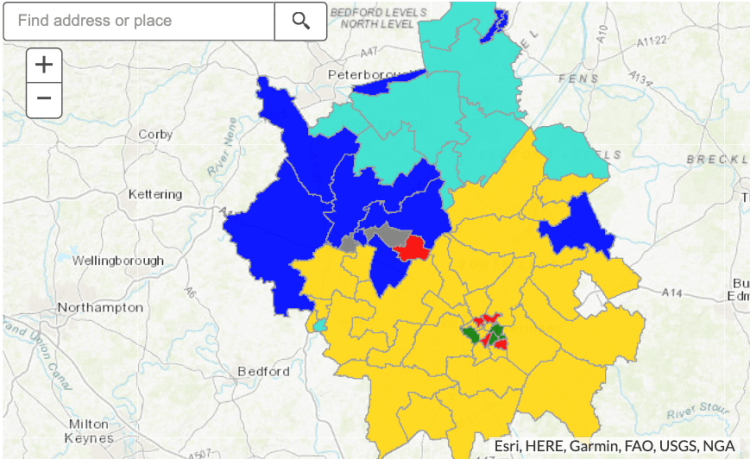
Above – the county council election results from May 2025
Ten county council seats went to TeamNigel back in May 2025 – now the same number as the once mighty and all-conquering county Conservatives. And within Cambridge itself, 25% of the seats went to The Greens. Whichever of the two parties you pick, both have policies that could have a significant impact on a range of businesses. A growing Green Party (coming up to 1,000 members in Cambridge and South Cambridgeshire constituencies alone – a record) would bring into question the rampant growth we have had and are still due to have. TeamNigel on the other hand would force firms dependent on access to international high-skilled labour markets to look much closer to home, or up-sticks and leave.
One of the things Keir Starmer’s Labour Government has to deal with is unpicking the structural problems which, by their very nature cannot be done overnight
In community development policy circles much has been made of the Pride in Place funding annoucened recently. But that only covers a fraction of number of places in need, and the funding itself does not come on-stream for another 18 months. (Nor should it – the planning needed for such significant sums of money over an extended period of time – a decade, cannot be rushed without the big risk of money being wasted or worse.
The topics I’ll be looking out for over the next two months – from Labour’s Party Conference through to the Budget at the end of November, is whether The Chancellor is going to increase the range of taxes that local councils can impose independently of The Treasury. Because the nationwide renaissance of local communities is not something that can be managed from Whitehall. (I’ve worked with people and teams that have tried!)
If you are interested in the longer term future of Cambridge, and on what happens at the local democracy meetings where decisions are made, feel free to:
- Consider a small donation to help fund my continued research and reporting on local democracy in and around Cambridge
- Follow me on BSky
- Spot me on LinkedIn
- Like my Facebook page

 The Cambridge Town Owl