Local political coverage catches up on what happened at the party conferences
You can catch up with:
- Buses, coffee, politics in Cambridgeshire with Cllr Dr Alex Bulat and friends
- ITV Anglia’s late edition – their October show coming up this week
- Trevor Dann on Cambridge 105 interviewing local MPs Daniel Zeichner and Pippa Heylings
- BBC Politics East talking about rail nationalisation
Fast food outlets to flood Parker’s Piece at student Freshers’ Fair
You can see the details here – it looks like they are being very tight on who can get in compared with previous years. Which will probably mean that the areas around the exit will be a honey pot for any groups, campaigns, and commercial outlets that want to target the student demographic. On the other hand, it’s much-needed additional income for Cambridge City Council in leasing out part of Parker’s Piece, even though there is understandable concern from local residents about the impact on the green plus the denial of public access to a public space when bookings like this happen.
“Can we have a Freshers’ Fair for town societies?”
It’s something that I’ve wanted to see happen in Cambridge for over a decade but have lacked the drive and competency to get it set up. For some time I’ve thought that this should be something that the city council should commission the students unions of ARU and Cambridge University to organise and deliver given their institutional knowledge. Furthermore, it’s paid work experience for them rather than outsourcing it to a private sector firm. (One other positive spin off is that done annually, it increases the awareness of town societies within the student body, breaking down those town-gown barriers).
One of the other reasons is more than a few of our societies need newer, younger members because time stops for no one. I was reminded of this at the Cambs Association for Local History AGM last Saturday just as I have been with our community singing groups.
“Anything of interest in the final two party conferences?”
Zack Polanski’s keynote speech for The Greens here, was well-received in progressive party political circles. It’s worth watching the speech in full to get a sense of why he has been able to generate a significant level of media coverage that the party was otherwise struggling for. (This was something that Trevor Dann asked Pippa Heylings MP about, yet this was something the Liberal Democrats leader Sir Ed Davey called out the BBC on in terms of skewed coverage of Team Nigel).
It’s also worth noting the deputy leaders’ speeches from the following day, by Rachel Millward and Mothin Ali both in terms of content and also diversifying the party’s image to the public in the media. Keep an eye on what the coverage is like on the two of them over the next few years – similarities and differences.
The Green Party has passed a party policy motion that clamps down on property landlords in favour of local councils and tenants. The tabloids are having a field day with it – but then at the same time it’s free publicity for The Greens in an audience that otherwise never gets to find out about their existence. With the total number of landlords estimated around 3million (according to one print press publication) and the massive rise in the number of people renting from the private sector (The rise from 2008-09 and 2023-24, was 3.1 million to 4.7 million households) means that there are a lot of potential votes in a cohort that is less likely to vote than others – and one that in principle would benefit from key policies within the motions including bringing in a ‘right to buy’ in the private sector, and giving councils first refusal on the sale of former council stock by private landlords. Delivering on it is easier said than done though. Especially given the lobbying power of landlords. But at least the conversation has been opened up.
Under our First Past The Post system, part of the political game is to influence the top two parties to deliver policies that are not otherwise top of their priority list. A referendum on the EU was a classic example. Strange to think that less than ten years ago David Cameron was Prime Minister. Yet the big reason for him committing to an in/out referendum on the UK’s membership of the EU was to shut down TeamNigel, close off the conversation on EU membership for the long term, and make way for George Osborne to succeed him. Remember that ‘Chaos with Ed Miliband’ social media post in the run up to the 2015 general election?
“As for the Tories in Manchester?”
Political tumbleweed given the photographs coming from reporters on the ground. How that compares with the previous millennium.

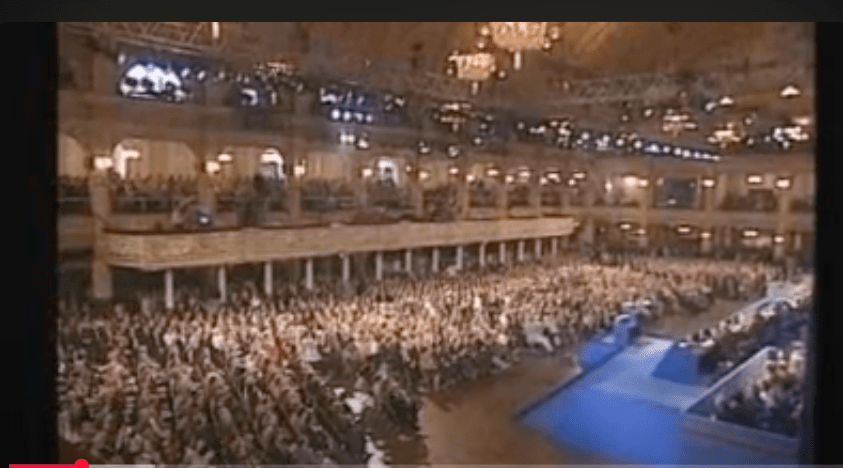
Above-left, screengrab from BBC News at the end of the party leader’s speech – Ms Badenoch did not stick around for a traditional extended applause. Above-right – from Michael Heseltine’s speech in 1995
“There was the same sense of existential futility inside the conference hall. The place was like a ghost town. The bars and stands empty. As if no one had cared enough to come, apart from those who were contractually obliged to be there. A place where the Tory party had come to witness its own extinction. The conference highlights were ghosts of the past. Some Margaret Thatcher mementoes and a Winston Churchill AI.“
Above – John Crace, The Guardian, 05 Oct 2025.
Hence Rob Hutton’s thread.
‘Free speech doesn’t mean a guaranteed audience’
That’s not to say other parties have not suffered similar fates – as some of you may recall the Liberal Democrats party conferences of the 2010s and the posts on Birdsite at the time (search #LDConf “Empty”). Who knows how things will look in another 10-15 years?
Food for thought?
If you are interested in the longer term future of Cambridge, and on what happens at the local democracy meetings where decisions are made, feel free to:
- Follow me on BSky
- Spot me on LinkedIn
- Like my Facebook page
- Consider a small donation to help fund my continued research and reporting on local democracy in and around Cambridge

 The Cambridge Town Owl