Should the Green Party of England and Wales go onto even greater things politically, the party conference speeches by their leadership team will be milestones in their story
Have a listen to the end of Rachel Millward’s speech from 20mins50secs here
And whatever you do next…
***Don’t let anyone use this as an exam text because it will ruin it!!!***
(That’s my 1990s chip on my shoulder showing through again!)
*That is our story – if we choose it now*
Next option for the digital creatives in The Greens? Find a suitable background soundtrack for this portion of Rachel Millward’s speech.
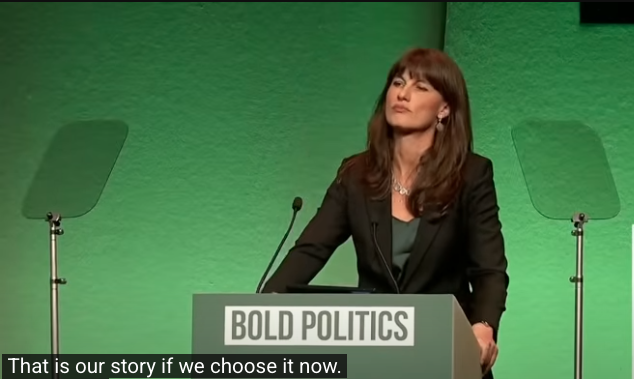
Above – a call to action from the Green Party’s co-deputy leader Cllr Rachel Millward (Greens – Hartfield, Wealden District in Sussex)
“So…what made her speech powerful?”
- It was a story
- it was poetic
- We still don’t know what the ending will be, but… we have the opportunity to influence that ending by our personal and collective actions if we make that choice
Then there was the framing – a party conference in a large hall full of people *wanting you to do well*.
It’s never always like that as Cllr Millward can tell you from experience as one of the senior councillors in the joint administration on Wealden District Council in Sussex – the grouping of Non-Conservative parties after the 2023 local elections ousting the ruling Conservative group of the first time since the Millennium. Council chambers can be bear pits at the best of times, having been to more council meetings than I care to remember!
Finally, Cllr Millward’s own professional experience in the media and arts, as well as her own disposition gave the audience the sense that she was in control
Standing up in front of a large audience to give a keynote speech is a **really difficult thing to do** – and it takes a lot of practice to become the sort of speaker who can regularly carry an audience with them. You only have to look at some of the regular faces on Question Time representing the party in government and the official opposition (irrespective of which party is in which role) to realise that there are lots of politicians that struggle with this. Political party bosses have their reasons for putting them forward for such things (can be trusted to ‘read out a line to take’ in front of a hostile audience on TV?’)
On disposition, Cllr Millward has (in my opinion) a naturally authoritative voice, and visually had a strong presence on stage. Keeping that tone and pace of delivery in a high pressure situation is a challenge in itself – there’s always a temptation to rush it which inevitably risks raising the pitch of your voice, rushing the words and ending up with the Micromachines man effect (1980s kids will get the pop-culture reference), resulting in people not being able to hear what you’re saying.
Reading between the lines – the examinations point!
The ‘finest hour’ point refers to the famous Churchill speech that lots in politics past and present like to recite, but which few recall just how perilous things actually were when he made that speech to The Commons on 18 June 1940. It’s only when you read the full transcript of Churchill’s speech (see Hansard here) that you get a sense of the catastrophic decisions that were made by the governments of his predecessors in the 1930s.
“Are you comparing a district councillor in Sussex to a great wartime leader who was the First Lord of the Admiralty for the Liberal Party in 1914, and in the same post for the Conservatives in 1939?”
No.
I’m comparing what I heard in a speech online recently with the transcript of a speech in the House of Commons made around 85 years ago.
Which is why it might seem something of a random take so bear with me!
It was only browsing through a wiki-page on Churchill’s finest hour speech here that I stumbled across concepts that I might have covered at school in the 1990s had we had more competent and inspiring English literature teachers amongst many other things in that austere era. For example, I was today years old when I found out about the concept of non-rhyming poetry, why it is such a thing, and what was behind it. For most of my life I’ve been of the view that if it doesn’t rhyme, it’s not poetry, because non-rhyming poetry at school was taught ever so badly (from texts that were completely irrelevant to the lives we were living) that it must have been invented as a form of punishment for us!
The ending – the peroration
Again, I was today years old when I found out what a peroration in a speech was – and is. (Again, clicking through a hyperlink which brought me to an extended piece on Western Classical Rhetoric.
“Wasn’t he a character in Asterix?”
Yes – the naughty interpreter who got thrown in a dungeon after being found out.
But in this case, we’re looking at this piece of rhetoric being used, in Churchill’s case “to remind the audience of the main points of the speech (recapitulatio) and to influence their emotions (affectus)”, and in Cllr Millward’s case to inspire the listeners how in a future victorious scenario how we would have one against each challenge currently facing us. Because while Churchill was talking about a coming storm, in the context of the climate emergency we are already here.
Cllr Millward reflected back to the familiar wartime poster of the child asking their father or grandfather what they did during the war, setting out her story and asking her audience to imagine themselves as the grandparents with their grandchildren sitting on their knees, telling them the story of ‘how we won.’ And keeping with the wartime analogy, she started with a phrase echoing the poem by Pastor Martin Niemöller, First they came.
But rather than the theme of an individual staying silent, she started on a positive theme of collective actions in response to threats and injustices.
- “They filled our rivers, poisoned our lands … …so we…
- “They extracted £billions while public services crumbled…so we…
- “They tried to take over our media, but our artists, story tellers…
- “They tried to divide…
- “They gathered the richest men on earth to fund their lies… so we…“
One of the most powerful points in this part of her speech? There was no one superhero coming to save everyone. [We had Captain Planet in the 1980s/1990s] Instead she mentioned a host of different groups of ordinarily people both by who they are and what they do, and described how they overcame each injustice.
“Who are ‘They’?”
By using the word ‘They’, Cllr Millward did not need to name any adversaries – party political adversaries or the ones far, far greater than that. This was a very clever move because not only does her message appeal to those in other parties, but it also challenges political opponents to stand by those adversaries – big media figures, the executives of polluting privatised utilities and those financing them, and so on. Think of them as Captain Planet’s big adversary, Captain Pollution – and note his five components too! By omitting words and phrases that immediately switch people off (she could have mentioned Class, and Capitalism for example, but that would have made it easier for opponents to frame her as they wished).
It gets dark so I can see the stars
I was reminded of Sigrid’s song with the above-name when Cllr Millward made the darkness and light analogy.

With each one of those stars representing hope, Cllr Millward then spoke to the room, saying every person who walked through the doors of the hall carried that flame of hope
The atmosphere must have been electrifying at the end of that speech. Groundbreaking even for what must have been one of the largest gatherings ever held by the party in its history. Note you could say similar with some of the events that TeamNigel has held as well. It’s not just the progressives that get boosts from such large gatherings. Which is what makes the next few years in UK politics all the more challenging.
Food for thought?
If you are interested in the longer term future of Cambridge, and on what happens at the local democracy meetings where decisions are made, feel free to:
- Follow me on BSky
- Spot me on LinkedIn
- Like my Facebook page
- Consider a small donation to help fund my continued research and reporting on local democracy in and around Cambridge

 The Cambridge Town Owl