
Cambridge City Council debated the contents of a report on improved forms of local engagement. But what real impact can they have in the face of gamed algorithms hotwiring social media users towards inflammatory content?
I blogged about this in the second half of this earlier blogpost, and earlier this evening city councillors had a debate which you can listen to/watch here.
The background to the debate is at item 5 here
Former Cambridge City Councillor Clare King posted a link to the below article
Above: Is social media destroying democracy – or giving it to us good and hard?
It was written by Dan Williams, an associate fellow at the Leverhulme Centre for the Future of Intelligence at the University of Cambridge.
“The problem is that platforms facilitate the spread of “misinformation”, “malinformation”, and “disinformation”. The problem is not that the voiceless have been given a voice. The problem is that content-moderation policies don’t do enough to protect the public from algorithmic manipulation.”
Above – Williams (2025)
He also picks up on a tension within left-liberal public policy circles where the structures and institutions of public policy-making are meant to help those with the least while at the same time remaining inaccessible to them. This is something that their opponents on the conservative right regularly pick up on as an explanation as to why voters have been streaming towards TeamNigel. Yet at the same time, one of the previous longstanding principles in the conservative right is that in return for low taxes and a minimal welfare state, those that become very rich are expected to give generously to charity. For which the deserving poor are meant to be grateful. Victorian Cambridge provides more than a few examples of this. This was called out in the Edwardian era by a young Eglantyne Jebb as she switched from the conservative leanings of her family (her uncle Sir Richard Jebb MP was the Conservative MP for Cambridge University during the first part of her Cambridge years) towards the liberals – as this newspaper feature in the liberal-supporting Cambridge Independent in 1910 reflects.
When you start to unpick the ‘content moderation policies’ issue, the root of the problems ultimately come back to that age-old challenge of who regulates multinational corporations, and how any regulatory authority is democratically accountable ‘to the people’.
Hence why the UK leaving the EU was a catastrophe for transparency campaigners, because a much-strengthened EU Parliament could have become that democratically-accountable forum with which to hold accountable any regulator that regulates multinational corporations. This also highlights the existence of the little-known but longstanding Inter-Parliamentary Union. If the United Nations is the international forum for governments to meet and debate, then the IPU is the form for members of national parliaments to do the same thing.
“What’s that got to do with civic engagement in Cambridge?”
Without a sound system of regulation – especially with disinformation, you end up with inflammatory content hotwired onto people’s screens in the form of clickbait – with financial incentives from the advertising revenue doubling down on the number of clicks each page gets. Let’s take two examples from the radical right, each with their own very wealthy proprietor.

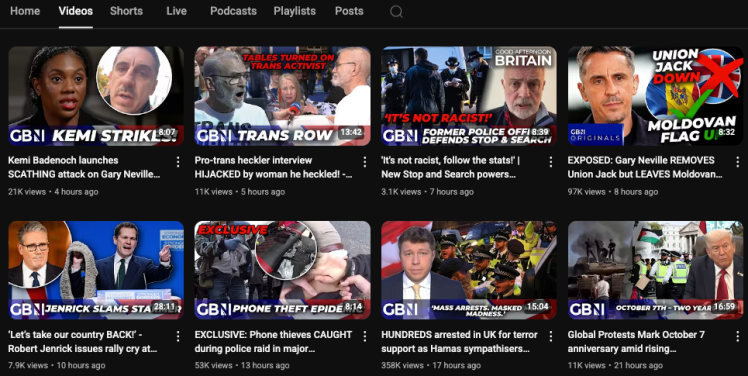
Above – top, the Rupert-owned brand, and Above-below, GBN owned by a hedge fund chief
As far as I’m aware there is no left-liberal equivalent that has substantial big-money backing or the profile and soft support that matches it (eg booking for presenters on BBC Current Affairs shows).
We’ve seen examples of how disinformation and misinformation can put huge pressures on public services – recall the case in Leicester a few years ago.
“Mayor Sir Peter Soulsby also blamed online disinformation, external and said otherwise there was “no obvious local cause for this at all”. At least one of those sentenced over the disorder has admitted being influenced by social media.”
Above – BBC Trending Blog 25 Sept 2022
This means that local public service providers and local councils are struggling against a range of challenges when it comes to community engagement
- The failure of regulators and the governments that provide funding and strategic guidance for them
- The broken and fragmented local public service structures combined with 15 years of austerity
- The lack of collective knowledge in democracy and civics – the reversal of which according to the public participants in the IPSA focus group on MPs’ pay and funding could make a huge difference.
- The implosion of local and regional news media corresponding with the rise of unchecked online sources – hence the rise of independent fact-checking institutions
The problem for Cambridge City Council remains that it is doing this work in an institutional silo – made harder by the looming overhaul to its structures
Put simply, officers do not know whether they will have a job in 3 years time. Having lived through similar job-cutting exercises, the decline in workforce productivity due to declining morale in the face of that uncertainty is inevitable. Coming at the end of 15 years of austerity makes it even harder for councils to make a positive impact.

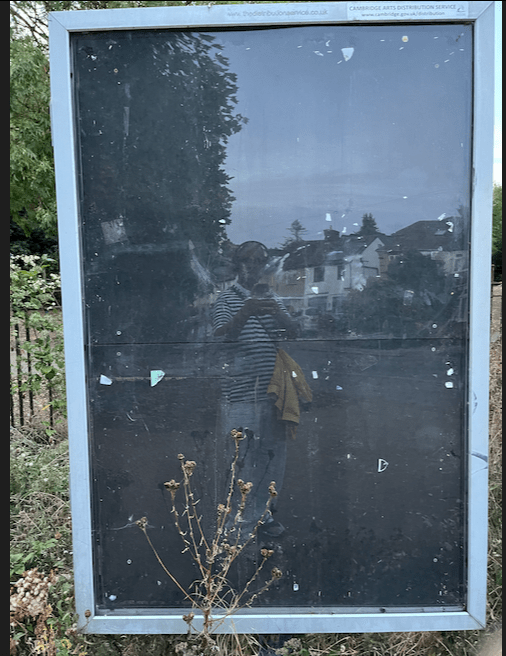
Above – empty community noticeboards in Cambridge in 2025
“Formal meetings where we invite people to sit down like a school assembly is off-putting for a lot of people. How can councils be in places where people are already at?”
Above – Officer contribution at Cambridge City Council 07 Oct 2025
“We didn’t get the general public – very rarely did we get ordinary people”
“What went wrong with area committees?”
Have a listen to Cllr Olaf Hauk here

Above – Cllr Olaf Hauk (LibDems – Trumpington (right) with Cllr Tim Griffin (Lab – Coleridge (left))
You can see how the city was divided up into ‘areas’ in the map below from CamCycle

Above – the old geographical areas that were represented by area committees in the late 2000s and 2010s. CamCycle (2016)
What made things tricky for me with the above structure is that I happen to live along the boundary of the old East Area and South Area. Therefore my life was not defined by public sector boundaries. There was also the added complication of having Queen Edith’s ward in the old South Cambridgeshire constituency – now joined by Cherry Hinton ward following the boundary change for the 2024 general election.
“The reason why people don’t attend is because most people are really busy”
Which is what Cllr Tim Griffin (Lab – Coleridge) said here.
And that reflects the wider challenge for the city’s institutions: Residents have a very limited capacity to engage in consultations
- The time needed to familiarise themselves with whatever the issue is
- The intellectual capacity to process the information put in front of them
- The desire and civic-mindedness to want to engage in the first place
Hence asking in a previous blogpost about shared publications. And three failed attempts at asking how Cambridgeshire could simplify its system of consulting residents here.
That’s why our city relies on voluntary organisations, community groups, and charities to act as informal civic watchdogs (such as Cambridge Past, Present, and Future on planning applications, and CamCycle on transport infrastructure in particular active travel).
It’s one of the reasons why I think in the longer term, a future civic engagement and democracy education strategy should explore encouraging residents to explore the issues that interest them at annual public events (like a societies fair) and invite them to pick one or two issues and focus on them – starting with getting and staying informed, and taking it from there. That way we increase the chances of getting the major issues covered, and also increasing the chances that more people will know at least one person with some familiarity of what is happening in their community.
Food for thought?
If you are interested in the longer term future of Cambridge, and on what happens at the local democracy meetings where decisions are made, feel free to:
- Follow me on BSky <- A critical mass of public policy people seem to have moved here (and we could do with more local Cambridge/Cambs people on there!)
- Like my Facebook page
- Consider a small donation to help fund my continued research and reporting on local democracy in and around Cambridge.

 The Cambridge Town Owl