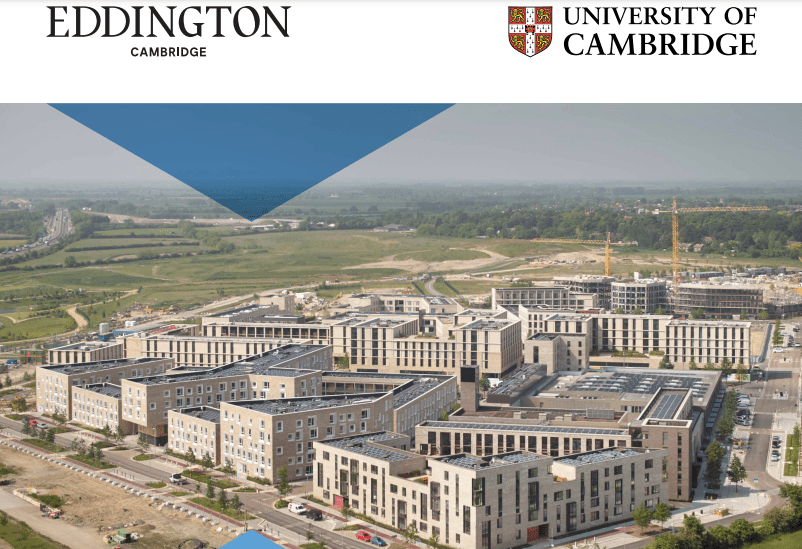
I was going to title it Ugglington because the architectural style makes me feel ill with rage, but I thought better of it. Anyway, they’ve submitted their outline planning application.
See the following:
- The summary in the Cambridge News
- The planning documents at https://applications.greatercambridgeplanning.org/online-applications/ typing in 25/03753/OUT into the search box
- Me moaning about the lack of a swimming pool that the University of Cambridge still owes the city
If you want to comment on this planning application…>
…see the guidance from the Greater Cambridge Shared Planning Service here
Note that your comments *must* be a material consideration which is set out in legislation and guidance – and summarised here. If you try to oppose an application on other grounds, your comment will be ignored and your time wasted. Please also don’t send personally abusive comments – it’s hard enough being a local government planning officer as it is.
Where you object to something, you can also state what actions you think the developers and designers need to take to amend the application to meet your concerns and withdraw your objection. CamCycle do this regularly on provision of cycling infrastructure and active travel routes. If you want to debate planning applications online with others, see the cyclescape boards for Cambridgeshire here. (Ideally I’d like to see a city/county-wide set of moderated message boards to enable wider and accessible discussions).
To get an idea of what a sound response looks like, have a browse through the responses collected by Cambridge Past, Present, and Future here. (And if you agree with their objectives and work, consider joining too!)
Such is the scale of this application that for most members of the public it will be impossible to cover all of the bases. Therefore pick a couple of issues that you’re really passionate about and run with those.
“What if you like the proposals?”
Send in a comment saying so – again keeping your comments to the material considerations. Because planning officers and councillors on the planning committee will have to judge the application on their merits as set out in law, planning policy guidance, and in the Greater Cambridge Local Plan 2018. That basically says: “These are the standards specific to our local area that have been scrutinised under the oversight of Planning Inspectors and have been found to be sound, and approved by the Secretary of State.” Any application that does not meet these standards is ‘A departure from the local plan’ and would need ministerial approval.
My take is that such is the scale of the house building in/around Cambridge that large developments like these should be allocating substantial funds and land for facilities that are up-to sub-regional in scale .
To get a sense of the proposals, you need to browse through the design and access statement
Above – via https://applications.greatercambridgeplanning.org/online-applications/ Ref 25/03753/OUT
The application is summarised as:
“Outline planning application (all matters reserved [so to be decided in separate planning applications if this is approved] except for means of access to the public highway) for:
- a phased mixed use development, including demolition of existing buildings and structures, such development comprising:
- Living Uses, comprising:
- residential floorspace (Class C3/C4, up to 3,800 dwellings),
- student accommodation (Sui Generis),
- co-living (Sui Generis) and
- senior living (Class C2),
- flexible employment floorspace (Class E(g) / Sui Generis research uses),
- academic floorspace (Class F1), and
- floorspace for supporting retail, nursery, health and indoor sports and recreation uses (Class E (a) – E (f)),
- Living Uses, comprising:
- public open space,
- public realm,
- sports facilities,
- amenity space,
- outdoor play,
- allotments and hard and soft landscaping works alongside supporting facilities,
- car and cycle parking,
- formation of new pedestrian,
- cyclist and vehicular accesses and means of access and circulation routes within the site,
- highway works,
- site clearance,
- preparation and enabling works,
- supporting infrastructure,
- plant, drainage,
- utility,
- earthworks and
- engineering works.
“I’m exhausted reading that list”
The planning system has a habit of info-dumping lots of things at once. It’s not just an ADHD thing!

Above – by GingerPale featured in my previous blogpost on explaining neurodiversity – Imagine someone is explaining every single document in that planning application to you. How long before you feel like the figure on the left?
This is how big the development is
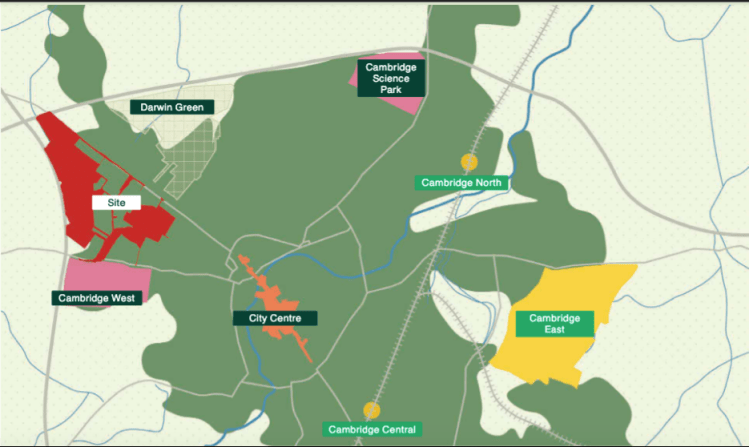
Above – Design and Access Statement Part 1 p11 (Ref 25/03753/OUT)
And that’s from a 21 page document. There are another 11 parts (so 12 in all) of the Design and Access Statement alone.
Which is why I think as a city we should be doing much more to co-ordinate civic responses while at the same time working with schools, colleges, and universities to make it easy for children and teenagers, and young adults to:
- Respond to issues that directly affect their collective interests
- Make it easy for schools to manage the requests and offers that come through from developers (and get developers to contribute towards the costs of the schools taking part?
- Make it easy for further education students to do their extended research projects on planning applications – for example creating study templates and frameworks that they can use to look at specific issues, eg heritage, transport, ecology etc.
- Make it easy for undergraduates and postgraduates to scrutinise in more detail specifics of the applications and sharing their findings back into the planning and policy-making processes.
Wishful thinking?
Don’t let big developers get away with stuff like this
If developers are going to put heritage architectural p0rn-style money shot pictures that sells postcards in Market Square, then they should be compelled to include landmark buildings built in an identical style, rather than saying **Oh we used the shade of the ancient college buildings when selecting which cheapo reconstituted stone material to use in our sci-tech park!**
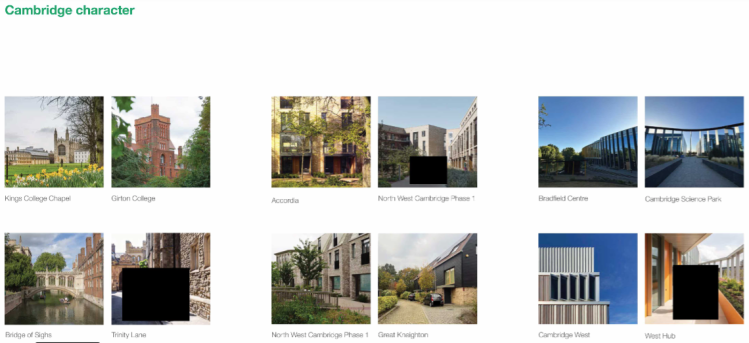
Above – if they are going to cite old buildings, reflect them in the design. Eddington at present at least does not do this. It does not even attempt to do this
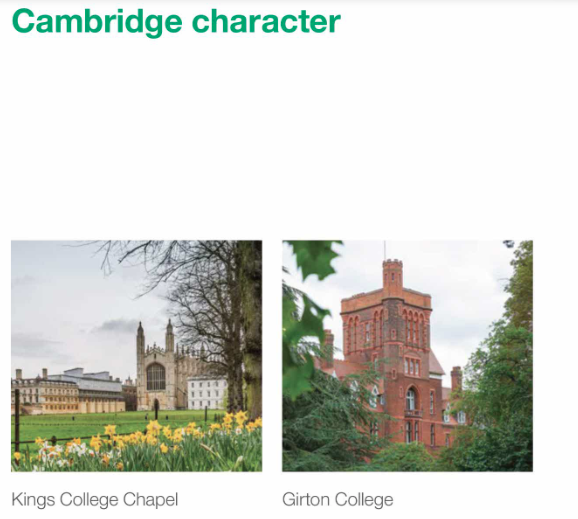
Above – down with these irrelevant pictures!
“Why so angry with Eddington?”
Recent research from the likes of the Heatherwick Studio and their Humanise campaign, Dr Cleo Valentine & Heather Mitcheltree and CreateStreets, in response to ugly bland identikit contemporary big buildings has tapped into a seam of new information on people’s responses to our built environment. In particular Dr Valentine’s work on neuroarchitecture.
Recommended reading: Routledge Handbook of Neuroscience and the Built Environment
Featured in the book is Dr Valentine in Chapter 19. Design for Well-Being: Understanding the Impact of Architecture on Physiological Stress – Cleo Valentine and Heather Mitcheltree.
Have a look at the contents here. If your institution has a library this may be of use.
At this stage, water, ecology, and climate are huge issues and have extensive assessments included
These need scrutinising in detail. Know any campaigners and campaign groups interested?
One for them. (Feel free to share!)
If you are interested in the longer term future of Cambridge, and on what happens at the local democracy meetings where decisions are made, feel free to:
- Follow me on BSky <- A critical mass of public policy people seem to have moved here (and we could do with more local Cambridge/Cambs people on there!)
- Like my Facebook page
- Consider a small donation to help fund my continued research and reporting on local democracy in and around Cambridge.

 The Cambridge Town Owl