
The Mayor of the Combined Authority has published his draft local growth plan – a requirement from central government. As the saying goes, location, location, location
You can read the plan at item 4 here
The section conspcuous by its absence
Why no mention of The Arts?
That’s an incredible omission given the amount of joy and pleasure the arts bring to our communities, as well as the revenues generated from the various festivals that happen all over the county. Please can someone raise this? (Drop an email to democratic services in the link here as a public question)
It’s essential that the city (and the University of Cambridge) learns from the lessons of Eddington, including:
- The lack of integration in the development’s public transport facilities with the rest of Cambridge (making the events/shows put on at Storey’s Field Centre all but inaccessible to residents on low incomes
- The lack of council housing at Eddington
- The failure of Cambridge University to build the long-promised West Cambridge Swimming Pool and the inconsistent communications over the years related to it
- The failure to consider research from the University of Cambridge’s own researchers about how the built environments and building facades affect the mental health of the people who live and work around such architecture. (See also how boring buildings can damage your health, in The RIBA Journal by Eleanor young)
Note that last bullet point is very controversial indeed – the development being one that in my experience polarises opinion. Some people really like Eddington’s building and design style. Others such as myself loathe it with a passion. You only have to look at the comments posted on my FB site on the next expansion phase for Eddington to see a reflection of this.
The Future of Cambridge will and should generate passionate debates and discussions by its very nature – we’re talking about somewhere that lots of people call home for a start
This is something that the corporate chiefs, influential individuals, and powerful decision-makers all too easily overlook. This is reflected in the over-complicated governance structures and the failure to build the infrastructure needed in time to match the growth of the city and the economic sub-region. But then local government structures have always been a ‘Political Football’ – just over half a century ago the Redcliffe-Maud Report of 1969 proposed massive changes for our city and county that could have resulted in a very different city to the one we have today. (Quite possibly one with a larger population).
There will be huge opposition from the growing Green Party of Cambridge and South Cambridgeshire to the proposals
Which is actually good for democracy. Not least because it forces the hands of the politicians and interests behind the proposals to ensure that they don’t take the environment, water, and ecology for granted. Furthermore, with the implosion of the congestion charge in the face of an electoral backlash, there’s a contemporary historical lesson for policy-makers to ensure that a critical mass of the public is informed and involved at design stage – beyond the usual suspects like me. (Which is why I think citizenship education for resident adults should be mainstreamed into an enhanced and revived lifelong learning offer).
“How much of a consideration should The growing Green vote be?”
Ultimately that is down to the politicians – it’s a party political issue. at the same time the Green Party’s local membership (Cambridge and South Cambridgeshire constituencies) has grown by 40% in five weeks – from 800 members to over 1100.

Above – since the above milestone was reached on 07 Oct by the Cambridge & South Cambs Green Party, another 100 members had joined.
“What’s happening with ‘Your Party’?”
The local collective has had some online meetings and a few stalls eg at the Fresher’s Fair in Cambridge. Their regional party will be having their first regional assembly in Norwich on Sat 18 Oct – details here – you have to be a member to sign up). (Other regions are available!). At the same time, TeamNigel has the same number of councillors as the Conservatives on Cambridgeshire County Council – ten each. I’ll leave the analysis of Labour vs LibDems in Cambridge to Phil Rodgers in this week’s copy of the Cambridge Independent. (Could a future unitary deliver a ‘super-majority to the LibDems in 2028?)
Locating the concert hall
I wrote back in 2021 that the time had arrived for a new large concert hall in Cambridge – something that followed the creation of the new Centre for Music Performance. My reasoning being that Cambridge cannot have a world class centre for music performance without a world class venue. Which we could have had in the late 1960s. In 1967 Gordon Logie considered the criteria (which I wrote about in the second half of this blogpost) but sadly both he and Sir Ivor Jennings (the Vice Chancellor who supported the joint project) were no longer around by the time ministers vetoed the borrowing needed to pay for it following the devaluation of the £.

Above – from the Cambridgeshire Collection, Cambridge Hall proposals
“Where could a new concert hall go today?”
That will ultimately depend on what Peter Freeman and the Cambridge Growth Company recommend. In September 2024 I made the case for a second urban centre for Cambridge on the Cambridge Airport site, with a new large concert hall at its heart. This followed the confirmation from the University that the old Cambridge Assessment Offices were being turned into a new innovation facility.
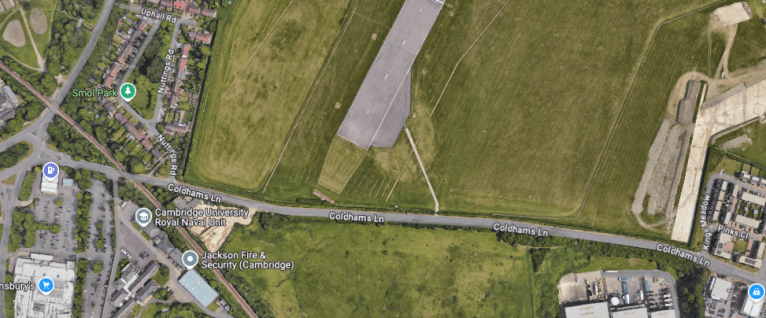
Above – from G-Maps here – the eastern section of Coldham’s Lane
Having a new concert hall and civic square in this part of our city also means there’s a wonderful chance of building a new entertainments and night-time economy quarter that doesn’t disturb local residents or residential colleges. (The presence of the old landfill site at the foot of the picture above does not make for good residential land!) Given the struggling state of the sector, this could help diversify our city’s economy which at the moment is dangerously over-exposed to a single sector – something the recent announcements by Astra Zeneca and others focused the minds of many on.
Where it definitely should not go: West Cambridge
– even though there will be strong university pressure to locate it there
Which is why this diagram made me go ***Eeek!*** until I realised the boxes and the points on the map were not linked.


Above – the North East Cambridge box in the south west, Cambridge East in the South East, and the Cambridge Biomedical Campus in the north. (CPCA LGP Draft, P65)
The reason why it should not go in West Cambridge is because that is where the fewer number of residents (in particular those on the lowest incomes) can get to using active travel or public transport modes of transport. The reason why the University of Cambridge and its corporate supporters would want it there is because it’s easier to market the University’s offer to the world with such a facility at the heart of its Eddington and North West Cambridge developments.
“What sort of venue does the University want and does it match what a growing city that has long functioned as a regional centre (just without the leisure facilities to match) actually needs?”
That’s a challenge they will need to untangle. Because it might be that a smaller, compact concert hall of the type at West Road is more what the University dons might prefer, while the Cambridge economic sub-region and beyond needs a venue with a minimum capacity of at least 3,000 people to attract top-tier musicians and performing artists in order to break even. Because when you look at the Cambridge Corn Exchange line-ups of rock/pop musicians, most of those listed are those who are not at the peak of their careers. And those that are coming back for a second peak eg the brilliant Amy MacDonald who I really want to see, won’t leave you with much change from £50 for a single ticket.
This is why we have to think both as a city *and* as a regional venue when it comes to our shared future.

Above – Lost Cambridge – I agree with John Parry Lewis (27 Nov 1973 in the Cambridgeshire Collection)
“What would it be like if the University (and its wealthier colleges) did the opposite of what it’s doing, and invest in communities and projects across our city and beyond?”
A fair question – one for University members to discuss?
Because while the colleges are self-contained communities with their world-famous courtyards, the university is much more a city-based institution. There is no ‘campus’ to speak of – which can confuse tourists when they ask ‘how to get to Cambridge University.’ (I normally send them to King’s Parade and point out King’s College, Senate House, and Great St Mary’s).
Furthermore, the Eddington development is doing what the people behind it proposed: producing a self-contained university district insulated from the rest of the city – one that appeals to a certain cohort of people who want to be in an exclusive district and far away from the social problems facing the less affluent parts of our city.
Let’s face it, exclusivity is one of the aspects of brand Cambridge that can be gift-wrapped, marketed, and sold for a lot of money
And that sits uneasily with Cambridge City Council’s vision.
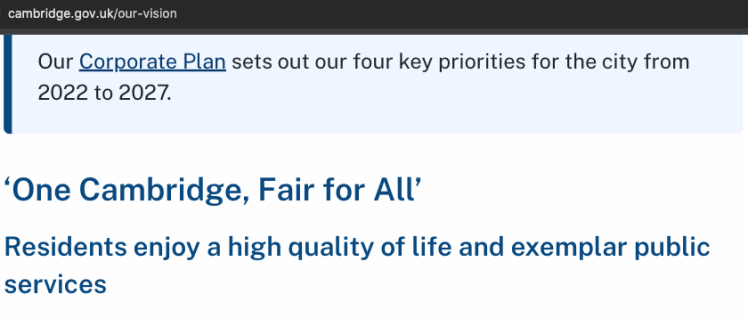
Above – Cambridge City Council’s vision 2022-27
I’ll leave you to resolve that tension.
If you are interested in the longer term future of Cambridge, and on what happens at the local democracy meetings where decisions are made, feel free to:
- Follow me on BSky
- Spot me on LinkedIn
- Like my Facebook page
- Consider a small donation to help fund my continued research and reporting on local democracy in and around Cambridge

 The Cambridge Town Owl