If this succeeds, it could be as significant as the work of Eglantyne Jebb’s uncle Sir Richard Jebb MP who piloted the Cambridge University and Corporation Act 1894 through its Commons stages following the Daisy Hopkins Spinning House scandal
Don’t worry – I didn’t ask the present Vice Chancellor to apologise for the injustices done by her predecessors told in Caroline Biggs’ epic local history study The Spinning House. Yet the launch event for the Civic Listening Report of 22 October 2025 could become one of the new historical milestones in the history of the city that the University of Cambridge shares with us town people.
Does the national political picture represent a risk?
One minor concern I have about the report is the lack of coverage on politics other than to acknowledge briefly 1) the uncertain times that we live in, and 2) the Greater Cambridge Partnership. The electoral gains from both TeamNigel and The Green Party (the latter of which won 25% of the Cambridge City seats in the county council elections earlier this year) represent existential challenges to the University of Cambridge’s growth plans, albeit for different political reasons.
Civic universities
It does however mention the UPP Foundation’s set of essays on The future of universities and their places, five years on from the Civic University Commission – otherwise known as the Kerslake Collection. It was named after the former Head of the Civil Service (who was also my permanent secretary for a short time in my civil service career) Lord (Sir Bob) Kerslake.
One of the many essays that stands out is the one on town-gown relations in the late Lord Kerslake’s home of Sheffield.
“Lord Kerslake often underlined the importance of the town-gown issue by telling the story of when he first spoke to his wife about the Commission. Her response (not unreasonably) was to ask whether it meant he was going to ‘sort out the car parking’ in Sheffield.”
“As a university sector, we like to show off our new shiny achievements – be it a new local project or a new facility used by the public. But the sector is rarely as good at focusing on everyday issues, often seen as mundane, which have a profound impact on local communities”
Above – Richard Brabner in Studentification and Town Gown Relations
This reminds me of the advice given by the pioneers in the civil service of all things digital in one of the early UKGovCamp unconferences on what to prioritise on your landing pages. ***Prioritise user need*** which is often revealed in the words users input into any search function your website has.
Going to UKGovCamp 2026
As an aside, Cambridge/Cambs people who work in the public sector, if you are interested in all things digital please sign up for UKGovCamp which in Jan 2026 will be in Birmingham (not London). It’s free and it doesn’t matter what your job title or grade is. What matters is your passion. This is important if Cambridge’s institutions are to get that extra level of challenge across the grade hierarchies. All too often we miss out as the regulars that used to go (including me) have all moved onto other things, leaving a void. The agenda is decided on the day and people have 30 seconds to pitch their ideas. See if you can spot the Head of National Archives making his pitch in the 2016 pitches I filmed here.
“How serious is the University of Cambridge about this?”
The Vice Chancellor opened proceedings and there were various familiar faces from local government, civic society, charities, and business groups as well as academia. Actually for me it was the first time in ages that I had seen so many familiar faces – such has been the impact of CFS/ME on my ability to get out of my house at the best of times.
The truth be told, I genuinely do not know. But as one of the local charity speakers said, this is a huge opportunity happening at the same time as major local government reform and housing growth that we dare not blow it.
“What is the starting point? The baseline?”
This was set out in the separate Civic Listening Report by consultant and former local resident Elma Glasgow (see here, scroll down, or click here) who with Jo McPhee facilitated a number of focus groups (I took part in the Cherry Hinton one as it was closest to where I live) and who carried out a number of in-depth 1-2-1 interviews. If anything, Ms Glasgow’s report for me is the more important report. It provides a snapshot of where ‘town’ is, along with indications of quick wins the University could make for all of us, alongside new areas of research. Furthermore, Ms Glasgow has included many quotations from the participants which together tell of a much more powerful story of the University of Cambridge since the 1990s as a major influencer of pro-growth policies, and the impact that this has had on local residents.
Senior Cambridge University figures – management, faculty, even student representatives, should read Ms Glasgow’s report in detail
…and then commit to plans of action as a result. Because the challenges that the residents have put to the University and its member institutions – in particular the wealthier colleges, make for very sobering reading. Not least because they cover decades of failures, of shortcomings, and of a collective lack of awareness.
Secondly, the work carried out by Ms Glasgow and Ms McPhee should be repeated and extended annually for the next decade so as to build a comprehensive evidence base including a timeline of what actions were taken and when (and why). This is because there are so many other major policies and plans being drawn up and delivered on that this is one method of ensuring that the University of Cambridge does not forget about its civic responsibilities to the city (irrespective of whether senior executives choose to accept them or not) in the Government-backed dash for growth.
“The University has a duty to improve the city” – Sir Ivor Jennings QC (Vice Chancellor 1961-63)
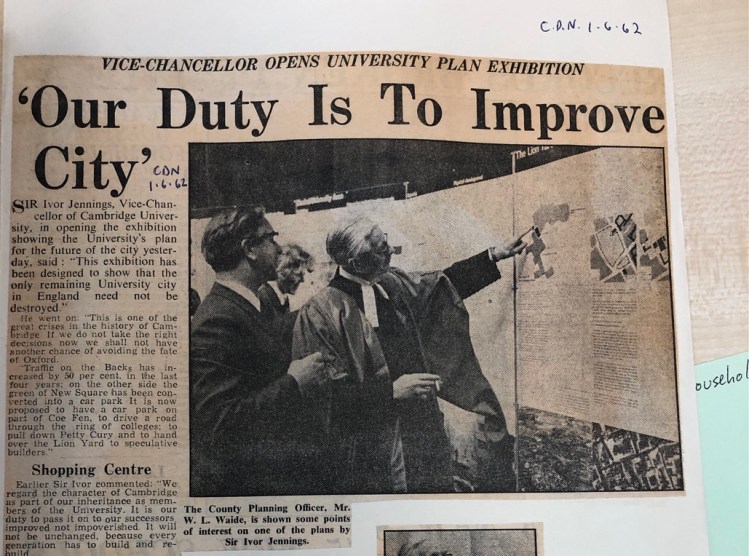
Above – Sir Ivor Jennings QC (in robes) with Mr Waide of the old, smaller Cambridgeshire County Council. From the Cambridge Daily News, 01 June 1962 in the Cambridgeshire Collection.
Question to the current Vice Chancellor and her pro-VCs:
“Do they accept collectively the statement from Sir Ivor?”
Within that statement was Sir Ivor’s commitment for the University of Cambridge to co-fund a new large concert hall for Cambridge – which I wrote about in Lost Cambridge back in 2021, followed up by my own updated call here. Because the Combined Authority Mayor Paul Bristow announced that a new concert hall and convention centre is part of his local growth plan (a legal requirement from central government) that senior councillors from across the CPCA area discussed today.
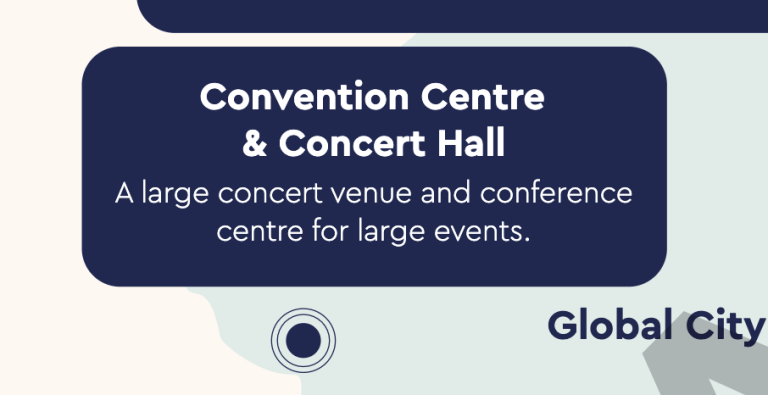
Above – detail from the Local Growth Plan from the Combined Authority which I blogged about here
In his response to my public question (See the papers and webcast link here), the Mayor of the CPCA said there was a significant opportunity for Cambridge to build a new large concert hall with world class acoustics and that he would continue to engage with local councils and other interested parties – one for the University of Cambridge’s Centre for Performance as well as Anglia Ruskin’s music department?
Future blogposts on the University’s report to follow
Although only 40 pages long, the amount of ground covered in the report is substantial – and the number of issues it raises are huge. I wouldn’t be doing the participants and the writers justice if I tried to cover everything in a single post.
Furthermore, the thoughts I have and the recommendations I want to make cover a range of institutions far beyond the University of Cambridge and local government. On top of that, there are some really difficult issues (for both town and gown) that collectively we need to be open and honest about. That will require some very senior people past and present in influential organisations acknowledging that they could have done some things better, or made alternative decisions that might have had a more positive impact. And no one likes doing that – least of all in public.
Learning from mistakes, errors, embarrassments and even humiliations.
I’m reminded of the anecdote in in Dreadnought by R.K. Massie when Admiral Jackie Fisher heard testimony from a senior army officer at the Royal Commission into the Boer War (1899-1902) about how inaccurate the gunnery from the Royal Navy had been. ‘So poor that it would have disgraced a girls’ school’ I think was the line! Massie wrote that Admiral Fisher was not only furious with the statement being made in such a public setting, but he was even more furious because he knew it to be true as well! It resulted in Percy Scott being appointed Inspector General of Target Practice who managed to turn things around.
That’s sort of what I would hope might happen with the University of Cambridge and its member institutions. I’d like to think that – similar to the conversations that UKGovCamp has every year, the open and honest conversations about the shortcomings by people who are passionate about solving them, and passionate about public service, would result in multiple improvements so widespread that they would be greater than the sum of their parts.
Greater than the sum of our parts
I can’t remember which speaker mentioned it, but it struck me because it’s a phrase I have regularly used in blogposts. i.e. ‘We will know when we have succeeded in making Cambridge become ‘Great Cambridge’ because our city will have become greater than the sum of our parts’. At the same time I have also cited examples symptomatic of why we have not been able to achieve this.
“Such as?”
The (still unbuilt) West Cambridge Swimming Pool.
“If we want our city – and our county to become greater than the sum of our parts, the case of the West Cambridge Swimming Pool provides a demonstration of how to prevent this from happening.”
The easiest thing for me to have done in response to the emerging and growing civic engagement unit within the University of Cambridge is to have said:
**Yeah – whatever. Come back to me when you’ve built the new swimming pool and concert hall***
…On the grounds that I’ve got very little to show for the past 15 years covering the changes happening in Cambridge and the decisions made by big institutions – from writing blogposts, creating videos, participating in campaigns, and even standing for election. (Other than maybe a dragon slide at Coleridge Rec and a few new streets named after civic figures past that I’ve publicised, I can’t think of anything substantial – but to what extent does this reflect the over-centralisation of our system and the inflexibility of big institutions?)
Why this new civic framework must deliver positive results – it must succeed
What’s the alternative? That local government continues to decline and become an irrelevant delivery agency of Whitehall that simply carries out public procurement exercises for specific services to be delivered by third parties?
No – we’ve more than reached the limits of the New Public Management paradigm. What emerges from this framework will also have to challenge the influential colleges – asking them to take into account of the needs of the wider city (in particular those with the least) when it comes to their longer term investment decisions. What would our city look like if all of the colleges did this? For example, would we see a curtailment in the growth of postgraduate student recruitment so colleges don’t end up referring their students to local homeless charities as reported in Varsity recently? In one of the most unequal cities in the country with a chronic social housing shortage, the idea that a college from one of the wealthiest universities in the country is telling its students to compete with local homeless people for accommodation is shocking. But that is where we are. We must do better.
If you are interested in the longer term future of Cambridge, and on what happens at the local democracy meetings where decisions are made, feel free to:
- Follow me on BSky
- Spot me on LinkedIn
- Like my Facebook page
- Consider a small donation to help fund my continued research and reporting on local democracy in and around Cambridge.

 The Cambridge Town Owl