
I led a walking tour through one of the most historic town neighbourhoods in Cambridge with a surprisingly large group of walkers who braved the miserable weather forecast
The Cambridge Living Streets Group – the local branch of the national campaigning charity has organised a series of local walking tours that double-up as a ‘state of the streets’ survey for those participating. At the end of each tour they are invited to fill in a short card survey highlighting what they experienced in terms of the state of the pavement through to the street and urban design through the lens of pedestrian safety.
This is also part of a local campaign to make Cambridge’s streets more walkable given the raised focus of active travel and the need to improve our collective health – especially in the face of an ageing population and a climate emergency.
The Cambridge Living Streets branch was formed at the end of 2020 and alongside the Cambridge Area Bus Users Group (also re-launched) has been paying close attention to the emerging transport proposals from the Combined Authority Mayor. Both groups are membership organisations so feel free to get involved in either/both.
The Kite – Contested pasts, contested futures
The fate of the part of Cambridge where The Grafton Centre is located in has a very long history to it. The area used to be known as Barnwell, and by the 1860s it had gained something of a notorious reputation within high society.
“The ” dens” of infamy, of which every right-minded person who knows the parish can feelingly testify, and the riots and drunken frolics, of which the police reports are often made up, exhibit Barnwell in very unenviable character before the eyes of the other inhabitants Cambridge.
Above – Proposed Improvements in Barnwell in the Cambridge Independent of 21 Nov 1863 and transcribed in Lost Cambridge
It was the Holford Wright report of 1950 that highlighted the area as a potential new urban centre based around retail.

Above – detail from the Holford-Wright Report map 1950 with the proposed new road bridge over the River Cam – Elizabeth Way Bridge, proposed in the top right
Thus began the struggle between local residents and local politicians over the future of the area. The residents came up with their own proposals which they published in a document in 1976, one which I wrote about in Lost Cambridge here.
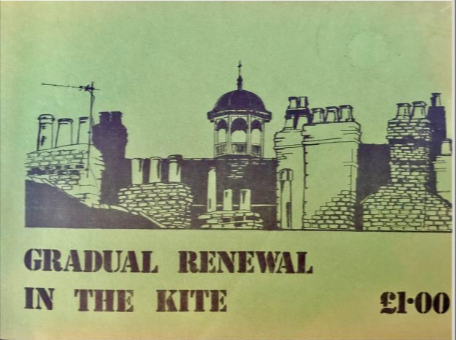
Above – Gradual Renewal in the Kite (Cambridge) 1976.
The controversy of the redevelopment plans – promoted by the leader of the Cambridge Conservatives Cllr john Powley were a contributing factor in the long term decline of the Cambridge Conservatives. One of the politicians around at the time, the late Colin Rosenstiel summarised what happened in this early online article from 2001. When he was still alive he also mentioned the impact that The Grafton redevelopment had on the fortunes of the party he spent much of his adult life opposing – Rosenstiel was a longstanding Liberal – and later Lib Dem Councillor. I wrote this short piece in 2018 shortly after his death.
It wasn’t just the Conservatives that declined in the face of The Kite’s redevelopment in the 1980s. So too did the once mighty Cambridge and District Co-operative Society. Their headquarters where Primark (previously John Lewis while Grand Arcade was being built) is where their headquarters were – the first side opening in 1895 representing a huge step forward in the retailing history of Cambridge. The building below is from a wonderful history of the co-operative movement in Cambridge from its beginnings through to the late 1930s: Co-operation in a University Town.


Above – I put the black and white image from the late 1930s showing the two Co-op buildings site-by-side, through an AI to see what it looked like colourised
Walking around the back of the Grafton Centre we saw the car parks and got a sense of how many residential streets were demolished to make way for it and the shopping centre. This was also where we got to see the plaque and the site of the old Cambridge Refuge.
The Cambridge Refuge was part of an attempt by affluent and the faithful in society to support the girls and women of Cambridge who had fallen on the hardest of times. Catharine Tillyard, the wife of Cambridge Independent editor Alfred, wrote about the work of the volunteers in one of her columns in 1906 which I transcribed here. In that piece I point to the study titled The Cambridge Association for the Care of Girls by Christina Paulson-Ellis which is very hard to find outside of public libraries. (See the Cambridgeshire Collection in the Central Library for a copy).
“What happened to the Grafton Centre? Why is it becoming a sci-tech space?”
In a nutshell the ownership of the site transferred between institutions. Legal and General spent £millions trying to improve it in the 2000s but to no avail – especially after the 2008 financial crash. Combined with asset-stripping owners of big high street names (leading to their implosion) along with the growth of online shopping, the profit margins demanded by shopping centre freeholders were just not there anymore. The firms and chains that were once there had vanished, and smaller local independent outlets could not make ends meet with such high rents.
Rather than reducing their rents – which is what textbook economic theory tells us should have happened (in order to make establishing new businesses more affordable), the owners decided to instruct property professionals to market the site to international investors as a potential sci-tech site. This despite the fact that the Cambridge Local Plan designated the site as a retail space.
For a whole host of reasons (primarily driven by central government policies on Cambridge and on science), the site was bought up by US investors and thus began the process of converting the retail site into a sci-tech hub, planning permission granted in Feb 2024.
Poor transport links for all those commuters
As I mentioned in earlier blogposts, the growth of the sci-tech industry is outstripping the city’s ability to supply a skilled labour force for it – something that the participants raised. This is why along with The Beehive Centre that RailPen controversially got ministers to call in for them, I have major concerns about the lack of a light rail stop that could otherwise serve both proposed sci-tech developments.

Above – From CTO 15 July 2023 – note the Grafton Centre top-right, the Newmarket Road Tesco and the Cambridge Retal Park on either site of Newmarket Road, and just below TK Maxx is Coldham’s Lane Bridge. It is around that bridge I propose a rail station – either light or suburban rail.
Some of you may want to raise the public transport and active travel issues with the Mayor of the Combined Authority to see what view he takes. Alternative you can table public questions on transport in/around Cambridge to the CPCA Transport Committee which meets on 17 November 2025. (You’ll need to get your questions in a week before).
If you are interested in the longer term future of Cambridge, and on what happens at the local democracy meetings where decisions are made, feel free to:
- Consider a small donation to help fund my continued research and reporting on local democracy in and around Cambridge
- Follow me on BSky
- Spot me on LinkedIn
- Like my Facebook page

 The Cambridge Town Owl