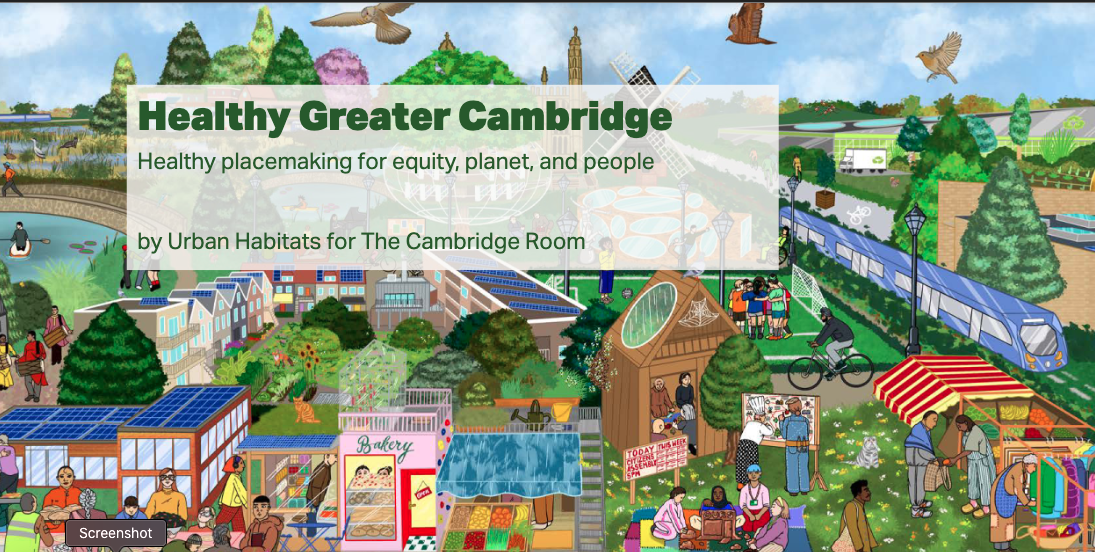
A new report from a group of Cambridge University researchers and associated colleagues, friends, and volunteers goes beyond the housing targets and challenges us to consider what a healthy expanded city might be like
Before I start, if you find what follows to be interesting/useful/even frightening, feel free to help support my continued research.
Making Greater Cambridge Healthy – the report
You can read the report, richly illustrated by Beth Blandford here
TL/DR? Scroll to the recommendations on p90.
It’s a ***really interesting report*** so do take some time to read it if you can.
There are so many interesting things to pick up on – things that others will almost certainly cover, that ensures my best contribution in commenting is focusing on the elephant in the room: i.e. the critical topic that as a city and county we really need to deal with. And not be afraid of doing so either.
“What’s that?”
Governance – how should this new Greater Cambridge settlement be administered, taxed, governed, and held democratically accountable?
One reason why this is such a difficult issue to handle is because perilously few of us actually know how the UK is governed – and just as importantly where power resides.
I don’t think it was in the remit of this report to go into detail on our city’s governance issues
I think that an in-depth report embedded in local history should have been the report researched and written *first* in order to inform the research and recommendations in the Healthy Greater Cambridge Report.
“Writing a report on how Cambridge [however defined] should be governed is a massive undertaking”
I know – that’s why I suggested it. Note that Lord Recliffe-Maud’s epic Royal Commission on the local government in England took three years to put together, and as he said in his introduction his team basically reinvented local government from scratch because what they had inherited was a complete mess.
Redcliffe-Maud’s report (which has its own WikiPage here) can be seen as follows:
- The maps to the research appendices
- The summary
- The main report
- The maps to the main report
- The research appendices
It’s worth reading the summary and the maps to the main report to get a sense of what he was recommending. I still think he was years ahead of his time, and local government would be in a better place today had his recommendations been adopted.

Above – Abandoned proposals for a Greater Cambridge and a separate Greater Peterborough unitary council, which formed part of the East of England province/region.
You can also see the boundaries of the old rural district councils – the existing South Cambridgeshire District being the result of combining the old Chesterton Rural District and the old South Cambridgeshire Rural District – both of whom had their offices inside Cambridge City. Note that the two former rural districts along with the old Newmarket Rural District and Cambridge Borough, formed the old Cambridgeshire County Council as established in 1889 by the Local Government Act of that year.
Because Labour lost the general election of 1970, his plans were abandoned and the structures put in place by Sir Edward Heath’s Conservative Government in 1974 have broadly remained in place until the present time – Sir Keir Starmer’s English Devolution policies being the biggest overhaul of local government in England for half a century.
Why sorting out the governance issues matters
Having proposed governance structures, systems, processes, and powers in place enables us to get into specifics of who needs to do what, when, where, and how. So many of the reports that have been produced on the future of Cambridge refrain from dealing with this – and understandably so. Who would want to fall down the internet wormhole that is Local Government Finance? (If you want a crash course, have a look at this).
It is the feeble revenue raising powers that means…
Cambridge UK ***should not in any circumstances be compared with Cambridge Massachusetts***
And anyone who does should be invited to phone the Treasury to see how far they get in trying to get equivalent revenue-raising powers for Cambridge UK that local/county/municipal, and state-level institutions have enshrined in the US Constitution. Because we don’t have a written, codified constitution protected by a constitutional/supreme court, local government institutions do not have the same level of protections. We have Parliamentary Sovereignty as a core principle of governance. Parliament can do whatever it likes within the borders of the UK. All it needs to do is to legislate to make things happen. That is why the Minister for Housing can decide unilaterally that Cambridge is going to expand as large as he says it will. (Note Michael Gove’s ambition for the last Conservative Government was for an additional 100,000 homes on top of what Mr Pennycook is proposing for Labour).
“What’s wrong with the recommendations in the Healthy Greater Cambridge Report?”
Nothing’s wrong with them in and of themselves.
However…
I could go through each one of them and come up with a reason why, under the existing governance framework on governing England hardly any of them could be taken forward in a meaningful manner. Their list of recommendations on p89 are:
- Apply the TCPA Planning for Healthy Places guidance
- Step up implementation of Health Impact Assessment
- Appoint a Healthy Places Lead
- Prioritise Health in all policies
- Build communities for people not just housing units
- Leverage available support
- Activate the Five Priorities for Healthy Greater Cambridge
- Use spatialised data to drive decisions
- Analyse healthy life expectancy to the street scale
- Map community knowledge
- Put community agency first
- Make movement easy and equitable
- Fix the Food System Locally
- Green every space
- Build capacity across sectors and with business
- Lead at a UK level in healthy placemaking
- Prioritise One Health and Circular Economy
- Demand Accountability at Every Level
- Build Strategic Partnerships
- Implement a civic University approach
- Plan for Scale from Street to Region
- Act now at the “speed of trust”
On each of the recommendations above, consider the following:
- Where is the money coming from for new commitments that come with this?
- What will be de-prioritised to make way for new priorities?
- Where are you going to get the extra capacity from for these new commitments? (Eg do you have the office space? Are the skilled staff available and affordable?)
- Does your institution have the power to do what the recommendation calls for? (If not, who needs to do what to ensure you get the powers you need? (That can often involve saying that this needs new legislation))
- Who are the people/institutions who don’t want to co-operate, and why? How will you change their minds?
- Who are the people/institutions who want you to fail/have a strong incentive in seeing you fail (eg Political, financial etc) and how will you deal with this?
- What information and data sets do you not have that you would like to inform your decisions/
- What level of knowledge do your partner organisations and the wider public need to have in order to make this succeed? How different is this to the knowledge levels they currently have? How will you bridge that gap?
- What is the capacity of both partner organisations and the wider public to take on what will be a huge undertaking over an extended period of time? What if that capacity is very, very low?
- Which are the institutions and organisations responsible for some of the recommendations who are far, far outside your influence? Eg ‘fix the food system locally’ is easier said than done in the face of the massive lobbying power of the big food multinationals. More green spaces means lower profits for developers.
- What is the level of ‘community knowledge’ in places that have very high turnovers of population? How will you manage this?
And that’s just for starters.
If we are going to do this as a city, we need to read up on the essentials of civics, politics, and democracy
You can read a more detailed recommendation from Qasir Shah of UCL from 2020 here
Who is going to persuade the Combined Authority to ask Central Government for adult civics courses and workshops/ (Or ask HM Treasury for the powers to tax the wealth generated within the Greater Cambridge Area to pay for this and many other initiatives and infrastructure improvements?)
If you thought implementing the recommendations in this report, and the ambitions in the University of Cambridge’s Civic Engagement Report was going to be straight forward…exactly.
It’s going to be a long slog, and it will be tough going. It will involve people in powerful and influential positions being made to feel uncomfortable – vulnerable even. It’s going to require lots of us doing things that we’ve not done before. But then the climate emergency is not going to wait around for us to be comfortable. Furthermore, the county council elections showed that there is now a sizeable party political risk to anything public institutions choose to do – whether it was the ten seats Reform got in north Cambridgeshire or the 25% of the county council seats in Cambridge divisions that went to The Green Party. And that was before their huge membership surge that has taken them to over 1,200 members in Greater Cambridge.
Note also we’ve go to do all of that at the same time as:
- Dealing with the Cambridge Growth Company’s proposals
- Managing new regional infrastructure such as East West Rail and new stations
- Familiarising ourselves with the huge volume of local plan documents
- Familiarise ourselves with the new local growth plan and its legal requirements
- Get our heads around the fourth local transport plan in a decade
- Continue responding to the consultations on the Chatteris reservoir
- Did I mention skills and jobs – which Ed Miliband has just added to?
- …while at the same time tackling inequality with an underfunded district level council
- Deal with Addenbrooke’s red risk-ridden risk register
- Underfunded police (the PCC for Cambs & Pboro having lobbied HM Treasury for more funds – see also here by the county council)
- Also remember when the Tories tried to close Cambridge’s Magistrates Court?
Chances are I’ve missed several things off of that list, but that simply goes to show how complex trying to make a growing city more healthy within a highly-centralised state actually is.
Food for thought?
If you are interested in the longer term future of Cambridge, and on what happens at the local democracy meetings where decisions are made, feel free to:
- Follow me on BSky
- Spot me on LinkedIn
- Like my Facebook page
- Consider a small donation to help fund my continued research and reporting on local democracy in and around Cambridge

 The Cambridge Town Owl