
Why do those commissioning new buildings on the Cambridge Biomedical Campus insist on instructing architects to come up with designs that make people feel ill?
Declarations of interest
This blogpost features the research led by Dr Cleo Valentine who is working in the pioneering field of neuroarchitecture. No one has paid me to write about her research and also I do not know in person/have not met Dr Valentine. Yet I believe that her research is of the utmost importance to the decisions taken about the future of Cambridge (my home town) that I am of the very strong opinion that senior decision-makers need to be familiar with the new discoveries made by her and her colleagues – in particular the joint paper submitted by by Cleo Valentine, Arnold J. Wilkins, Heather Mitcheltree, Olivier Penacchio, Bruce Beckles and Ian Hosking.
Now, before I tear a strip out of the latest monstrosity to get rubber-stamped by rail-roaded planning committees…
*Have your say in shaping our Campus and become a Local Voice.*
Basically if you disagree with my continual moans about urban design and architectural styles of the new buildings going up on Discovery Drive, get involved in the forums of the Cambridge Biomedical Campus here. It’ll give the staff some much-needed relief!
Now, let’s compare these unimaginative carbuncles with the 19thC Gaols
Below is the old County Gaol at the top of Castle Hill. The OId Shire Hall (made out of the bricks of this) sits on the site. Look at the variety of buildings on the site – and the decorative brickwork around the main entrance! And can you see the chapel-style build at the centre? And the Governor’s house to the right? Isn’t it marvellous!

Above – Cambridge County Gaol – I think this one’s from the Museum of Cambridge – which is just down the hill from this site, and at the time was a public house.
Then there was the town gaol which lasted not long at all. But it had an even more glamorous entrance which was proper-castle-shaped with turrets and arrow slits!
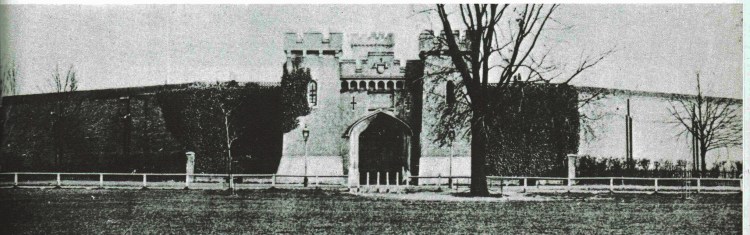
Above – Cambridge Town Gaol which overlooked Parker’s Piece. (Today it’s somewhere underneath Queen Anne Terrace Car Park and the Kelsey Kerridge Sports Centre)
Now, let’s compare those old prisons with what the building industry and the profession of sci-tech lab architects are imposing on our city.

Above – the Discovery Drive Carbuncles. Michelle Bolger for Prologis, (2025) p23 via Greater Cambridge Planning Portal Ref: 16/0176/NMA3
I jest with the prisons comparison. But there is a more serious point at hand, and that is the mental stress generated in human brains by the sort of designs the Cambridge Biomedical Campus’s partners are commissioning. Below is a quotation from research led by Dr Cleo Valentine who recently completed her Ph.D at Cambridge in architectural neuroimmunology. While she was researching for her Ph.D she was interviewed in this extended piece in 2023.
Two years later, her research team summarised their discovery as follows
“The results revealed that façades with regularly spaced elements at approximately three cycles per degree exhibited the highest stress metrics, particularly when combined with high contrast ratios and consistent repetition. Vertical wooden slats and vertical metal screening elements produced the most pronounced indicators of visual stress, while more varied geometric compositions demonstrated substantially lower stress metrics.”
Above: Visual Discomfort in the Built Environment: Leveraging Generative AI and Computational Analysis to Evaluate Predicted Visual Stress in Architectural Façades (2025) by Valentine et al.
I’ve put the emphasis in bold, and the quotation is just from the abstract.
In September 2025, Dr Valentine, and Uemee Jung, researching for a Ph.D at Yonsei University in South Korea gave a presentation at the recent Seoul Biennale of Architecture & Urbanism. You can watch a video of their bi-lingual presentation here.
“Buildings from the contemporary era in Seoul show on average the highest levels of visual stress of any era since the late nineteenth century.”
Dr Cleo Valentine for Humanise, 2025
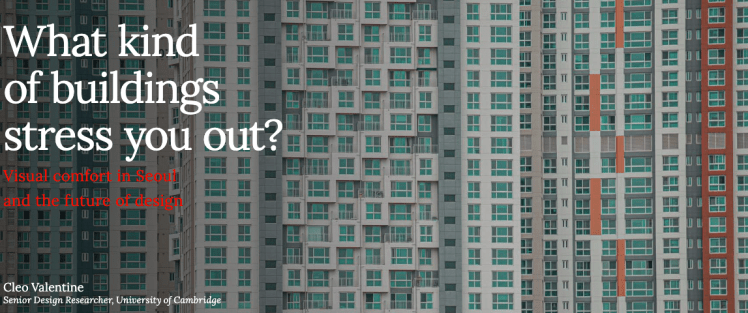
Above – the front cover of Dr Valentine’s report in English. (It’s also produced in Korean too)
Dr Valentine’s report needs to be put in front of ministers and senior civil servants
Back in the day that might have been my job. But not today. The statement from Dr Valentine highlights a significant risk with the Government’s mass-house building programme. In particular the use of pre-fabricated parts. In this case Dr Valentine goes into Korean industrial history.
“Standardised design systems and prefabrication introduced rigid patterns — and with them, the seeds of visual monotony. Today’s digital design tools can generate extreme regularity — amplifying visual stress even in high-tech architecture.
What’s even more striking was when Dr Valentine mentioned in her presentation in Seoul about the detrimental impact some modern designs had on the health of those working in the buildings – to the extent they could no longer work there due to the headaches and migraines triggered by the visual designs.
“I’ve spoken with people who report being unable to enter certain environments… …and when showing this to some architectural and engineering firms [in Korea], they have had clients come back to them reporting that occupants have complained so significantly that they have had to alter the designs retrospectively“
And that retrospective work does not come for free. It has a financial cost.
Are decision-makers on the Cambridge Biomedical Campus creating new financial costs later on down the line for themselves – costs that could easily be avoided?
The risk for ministers is that in their efforts to drive the costs of components and building materials down – and also to speed up construction times, they risk creating a new generation of buildings and new settlements that actually make the health of the new occupants worse. This is the opposite of what
“Around 1 in 10 people are especially sensitive to visual stress — and rates are even higher in neurodiverse groups.”
Above – Valentine (2025) p4
Well I happen to be one of those one in ten.
And this is happening in my part of town – a place where I’ve lived in for the best part of over four decades. Which probably explains why I’m kicking off on it. This is my home. I have nowhere else to go.
**Why on earth would decision-makers within firms on Cambridge Biomedical Campus want to commission buildings that make people ill?!?**
I’m picturing the scenario of me being discharged from hospital (as I was back in 2021 at Royal Papworth)
“Thank you for helping me get better – I’ve just walked out of your front door and have seen those monstrosities over on Discovery Drive and they’ve made me feel ill so can I come back in please?!?”
Although I don’t think it would work out quite like that!
I don’t know. But at some stage the research and growing body of evidence is going to force the issue.
Actually, this could be the spark to start up an informal group open to all but particularly aimed at those with a neurodiverse disposition who are likely to be disproportionately affected by the current urban design patterns and styles not just on the biomedical campus, but across the city and surrounding district.
“Will the industry listen?”
Some will push back. In what is such a macho industrial/economic sector – one interwoven with the toxic working environments of Whitehall and Westminster (which I lived through myself) inevitably there will be those that dismiss the findings because it is their work that is being criticised. Recall the fallout between the King when he was Prince of Wales and the architectural establishment – not just his 1987 ‘carbuncle’ phraseology, but with the Chelsea Barracks case.
“Back in 2009, Foster was one of a number of architects to condemn the then prince for using ‘his privileged position’ to intervene in the design process for Richard Rogers’ Chelsea Barracks scheme in London.”
Above – Anna Highfield in Architects’ Journal, 09 May 2023
“The prince’s objection to the modernist steel and glass design was expressed in a letter which was described in court as “a hand grenade”.”
In this case, the Prince of Wales was not on strong grounds, and original developers successfully sued for breach of contract. But because it was effectively the Qatari Royal Family (who are close to the now King) they could afford to bring in a new firm and commission designs much more appealing to the then Prince of Wales. (Compare the original design featured in The Guardian here, with the one that ultimately got built, designed by Squire and Partners here).
The public policy challenge
This is what makes public policy so much more complex than people in other professions and trades perhaps realise. (Not their fault – if schools don’t teach children about politics, democracy, the rule of law and how public decisions are made, then what hope have they got?) Civil servants have got to weigh up the multiple and competing interests and evidence bases before coming to a conclusion on what to recommend to a minister. Where do you strike the balance? In the built environment you’ll be more than familiar with the concerns from environmentalist vs the demands from developers. Ministers facing a housing crisis have decided that building over a million homes in the next five years is the way to solve it – but that involves building techniques that produce the sorts of designs that Dr Valentine’s research and those of her colleagues are cautioning us about.
It’s just over three weeks until the Budget – expect lots of new decisions to flow from that.
Food for thought?
If you are interested in the longer term future of Cambridge, and on what happens at the local democracy meetings where decisions are made, feel free to:
- Consider a small donation to help fund my continued research and reporting on local democracy in and around Cambridge
- Follow me on BSky
- Spot me on LinkedIn
- Like my Facebook page

 The Cambridge Town Owl