
So why on earth are senior decision-makers still equivocating over light rail?
Before I start and if you’re quick, you can catch Peter Freeman’s interview with BBC Look East earlier. (06 Nov 2025). The BBC really should extract the interview and provide a permalink to it given the importance of his remarks. Also, two looming meetings in December:
- Rail Future East in Cambridge on Sat 06 December 2025
- Cambridge Biomedical Campus Open Forum on Mon 15 December 2025
And for those of you who find these blogpost updates useful, feel free to help support my research costs via Ko-Fi. (It makes a huge difference being on Universal Credit due to long term illness).
The BBC Look East piece featured a piece from the Wellcome Genome Campus and concerns about transport infrastructure. They responded positively to the investment announcement from ministers in Cambridge recently, but for me if it does not deliver on significant new rail-based transport infrastructure to get people out of their cars, ministers risk inflating an over-inflated economy. This was demonstrated in the interviews with the landlord and patrons of the Ship Inn in King’s Hedges, where new small houses are on the market for £half a million, and one patron remarked how her son could not afford his own place despite wanting to leave home. He’s 37 years old.
“Over the next few years, [The Wellcome Genome Campus] will grow from 125 acres to 440 acres, with the number of people working on it expected to increase from around 3,000 to between 7,000 and 9,000.”
Above – WGC Press Release appointing leisure advisers 22 Sept 2025
“Where is the campus?”
It’s down the road from Duxford – I wrote about their expansion plans back in 2023 here

Above – where the Wellcome Genome Campus is on G-Maps – not far from Great Chesterford on the Cambridge to Liverpool Street line to London
In that same 2023 blogpost I had a look at how a Cambridge-Haverhill light rail or suburban rail service could loop around to serve the Campus as well as providing a rail service to Saffron Walden, the Imperial War Museum at Duxford, and the large village of Sawston.

Above – from G-Maps here which I’ve plotted out as a walking route to try and get the most direct route from Haverhill to Saffron Walden, then back up to incorporate the Wellcome site, the Imperial War Museum at Duxford, Sawston’s industrial parks, and ultimately back onto the existing railway line at Great Shelford and onto the Cambridge South Station.
Connect Cambridge’s proposal to connect with the Wellcome Genome Campus
I wrote about it in this blogpost in August 2024 as the group sought ministerial support for feasibility funding. I also covered it again here when Create Streets came out with their proposals for a large expansion of Cambridge. Given the scale of growth that ministers are now proposing, the reluctance to commit to a radical green package of public transport solutions remains puzzling.
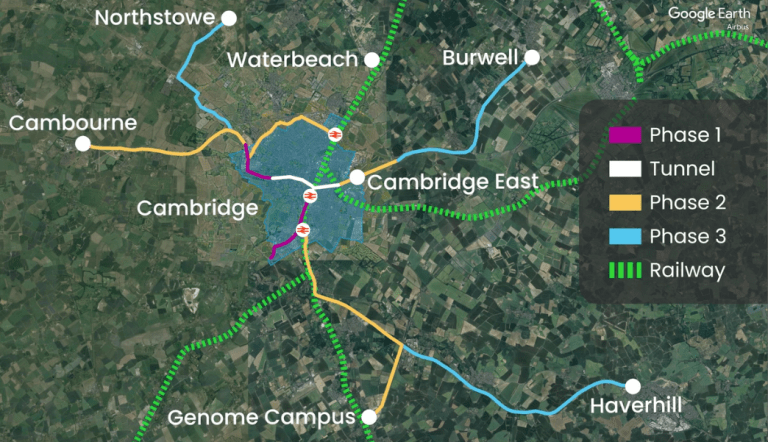
Above – the completed plan from Cambridge Connect – something the Wellcome Genome Campus really should be supporting if they are that concerned about infrastructure.
In a nutshell I’m not the only one calling for trams and light rail to form part of our new transport infrastructure to get us out of petrol and diesel cars.
Wellcome Genome Campus proposes new pool
“The retail, leisure and dining facilities will include a new gym and health centre with pool, a hotel with conference facilities and a wide range of locations across the estate.”
Are they talking ‘swimming pool’ or ‘pocket exercise pool’?
It’s hard to tell but if they are working on up to 9,000 people on site, it makes sense for planners to make the case for it to be a public facility rather than a members only facility – if only to benefit the residents of Duxford and Great Chesterford villages.
Why the equivocation on transport modes?
I don’t know. Some of it is historical – for example when Cambridgeshire County Council’s senior transport officers did not want to say the word ‘buses’ but also did not want to concede to anything that involved rails. One of the meeting papers from the county council from 2021 infuriated several of us following transport debates closely when the county council came out with the acronym HQPT to hide their intentions.
“WTF foes HQPT stand for?!?”
“High Quality Public Transport”.
But if it’s a bus that gets snarled up in Cambridge’s motor traffic as the guided buses do when they hit the city centre – a piece of infrastructure that cost far, far more than budgeted for, it fails on the reliability criterion. In the end this paper including the series of options on Cambridge Eastern Access was abandoned. The Cambridge Eastern Access ‘CAM Metro’ link was dropped after James Palmer lost the 2021 Mayoral Election, and the road user/congestion charging was dropped after a strong public backlash that in my opinion exposed how the Greater Cambridge Partnership tried to manipulate the Citizens’ Assembly process to create evidence in support of congestion charging without building a comprehensive off-road alternative mass transit beforehand. (I.e. a Cambridge Light Rail).

Above – Greater Cambridge Local PlanTransport Evidence Report Preferred Option Update (2021) p145
Some of you may recall the call for a new generation of trams across UK towns and cities.
Above – Back on track. How to build new trams in the UK and get Britain moving
Peter Freeman said in his BBC Look East interview while he’s not got a preference on mode of transport for any mass transit, the work being undertaken now should come up with a firm proposal by the end of the year
“On transport we are working with other government departments and with the Cambridgeshire and Peterborough Combined Authority, as the Strategic Transport Authority, to explore mass rapid transit solutions for Cambridge.”
Above – Cambridge Growth Company
By early next week we’ll have the CPCA Transport Committee Papers which should indicate whether any progress has been made on light rail, or if Whitehall is digging its feet in.
And finally…The Cambridge Science Park site intensification
They asked for an Environmental Impact Assessment from the city council

Above you can read the above report via https://applications.greatercambridgeplanning.org/online-applications/ typing in the reference 25/04309/SCOP into the Search box via the dropdown menus.
The design of the Proposed Development is currently evolving at the time of preparing this EIA ScopingReport, however, the Proposed Development will likely comprise up to 800,000m2 Gross External Area(GEA) of total floorspace (comprising new and retained) including;•
- up to 611,000m2 GEA of office and lab space (Use Class E(g) / B2 / B8);
- up to 3,600m2 GEA of Sport and Leisure provision (Use Class F1 / Sui Generis);
- up to 3,000m2 GEA of Secondary Conference space (Use Class F1 / Sui Generis);
- up to 600m2 GEA of Community space (Use Class E(d)/F2);
- up to 22,300m2 GEA of Retail, Food and Beverage, and Co-working (Use Class E(b) / E©(iii);
- up to 9000m2 GEA (200 room) Hotel (Use Class C1);
- up to 7000m2 GEA for the new Trinity Centre;
- up to 5,100m2 GEA for Nursery facilities (Use Class E(f));
- up to 41,400m2 GEA Plant and Services; and
- multi-storey car parks comprising up to 99,200m2 GEA (Use Class Sui Generis).28 Buildings will generally range between 2 and 8 storeys in height based on a commercial 4.5m slab to slab storey height. Basements are proposed as part of the Proposed Development
“Who is Sue Generis?”
A posh person who speaks in legalese Latin invented to confuse the general public.
Basically it’s to do with land use classes. The classes are B, C, E, F, and Soozie.
Keep an eye on the sports and leisure provision, and also the community space provision. The latter feels a bit on the small side for me, but I’m happy to be convinced otherwise.
If you are interested in the longer term future of Cambridge, and on what happens at the local democracy meetings where decisions are made, feel free to:
- Follow me on BSky
- Spot me on LinkedIn
- Like my Facebook page
- Consider a small donation to help fund my continued research and reporting on local democracy in and around Cambridge

 The Cambridge Town Owl