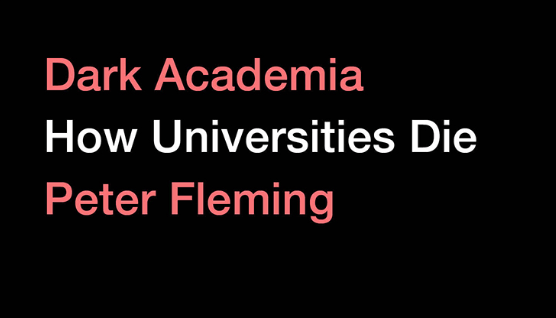
The book Dark Academia by Peter Fleming (Pluto Press) highlights not only how broken the neoliberal higher education model is, but also shines a light on how the impacts go beyond campus boundaries
It’s not often that an article or book review thumps me in the stomach (metaphorically) because it’s something that I have lived through or observed with others, but the summary in the above-link came up with a superb top-ten highlights. Just a shame that whoever wrote it is anonymous! It states:
1.The University is a “Zombie Institution”: It walks and talks like a place of learning, but its core has been consumed by corporate managerialism, leaving a hollow shell that mimics its former self.
This has been a constant criticism ever since I moved down to the south coast back in 1999 to begin life as an undergraduate. (That I so rarely mention the name of my old university in blogpost speaks volumes. I can carry grudges from my formative years like an elephant: I never forget!!!) My uni cohort was the second year of up-front fees – I took a year out before going to uni working in a back office for a big bank – which announced the closure of the office the day before my final day. (I missed out on a £3,000 redundancy payment!)
2. “Toxic Professionalism” is the Prevailing Culture: A performative ethos of overwork, competitiveness, and feigned passion masks a system of exploitation, creating an environment where burnout is the norm, not the exception.
That ethos of visible overwork – presenteeism if you will, is something that has also been critiqued in neurodiversity/ADHD circles. Live to work vs work to live? Burnout should not be the norm. Where burnout is the norm, that is a team/institution that is not performing to its potential because the staff are not getting the support they need to reach their potential.
3. Your Value is Reduced to Metricized Output: Your worth as an academic is not your teaching or intellectual contribution, but your ability to generate measurable “products”—publications, grants, and citations.
The price of everything, the value of nothing. The problem is that in a culture where everything is quantified and where the research on many subjects can be abstract even at the best of times, how do you ‘measure value’? Especially in a world where history tells us that so many major discoveries or leaps forward come almost by accident. The two well-known examples are Alexander Fleming and the discovery of Penicillin, and the discovery of the branded anti-impotence drug that was originally a research programme trying to find a drug that increased blood supply to the heart rather than to any other organs.
4. The “Publish or Perish” Imperative is Structurally Sadistic: The system is designed to create a permanent state of anxiety and job insecurity, especially for early-career researchers, forcing them into a cycle of endless production.
It reminds me of primary school where the more words you wrote, the better the piece of work was meant to be. Furthermore that permanent state of anxiety and job insecurity is not a pleasant place to be in. It plays havoc with your mental health. In academia where at a post graduate level many early career researchers are not living in their home towns, that insecurity combined with insecure accommodation compounds that impact.
5. Administration is the New Core Activity: The real growth in universities is in managerial and administrative roles, which impose auditing and compliance regimes that strangle actual teaching and research.
Where do these roles come from? Where do the requirements for audit and compliance come from? Is the expenditure on managerial functions proportionate to the benefit derived from them?
6. The “Impact” Agenda is Often a Farce: The pressure to demonstrate the societal “impact” of research often leads to contrived, box-ticking exercises that distort genuine intellectual inquiry.
This has become more prominent over the past decade or so as more universities have founded new public policy-facing institutes – which in itself is a positive move. The problem is that the over-centralisation of the UK means that there is a massive incentive for higher education institutions to target central government policy-making functions, rather than diverting at least some of that public policy research capacity towards local and regional issues. While the not-so-new government is supposedly strengthening local and regional government, in reality so long as HM Treasury holds such a tight grip of tax-raising powers (as Prof John Denham, the former Communities & Local Government Secretary states here), local and regional government will remain little more than delivery agents for central government. Public policy institutions in higher education will discover this and stay focused on Westminster and Whitehall.
7. Precarity is a Feature, Not a Bug: The reliance on a vast, underpaid army of adjuncts and fixed-term contract researchers is essential to the business model, ensuring a disposable workforce with little power or job security.
This has a massive impact on those universities that have a large presence in the cities they are located in – such as Cambridge. Moving from permanent contracts to shorter term fixed term contracts where the only jobs in a similar field are often in other cities or countries means it’s much harder to put down local roots. Family life is disrupted as children have to move with parents, and this makes it much harder for primary schools in particular to plan ahead. In Cambridge the result is early year groups are over-subscribed, while older year groups find themselves with gaps. Every unfilled place means central government cuts the funding. Which has a knock on impact for the rest of the children in the school.
8. Cynicism is the Collective Coping Mechanism: Most academics are privately cynical about the system’s demands, but this cynicism is passive. It allows the game to continue because everyone is too afraid to stop playing.
Which is also one of the reasons why it’s ever so important to have an independent community of bloggers / newsletters that make it easier for concerns to be raised outside of the top-down control of institutions. (What would a localised version of Private Eye be like for Cambridge?)
9. The “Brand” is Everything: The university’s primary concern is its market brand and position in league tables. Education and research are merely marketing tools to attract customers (students) and investment.
We saw one recent textbook example of this in Sheffield.That’s not the fault of the researchers or the students from the country/ies concerned. The moment ministers enabled universities to charge international students vastly higher fees compared to UK-based students, the incentive for institutions to recruit the former over the latter was created. Not surprisingly as central grants dried up, it created a dependency culture with the inevitable results.
10. Escape is a Legitimate and Often Sanity-Saving Choice: Fleming legitimizes the desire to leave academia. Recognizing that the system is dysfunctional, rather than internalizing its failure as your own, is the first step toward liberation and a healthier professional life.
That also applies to so many other areas of life – not just academia. The work place, voluntary and charity work, even the system of housing that the majority of people struggle with.
“Who needs to do what to change things?”
Where do you start?
That in part what makes this such a challenging problem: public policy by its nature is very complex. When Ron Dearing made his first proposal for fees, and when the Browne Review commissioned by Gordon Brown’s dying government reported back just after the 2010 general election as planned, they either did not anticipate the wider fallout, or they did not care – in that they ruled it out of scope.
“I remember Peter Mandelson coming to me before the 2010 general election, he was the [Labour] deputy prime minister, and saying “we want to put up student fees, tuition fees, but we can’t do that before an election, its too difficult for Labour, why don’t we set up a report, and while you as Conservatives hopefully want to see the tuition fees go up so that the universities are better funded, why don’t you sign up to this commission and it can report after the election?”“
Above – George Osborne to Ed Balls in Political Currency 11 Sept 2023 quoted in The Conversation
This is corroborated by the minuscule budget allocated for research – £120,000. For a major policy review affecting hundreds of thousands of people potentially over decades, and what is still one of the UK’s major economic sectors, is little short of scandalous. Yet so enfeebled was Parliament that no one called them out on it. Not to the extent that the public noticed anyway.
The whole thing very nearly got blown out of the water when the Liberal Democrats led by Nick Clegg made a promise to scrap tuition fees, safe in the knowledge that they would not be elected to form a majority government, and assuming that a pro-EU party would want to have nothing to do with either a EU-sceptic Conservative Party or a Labour Parliamentary Party that had been clobbered by the MPs’ expenses scandal. But then the electorate returned a hung parliament and the rest is history.
For academia to break out of this malaise requires the sort of social revolution of the scale that the Thatcher Government achieved when she managed to break the post-war consensus of a mixed economy, large trade unions, and directly-provided public services free at the point of use and funded through general taxation.
My take is that ultimately the climate emergency will force the planet to break from the economic paradigm of the past four decades or so. How difficult it will be to move to a new steady state depends on how much gross inequalities that societies can cope with. When I look at the criticism being thrown by media talking heads towards Zack Polanski and The Greens – much of it failing to engage with the policy substance, very little of it resonates. It’s hard to criticise others for failed politics/economics when for the past 15 years your own politics/economics has very visibly failed.
This is a lesson that some within pro-EU circles picked up on very quickly after the EU Referendum. Those that benefited started taking those benefits for granted, and when the EU came in for criticism irrespective of truth, few stood up for it. In a world of multinational corporations, disinformation, and global tech giants not on the side of democracy and the rule of law, this is the very moment where we need democratic and civic society institutions to be strong. As far as the UK is concerned, after 15 years of austerity and 45 years of outsourcing, contracting out, council house sales, and short term contracts, it sometimes feels like civic society institutions are weaker than they have ever been. Think global, start local?
Talking of which:
A quick reminder for the two free public workshops in Cambridge that I’m running which are coming up soon
- Sat 15 Nov 2025, 11am-1pm. Rock Road Library, Cambridge
- Sat 22 Nov 2025, 11am-1pm, Cherry Hinton Library and Hub, Cambridge
Click on the links above to sign up. (It helps with working out things like chairs and materials needed)
If you are interested in the longer term future of Cambridge, and on what happens at the local democracy meetings where decisions are made, feel free to:
- Follow me on BSky
- Spot me on LinkedIn
- Like my Facebook page
- Consider a small donation to help fund my continued research and reporting on local democracy in and around Cambridge

 The Cambridge Town Owl