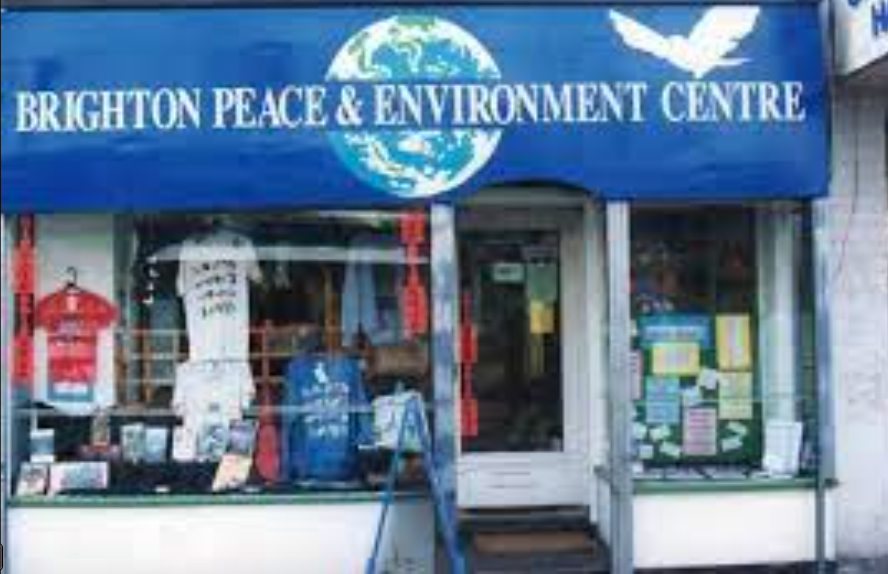
With so many empty shop units on high streets, you’d have thought that these spaces would be ripe for vibrant and colourful social movements to find homes in
Pictured: the old Brighton Peace and Environment Centre on Gardner Street by Stephen Drenan here.
This piece bounces of an article in New Internationalist by Rosie Hampton here on physical spaces for people and groups to organise in. Or perhaps rather exist in, live in, and thrive in.
“If you needed somewhere to meet for left-wing political organizing in 1980s Glasgow, you wouldn’t have been short of options. Walking down Miller Street in the city centre, you could brave the ‘1,000 stairs’ up to the meeting rooms of the Glasgow Women’s Centre, where you could get advice about welfare or housing benefits. Or you could visit one of the city’s six unemployed workers’ centres, where you’d find trade union resources, even if you weren’t working.”
Above – Hampton (2025)
Cambridge used to have such spaces in and around The Kite.
- The Andrew Murden Centre for Unemployed and Unwaged Citizens
- The TGWU premises on Burleigh Street
- The Grapevine Bookshop

Above – by Simon Knott, which he tells us was taken in 1982 during the redevelopment and construction of the first phase of The Grafton Centre in Cambridge (and note the bus stop outside it on the long-since pedestrianised street).

Above – via Simon Knott by Roy Hammans back in August 1982.
In the case of The Kite, there was also a newsletter produced, which i managed to buy and digitise some copies dating back to the late 1970s
- Grapevine No 07 – Nov-Dec 1978
- Grapevine No 10 – May-June 1979
- Grapevine No 11 – Jul-Aug 1979
- Grapevine No 12 – Nov-Dec 1979
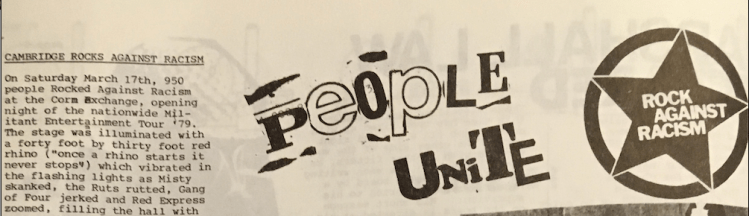

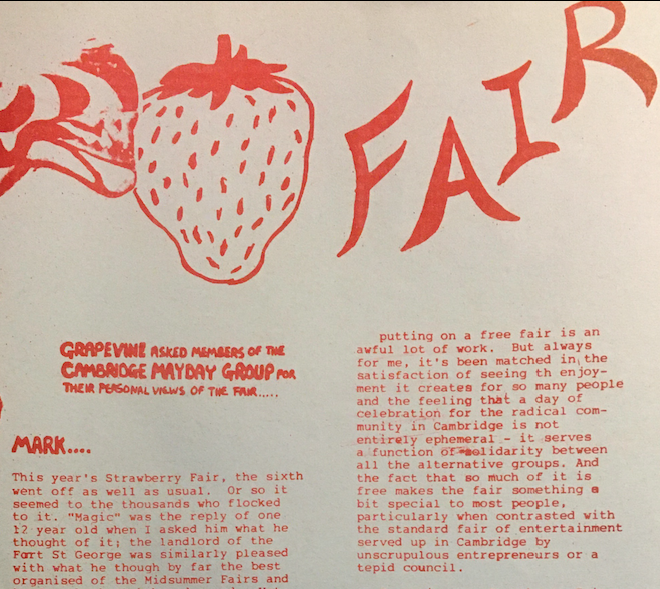


Above – various images from the Grapevine zines
In Cambridge’s case we are familiar with what happened: The comprehensive redevelopment of the site led to the construction of the Grafton Centre which surprisingly lasted for less than 40 years before work began on converting it into a sci-tech bubble venue. The story of the Conservative Councillor who effectively drove through the redevelopment that led to the implosion of his once mighty local party was told by the late Colin Rosenstiel here.
Since then, Cambridge has never really had the critical mass of people, independent shops, and social movements concentrated in a small geographical area. Mill Road has hints of what once was, but the combination of gentrification and London house prices did what the same forces did to North Laine in Brighton – although they were more successful in stopping the comprehensive redevelopment that crushed The Kite.
Rosie Hampton continues:
“There is something worth mourning about the absence of permanent, dedicated premises for organizing. There was absolutely conflict and disagreement; no history of left-wing organizing is complete without those stories. But the chance to navigate this in person, in spaces built collectively, meant generating new ideas and new ways of doing things. The disappearance of the spaces has made it harder for these diverse – and even sometimes contradictory – ways in which people are engaged in left-wing politics and day-to-day organizing to flourish.”
The old Brighton radical movements from the 20th Century
Have a browse through this FB group where I’ve done a street search for Gardner Street – where the old Brighton Peace and Environment Centre was. It was next door to the brilliant Komedia which is still one of the beating hearts of the area – with the organic vegetarian and vegan co-op Infinity Foods on the corner.
Basically if you’ve not been there, go down there this coming summer and spend a few days by the seaside too.
What made those days function as a radical space in the early 2000s were the very cheap rents combined with the imagination of the people in the neighbourhood to turn it into something wonderful.
There’s something very different about having a permanent space vs having to rent out spaces – most of which have been revamped for the purpose. One of the closest spaces you’ll get to the feel of those days 25 or so years ago in Brighton is at Cambridge Community Kitchen. The culture, the values, even the artwork are very similar to what was kicking off on the south coast.
Brighton’s own radical zine – Schnews
You can browse through their back catalogue 1994-2014 here. Furthermore, the culture that I found myself in (having never settled into cliquey student circles so had to figure my own lonely way through those years) was one that was fiercely autonomous by disposition – so much so that they produced this riposte of a pamphlet in response to the Socialist Workers Party trying to take over the then high profile anti-globalisation and pro-environmentalist movement. It still reads well today and may be familiar to those of you seeing the same quarrels taking place in radical political circles today. (FWIW the establishment of Your Party by Corbyn and Sultana along with the independent group of MPs probably did The Green Party a favour by drawing away most of the established far-left activists who might otherwise have tried to rein in the newly-elected Zack Polanski who in the space of about six weeks doubled the Green Party’s membership to a level not seen in their history – breaching the six figure mark with it standing at over 150,000).
That aside, the problem remains that there isn’t an equivalent of North Laine in Cambridge
I sort of hoped back in 2021 that one would emerge post-lockdown but in the grand scheme of things, such is the state of the land and property market that there are no benevolent property owners who would be willing to do what the Howard de Walden Estate did with Marylebone High Street and deliberately charge artificially low rents for small independent outlets while at the same time refusing to let out their premises to big brands and their franchises. Which means that the wealth generated effectively gets reinvested back into the community.
Back to Rosie Hampton again
Skipping the bit about left wing organising online (in this article I’m interested in physical spaces), I scrolled to the end on the ‘Reclaim the City’.
“If we are not able to come together in women’s centres, gay centres, unemployed workers’ centres, it is imperative that we find new avenues through which to build and reinforce relationships and trust. This must also be rooted in a politics of community, like that of Reclaim the City, so that the vision and politics we practice make a positive difference to people’s lives, today.”
The tension that inevitably exists is that most politicians from the centre leftwards would have found early 2000s Brighton to be a pleasant place to be – and they would have thoroughly enjoyed the Brighton Festival with its riot of colour, noise, and energy. Some of them might even have asked what policies they needed to enable something like this to emerge in their town/city.
One of the things that emerged from that tension – mindful it was under a Labour Government throughout the 2000s, was the slow but steady growth of The Brighton and Hove Green Party. For reasons which could be the subject of a Ph.D thesis, the centralised structures and policies of the Blair & Brown governments were not enough to deal with the poverty and inequalities across the Millennium City (It got city status in the Year 2000 with the lovely strapline: All Things Brighton Beautiful). When the incumbent Labour MP David Lepper for Brighton Pavilion stood down in 2010, his replacement candidate was not able to hold onto the seat which Caroline Lucas won for The Greens – one the party has held onto ever since.
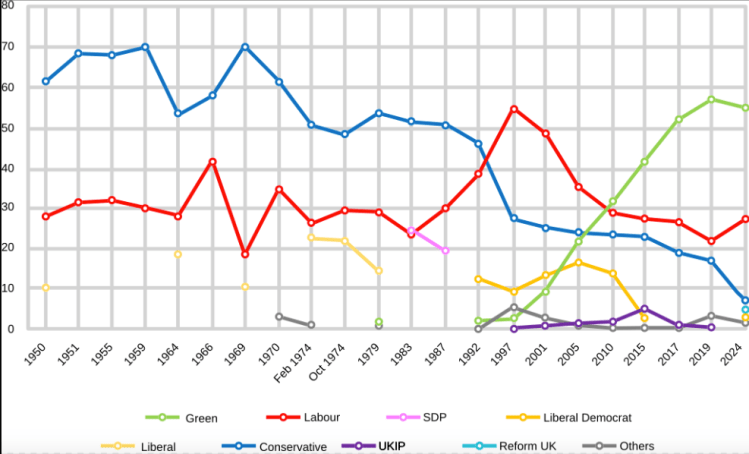
Above – the changes in the electoral fortunes in Brighton Pavilion, which in my lifetime has gone from being a safe Tory seat, to a safe Labour seat, and now a safe Green seat.
What’s stopping people from taking over the empty physical spaces?
The succession of laws past that made squatting properties much harder, combined with robust enforcement and evictions. Amongst other things. The costs of energy alone are prohibitive. Combine those with wider costs of living and costs of borrowing/lack of grants available, who in this age would take on the risk of setting up a new business in a neighbourhood full of empty shop units?
I don’t know what the answers are
What I do know from personal experience is that the lack of those physical spaces for people to be in without having to pay for something or buy something as per privately-owned mall-type public spaces, is one of the main drivers of loneliness in society. I was really hoping that Together Culture Cambridge would have provided both the model and the spark to change this but even they were unable to make ends meet with their original model. Hence waiting for news of what they want to do next – see their events list here for their face-to-face meetups.
…and neither do the top two political parties it seems… …well, according to Ken Clarke on Question Time earlier!
The former Cabinet Minister (who is somehow still alive) was plonked in the Tory chair. That in itself spoke volumes about the state of the official opposition who out of all of their current MPs could not find anyone either willing enough or suitable to take their weekly place. And yet the former Chancellor under John Major (Also ex Home Secretary, Justice Secretary, and Education Secretary…) said that this was the first time in living history that both the Labour and Conservative parties were unpopular with the public because of their records in government. He also noted that Labour’s hope was that they could take all of the unpopular decisions now in the hope that things would improve sufficiently so as not to lose the next general election. But these are not normal times. The debate they had on gamed social media platforms later in the show demonstrated that – along with the cluelessness of the political class on how to deal with what is an existential threat to social wellbeing.
Which brings us back to the importance of physical spaces where mis/disinformation can be challenged face-to-face. And robustly with the emotional force that you don’t get in an online exchange.
Much as I’d like to see some of the new communities creating the new radical physical spaces, the land and property ownership structures we have means that it’s unlikely to happen anytime soon.
Food for thought?
A quick reminder for the two free public workshops in Cambridge that I’m running which are coming up soon
- Sat 15 Nov 2025, 11am-1pm. Rock Road Library, Cambridge
- Sat 22 Nov 2025, 11am-1pm, Cherry Hinton Library and Hub, Cambridge
Click on the links above to sign up. (It helps with working out things like chairs and materials needed)
If you are interested in the longer term future of Cambridge, and on what happens at the local democracy meetings where decisions are made, feel free to:
- Follow me on BSky
- Spot me on LinkedIn
- Like my Facebook page
- Consider a small donation to help fund my continued research and reporting on local democracy in and around Cambridge

 The Cambridge Town Owl