
I can’t find a copy of the strategy itself (although it was launched earlier today) but there are a few pitfalls to avoid – and one big elephant in the room that those with the greater wealth and influence could address
TL/DR? Bring back Activate Cambridge – get in touch with Hilary Cox Condron who got this going last time here in Coleridge Ward and elsewhere, and commission her for this.
(The importance of contemporary history and corporate/collective memory)
You can see the news article in BusinessWeekly here
I’m not going to tear it to bits – not just because I know some of the people involved, but also because any sort of regeneration is fiendishly complex with no ‘one size fits all’ model. Which is also why it’s ever so important that those behind the strategy start thinking about evaluation and what success looks like.
WIth the above in mind, have a look at Abbey People’s strategy for 2025-30 here. Like Arbury and King’s Hedges north of the river, Abbey ward south of the river in the east of our city is also one of the most economically-deprived in the whole of Cambridgeshire. To get an idea of how unequal our city is, look at the average life expectancy for women. (which I featured in this blogpost on inequalities in Cambridgeshire here)


Above – from the live dashboard link on p2 here
The differences between the predominantly ‘gown’ wards of Newnham and Castle in west Cambridge vs the wards on the northern and eastern edges (Arbury, King’s Hedges, East Chesterton, and Abbey wards) are striking.
What the people of Abbey ward want to see by 2030
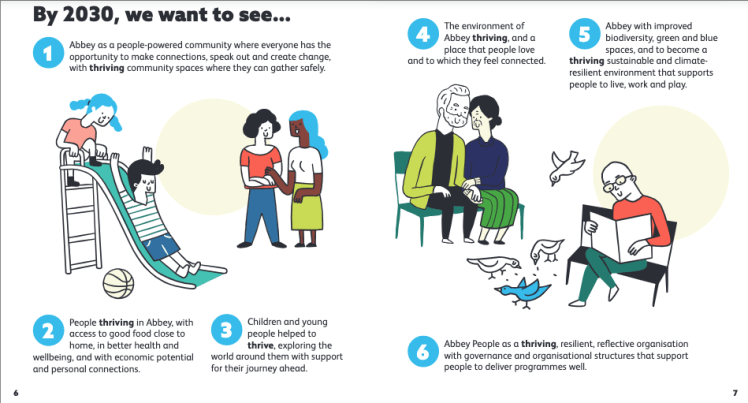
Above – Abbey People Strategy 2025-30, p6
It would be interesting to see what the people of Arbury and King’s Hedges would like to see for North Cambridge by 2030. Which is also why it’s very important that as many residents as possible respond to the city council’s consultation on the North Cambridge Framework for Change. (Cambridge 2030 partners may want to have a look at this if they have not already seen it).
“Our strategic approach is designed to be collaborative and will engage and involve the community in developing and owning initiatives and solutions. We will continue to listen, learn and collaborate and, initially, seek to address needs already identified as:
- therapeutic support for children, young people and their families;
- bespoke work experience, mentoring, skills development, role models, careers guidance and employment opportunities;
- increased enrichment opportunities in the form of trips, excursions and clubs that build cultural capital.
Above – Jonathan Martin, CEO of YMCA in BusinessWeekly, 17 Nov 2025
On the first point above, note the controversial statements that are coming from TeamNigel on neurodiversity – something that those involved will need to be prepared for should locals raise what they’ve seen in the media in response to such provision.
With the bespoke provision mentioned in the second point, one risk to be aware of is that residents in smaller social and council housing estates will ask (understandably) why their children won’t be eligible. This came up a few years ago at a Queen Edith’s event when one local resident asked me why so many things were being put on at The Meadows Centre in Arbury that her children could not get to, but nothing was being done in Queen Edith’s ward. (Queen Edith’s is generally an affluent ward but it has a small post-war council estate at its heart that easily slips through the official statistics.) With that in mind, is what Cambridge 2030 proposes something that can be extended to cover the wider city?
Bring back Activate Cambridge
Re “increased enrichment opportunities in the form of trips, excursions and clubs that build cultural capital” ***Please do not try and reinvent the wheel that is already there!***
Here’s Activate Cambridge from the late 2010s

Above – Activate Cambridge – have a browse of their archived website.
“ACTIVATE is delivered in collaboration with Cambridge Junction, Menagerie Theatre, The University of Cambridge Museums and NIE Theatre.
ACTIVATE is a My Cambridge project initiated and funded through the Cambridge City Council Sharing Prosperity Fund.”
Above – Cambridge Creative Partnerships 22 Jan 2019
That should inform the planning of whatever Cambridge 2030 comes up with. (Could they appeal to those children who took part in the original Activate Cambridge programme to see if they are still around and find out what impact it made?)
Building new splendid facilities in walking distance from where the families live.
One of the most expensive private schools in Cambridge, The Leys, has a splendid bespoke theatre in its grounds. It also hosts public events including new comedy nights. No complaints there – good luck to them. Especially in these dark times, we all could do with some comedic relief.
The problem is that so many of our venues are too far away from residential areas in north Cambridge. That was one of the big urban design failures of the 1960s – and residents told them about it at the time.

“They have no facilities for social recreation. It seems that the council’s chief officers feel that because there are two schools in the area – which provide evening centre activities – this is enough”
Above – Cllr Ann Tweed (Lab – W Chesterton, in the Cambridge News, 25 March 1965) in LostCambridge 27/03/2021
So by intervening in Arbury and King’s Hedges, Cambridge 2030 is taking on a challenge that has *really deep roots* – one that charity alone will not alleviate.
Build a new municipal swimming pool for King’s Hedges
I first made the case for this in this blogpost, noting that small grey plot of land at the junction of the busway and Milton Road is currently a motor garage.

Above – detail of the map of the North East Cambridge Area Action Plan.
The abandoning of the Hartree plan and the ditched relocation of the water works means funding cannot come from the new housing there.
The following year I asked Cambridge Science Park executives about making more of a difference for residents of King’s Hedges.
“The Director of Cambridge Science Park Ltd, Jane Hutchins, said it was “not right” that for all the wealth being generated by firms on the science park, King’s Hedges ward remains one of the most economically deprived parts of Cambridge and Cambridgeshire – in a city that is the most unequal in the country.”
Above – on Jane Hutchins’ comments at Open Cambridge 2023
In the case of King’s Hedges, there are enough sites that landowners could make both available and accessible to residents in North Cambridge. If we re-orient the map of North Cambridge we can see geographically just how close places like the Cambridge Science Park are to residential areas.
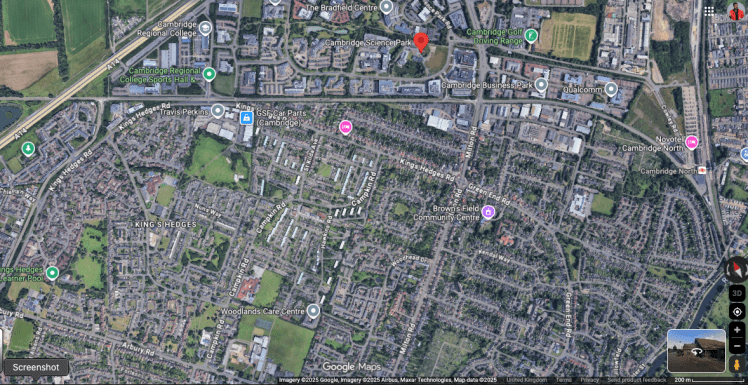
Above – King’s Hedges south of the busway, & Cambridge Science Park to the north. GMaps
It should not be beyond the talents of the planning and transport professionals in the private sector in/around Cambridge to figure out the most accessible and most effective solutions to connect the sites north of the busway with the residential areas to the south, and then to work with residents to come up with ideas for shared leisure and amenities that people would choose to use. And share.
To paraphrase the words of Gustavo Petro, Mayor of Bogota and later President of Colombia, Cambridge will only be a great city when it has a world class accessible and affordable public transport system that the affluent choose to use instead of driving a car.
Which is why I continue to support Connect Cambridge’s light rail proposals
Food for thought?
Want to talk more about the future of Cambridge? The next Future of Cambridge workshop I’m running is on Sat 22 Nov from 11am at Cherry Hinton Library. Sign up here – it’s free.
If you are interested in the longer term future of Cambridge, and on what happens at the local democracy meetings where decisions are made, feel free to:
- Follow me on BSky
- Spot me on LinkedIn
- Like my Facebook page
- Consider a small donation to help fund my continued research and reporting on local democracy in and around Cambridge

 The Cambridge Town Owl