In a written statement to Parliament, the Housing Secretary made an announcement that will have huge implications for rural stations east of Cambridge
You can read the Secretary of State’s statement here, and the joint press release with The Chancellor here.
Want to talk about this in person? Sign up to my next Future of Cambridge Workshop in Cherry Hinton Library and Hub on Sat 22 Nov 2025 from 11am – it’s free.
For me, this means two things.
- The rural land around the stations of Kennett and Dullingham will see major housing development – possibly becoming new towns under the auspices of the Cambridge Growth Company
- East Cambridgeshire District Council Conservatives will find their local plan needs a major overhaul
***Which is splendid!*** (if you are not a Conservative as East Cambridgeshire District). The council has, with the exception of the 1999 elections has been a Conservative/Independent district for most of its 50 year existence. In one sense, Labour have a huge party political incentive to get new towns linked to Cambridge’s overheating sci-tech bubble built in otherwise safe Conservative seats. The experience of South Cambridgeshire District Council over the past decade has shown what happens when the Conservatives nationally lurch to the extreme right. They got absolutely crushed in 2018 (which surprised everyone including me) and surprised everyone again in the face of busway/GCP protests by losing even more seats even though they had lost representation on the GCP Board, and had turned against the busways they had once championed.
The Cambridge Biomedical Campus has already circled Kennett and Dullingham villages for housing
The CBC’s housing study by Lichfield’s in 2024 highlighted their rail catchment area. below.
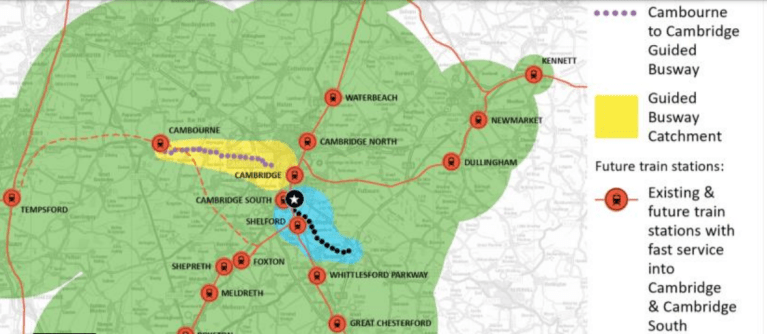
Above – CBC (2024) p27
Both Dullingham and Kennett – which are in Cambridgeshire (while Newmarket remains in Suffolk – long awkward story dating back to the 1880s) are surrounded by fields. I can picture the developers pondering the site already.
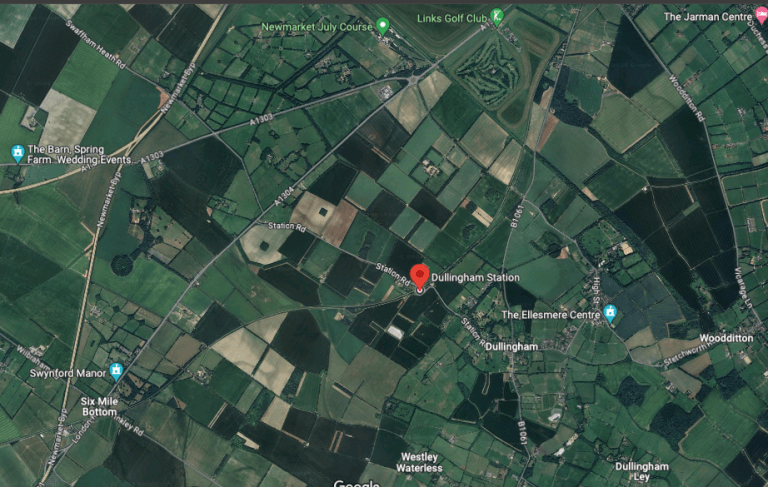
Above – Dullingham Station surrounded by lots of green fields. Or ‘Industrial Agriculture’ if you look at some of the biodiversity stats
Back in March 2024 I noted that this was an ideal location for a new town if Michael Gove – then the Levelling Up Secretary, wanted to deliver medium term housing growth for Cambridge’s overheating housing market. This was after Mr Gove said his ambition was for Cambridge to grow to 250,000 homes (from a starting point of just over 60,000 homes. He never did define the geographical boundaries for his proposals for Cambridge – and the present government hasn’t either).

Above: “What shade of grey do you think we should use in the concrete to replace all that horrible green stuff that makes no money for our shareholders and owners in land value uplift?”
Cynical? Moi?!?
If ministers want to build homes at Dullingham and Kennett, they need to get the Department for Transport to upgrade the railway line between Cambridge and Bury St Edmunds
Rail Future East (which meets in Cambridge on 06 December 2025 – do go along!) has been tracking this (no pun intended!) for years.

Above – from Rail Future East and the proposed Cambridge East railway station somewhere between Cherry Hinton and Fulbourn.
Note also that proposals remain for re-opening the village station stops at Cherry Hinton and Fulbourn – and both of these are within the Cambridge Connect proposals too.
East Cambridgeshire Conservatives really won’t like this
The problem they face on this front is that Michael Gove’s proposals would have resulted in something very similar. Hence the strange situation in the 2024 general election with the Conservative Party’s candidates in Cambridgeshire calling for a different set of policies (very limited growth) to what their own Secretary of State (who subsequently did not stand for re-election) spent the past couple of years promoting.
“What does their existing local plan say?”
Kennett: “Kennett is likely to continue to grow at a slow rate, with new housing being built on suitable ‘infill’ sites within the village. No new housing allocation sites are proposed on the edge of Kennett. A ‘development envelope’ has been drawn around Kennett to define the built-up part of the village where infill development may be permitted. The purpose is to prevent sprawl into the open countryside.” (ECDC Local Plan p206/7)
Dullingham: “Dullingham is likely to continue to grow at a slow rate, with new housing being built on suitable ‘infill’ sites within the village. No new housing allocation sites are proposed on the edge of Dullingham.” (ECDC Local Plan p152/3)
The options ministers have include inviting/directing East Cambridgeshire District Council to ‘refresh’ their local plan, or simply allocate the sites to the Cambridge Growth Company development corporation and incorporate the southern half of East Cambridgeshire District into the new Greater Cambridge Unitary Council. Which is a possibility.
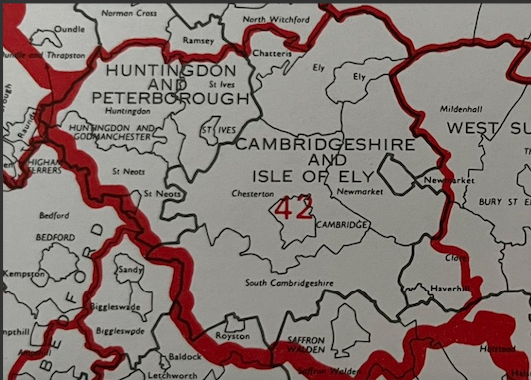
Above – Redcliffe Maud’s report proposals in 1969 (The Royal Commission on Local Government in England 1966-69) recommended incorporating East Cambridgeshire District and parts of Huntingdonshire District into a Greater Cambridge Unitary. (Plus the towns of Newmarket, Saffron Walden, Royston, and Haverhill!)
Land value uplift tax
The Chancellor of the Exchequer really needs to get land value uplift levies into law in the upcoming Budget Speech (which is also the Second Reading of the annual Finance Bill) so as to ensure the paper land price rise is captured by the state to spend on the inevitable infrastructure requirements rather than as at present letting rich land owners and developers run off with the gains, leaving communities ripped off.
“How big might the settlements be?”
It depends on how big the land allocation for new housing is. A 1mile radius aroudn Dullingham Station looks like as below.
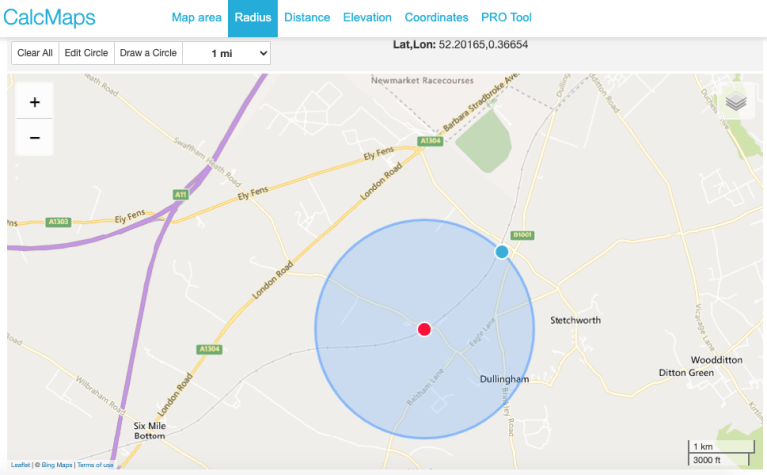
Above – a 1 mile radius from the existing Dullingham station from CalcMaps
When you look at the average densities of housing in 2021/22, in Cambridge the number is over 30 per hectare, which is medium density. If we account for green space and amenities, then we might be looking at 20 per hectare. Multiply that by the number of hectares in a 1 mile radius and you end up with around 815 Hectares. Multiply 20×815 and you get 16,300 homes. Which is a town of around 25,000 people. Which is like building another Haverhill. Or two in this case!
“Where’s the water going to come from?”
Good question. The Government’s announcement did not mention the environmental limits to growth. It’s beyond time that they addressed environmental and ecological challenges much more seriously.
“Also, what’s the flood risk?”
That doesn’t look too risky from the Cambridgeshire Insight map, but given the floods at Monmouth earlier, there are a host of urban drainage features that need to be designed in at the start. Furthermore, creating a network of holding ponds and lakes will need to become part of the flood control strategy given the increased occurences of very heavy downpours that already overwhelm sewage systems.
“Does the construction industry have the capacity to build all of these homes on top of the existing allocations?”
Hell…no.
And given the rise in materials costs and labour costs – combined with the chronic skills shortages, simply allocating the land for development won’t automatically make the new homes appear. Ministers will need to make much more radical interventions in the labour market to deal with those shortages. Given the mess they are making of immigration policy, that doesn’t look like it’ll happen anytime soon.
Food for thought?
Want to talk more about the future of Cambridge? The next Future of Cambridge workshop I’m running is on Sat 22 Nov from 11am at Cherry Hinton Library. Sign up here – it’s free.
If you are interested in the longer term future of Cambridge, and on what happens at the local democracy meetings where decisions are made, feel free to:
- Follow me on BSky
- Spot me on LinkedIn
- Like my Facebook page
- Consider a small donation to help fund my continued research and reporting on local democracy in and around Cambridge

 The Cambridge Town Owl