Cambridge’s rapid expansion is a political response to multiple crises.
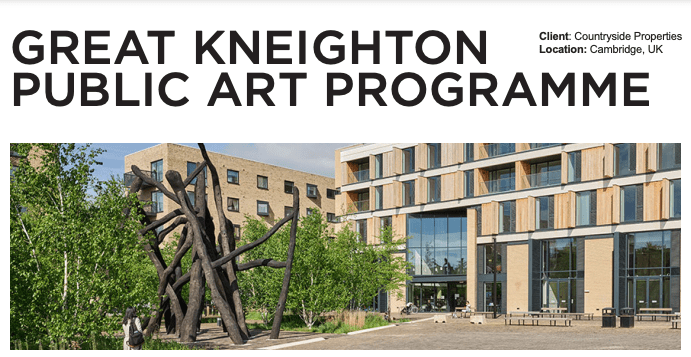
Image: Great Kneighton boxy buildings with expensive abstract sculpture plonked in front of it. Can we avoid repeating this too?
What the city and surrounding districts are going through is the opposite of what Holford & Wright proposed for our city back in 1950, which was to limit the growth of the city and its population to around 100,000 people until the end of the century. Back then, the emphasis was on preserving what those with power and influence liked about Cambridge – a beautiful, manageable university town unspoilt by heavy smoke-belching industry. Yet the smog-stained walls of 19th to early 20th Century housing points to a past where every house had a fireplace in every room. I’m sitting in front of one now as I type this.
I was going to write that Cambridge City Council has some important meetings coming up in the next two weeks. But let’s face it, it’s the equivalent of going down a log flume at high speed while being asked whether you want to go right or left. You can’t. You just keep on going forward. My point is that if the councillors refused to vote on the motions coming up, there are automatic central government and legal triggers that will make the decisions for them without their input. I’m talking about the preferences for new unitary council boundaries along with the consultation of the emerging local plan documents.
A city in crisis
It’s not one that requires an urgent and immediate response by a mobilised population such as the one we experienced with lockdown. This is different – not least because it does not require the vast majority of the population to stay indoors and carry out social distancing. Ours is a crisis that requires major overhauls of our institutions because they have become so enfeebled they are not able to respond to the multiple demands placed upon them. The fact that:
- The Minister for Housing and Planning is going to impose a centrally-managed development corporation on Greater Cambridge, and
- The announced abolition of the Office of Police & Crime Commissioner for Cambridgeshire & Peterborough…
- The pumping of raw sewage into the River Cam by Anglian Water…
…are all symptoms of this. As is our city’s major hospital’s inability to respond to all of its corporate red risks within its own powers and resources allocated by ministers.
What we build has got to be visually different to the architectural styles that we see in and around the city today
I’m not going to go into detail about how ‘orrible modern Cambridge sci-tech vernacular is. Just thinking about it often drives me into an instant ADHD-triggered rage.
Instead, I’m going to take inspiration from an organisation I was part of during my London days – the Mary Ward Centre in Holborn. I was for a short while part of their string orchestra – one of two viola players. I couldn’t understand why Cambridge didn’t have anything like it and I still don’t understand today. Other than the enfeebled institutions who ministers won’t empower.
The Mary Ward Centre was an articulate idealistic response to the inner city crises of the late 1800s
Mary Ward “…had an enduring impact on public education through the pioneering work she initiated. Her aim was to promote equalisation in society and the building was soon crammed with local residents enjoying the pleasures and opportunities that had previously only been enjoyed by the rich.”
Above – Mary Ward Centre History
Would this be a useful thing to have in one of the most unequal cities in the UK?
For me there’s a difference between wanting to make available to the many the opportunities mainly held by the wealthy, and trying to make working class people middle class. I can’t recall on which TV programme I heard it on but someone said that the mistake middle class people make is that they think working class people aspire to be like them. Whereas working class people would rather be very rich than middle class! How much truth there is in that? You’d have to ask someone else who has read a book on/by Marx.
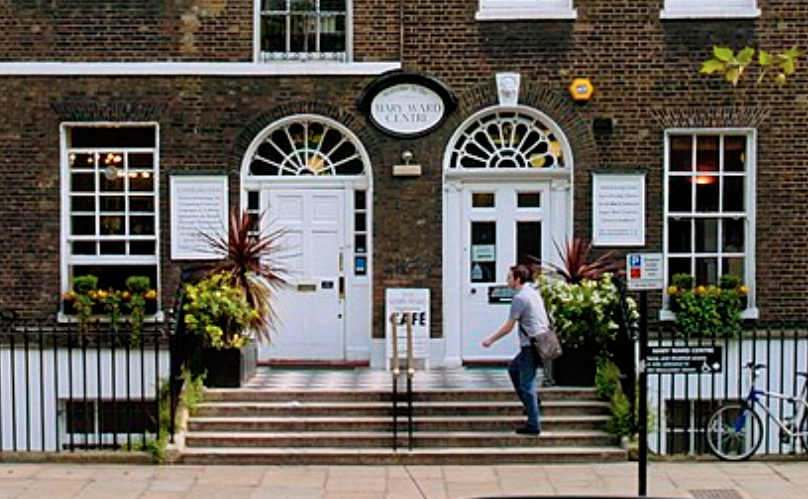
Above – the Mary Ward Centre in Queen Square, London WC1N the doors of which I used to walk through and which had a warren of corridors to get to the various rooms
“The house acted as a magnet for ordinary people who not only came to pursue intellectual interest and learn practical skills but to be part of a social and community network that included interest groups such as:
- music,
- debating,
- chess societies,
- self-help groups.
“A poor man’s lawyer service, retraining facilities for the unemployed and domestic economy classes for wives were also included in the programme.
“Concerts and music were an important part of the House reflecting Mary Ward’s belief in the value of knowledge and experience for its own sake. Gustav von Hoist was Musical Director for a time and George Bernard Shaw, Sidney Webb and Keir Hardie were amongst those who gave lectures.”
Above – Mary Ward Centre, further reading
Remember that loneliness epidemic that’s hitting the planet? Even the World Health Organisation is writing about it. And for all the platitudes we hear in society, the institutions that can do the best to combat it indirectly are the ones that bear the brunt of the cuts. Such as libraries. And arts programmes like this one we lost in Cambridge recently. The same goes for children’s services. Which is why it was a relief to hear Green Party leader Zack Polanski challenging Labour Ministers to take the really tough decisions to go after accumulated excess wealth rather than earned income. In the meantime we’re told that the investment into Cambridge such as in this press release from Cambridge University’s Enterprise section last month is somehow good for the city. If it is, I’m not feeling it, and nor are enough of those around me.
Furthermore, when I look around at the street scenes and the traffic jams, I’m not seeing the benefits of all of this private investment. I’m seeing and feeling more of the opposite. As are a growing number of residents judging by the growth of votes for both The Greens and TeamNigel, the former having won 25% of the county council seats in Cambridge city divisions.
With the announcement of the new Cambridge East Station being confirmed by the Transport Secretary earlier, is there any chance we can start working on a new civic square anchored by civic buildings as I described on BBC Radio Cambridgeshire earlier this morning? (See here, scroll to 1h37m45s)
Let’s not let Brookgate ruin another station square like they have with the main railway station and with Cambridge North.
If you are interested in the longer term future of Cambridge, and on what happens at the local democracy meetings where decisions are made, feel free to:
- Follow me on BSky
- Spot me on LinkedIn
- Like my Facebook page
- Consider a small donation to help fund my continued research and reporting on local democracy in and around Cambridge.
 The Cambridge Town Owl