
A 1 year progress update from the East of England’s section of the Local Government Association reflects the damage that over-centralisation does
You can read:
Doing such progress checks in principle means that institutions find it harder to ignore things that can easily be left on digital shelves and get forgotten about.
“The report contains a number of challenges, but lists the main ones as:
- Poor transport links
- Poor connectivity
- Skills shortages
- Housing availability and affordability
- Water scarcity
“Like many reports before it, “historic underinvestment” in transport and communications is blamed for holding back the region’s growth.“
Above – Andrew Sinclair for BBC News 20 Nov 2025
“All of the above is hardly news though!”
It isn’t – but what’s striking in the 2024 report is how local and regional institutions are so utterly disempowered, and are thus unable to do the things their residents may want them to do without Central Government action. The two pages of requests in the 2024 document are striking.
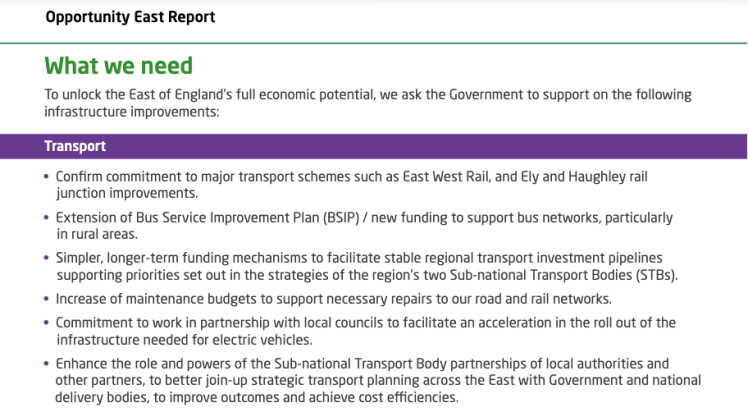
At the end of the two pages of requests, the report states that the existing regional infrastructure is not functioning either.
“A key enabler will be to bring regional partners together to co-ordinate a stronger regional approach to infrastructure. This co-ordination should include representation from: local government, STBs, business representative groups, universities, the Regional Climate Change Forum, utilities, infrastructure companies and Freeports. We ask for support and engagement from government to ensure that our regional work informs and drives stronger public investment.”
Above – LGA-East (2024) p12
As things stand I cannot see how the existing combined authority structures (soon to be renamed ‘Strategic Authorities’ following enactment of the Devolution Bill) will be able to deliver on this.
Any progress in the 16 months?
Not by the sounds of it. But then for major changes to be done well you need (in my experience) to have a sufficient amount of time spent on planning and research. So I wouldn’t expect that much after 16 months.
At the same time, if ministers wanted visual impacts that the public could see visibly, they would look at ‘hanging-basket-style’ policies and actions done by local government. (The metaphor being that people notice colourful hanging baskets with flowers in that are put up and maintained by the councils!) In policy terms it would mean ministers focusing substantial new funding for local councils to spend on things like road maintenance and street level repairs and improvements. This is something that cannot be done well if micromanaged from the centre. (I found this out the hard way in my civil service days!)
*Experts from the University of Cambridge have called on the next Prime Minister to invest £1bn in local communities to boost civic pride.*
This was a recommendation from back in 2022 from the Bennett Institute for Public Policy at the University of Cambridge. There are a number of other recommendations in the policy paper which you can read here. One that stands out is their final recommendation:
“Finally, we suggest that a Minister for Civic Pride is created to drive focus across Westminster to ensure that departments are boosting pride in a way that meaningfully impacts the lives of millions of Britons.”
Above – Bennett School of Public Policy (2022)
I can understand why they recommended it. I just don’t think it would be effective in a white hot policy-making environment in Whitehall. Such a post would probably go to a junior minister and in the stressful environment that Whitehall is at the best of times, said minister would probably be told where to go by more senior ministers in other departments. Not least because ‘civic’ pride’ is an intangible concept that is very hard to measure. More senior ministers being held to account over things that have numbers at the end of them – GCSE passes, number of homes built, crime rates…you can see how this is likely to turn out.
The financial elephant in the room: Independent tax raising powers
Although a number of projects were listed as being given government support – such as East West Rail and the Chatteris Reservoir, the report notes that:
“…many of our key infrastructure asks were not funded.”
Above – LGA-East (2025) p8
The big transport item being turned down being the refusal to upgrade the railway junction at Ely, which requires almost £500million of funding.
And that illustrates the problem. The 2024 report had two pages of ‘asks’. This reflects a culture of a political system where the local government sector is little more than the delivery or commissioning agents of central government – with the interesting policy work being done in London. All that is left is commissioning and contract management. Take for example Cambridgeshire County Council’s Children and Young People Committee which meets on 25 November 2025 here. In the mercilessly not-huge set of meeting papers the words ‘commission’ / ‘commissioner’ / ‘commissioning’ appears 75 times. Which tells you where the power really resides. What is the point of going to such council meetings to ask public questions if all that happens is to be told that your request is not in the service level agreement or that ministers did not provide flexibility in the funding for your request?
There’s no point in applying what Cambridge needs to the rest of East Anglia and assuming everything will be fine.
Whatever ministers choose to do, if they don’t overhaul the way in which local councils are funded, and the range of taxes that they can impose without central government intervention, then they (ministers) will be stuck in a doom loop. This LGA-East report is just one of many that asks ministers to provide funding for their list of requirements.

Above – from the Royal Commission on Local Government Finance 1976.
I digitised the conclusions of the above report here. If you want to read all 538 pages of the main report here, you’ll need to sign up with the Internet Archive here. The Commission also produced a separate annex on the option of a local income tax which at 313 pages I have not read. But some of you may want to browse the digitised version here.
On a local income tax, Cllr Lucy Nethsingha (LibDems – Cambourne) who is the leader of Cambridgeshire County Council, told me a few years ago that her party’s policy nationally is to have a funding formula that slices off around 30% of the income tax receipts for redistribution around the country by formula grant. I.e. using a very complex mathematical formula that accounts for things need – population, poverty rates, education attainment, age demographics and so on. (Which is why it’s so important to fill in the census because every person that does not means less public funding for their area!). For those of you interested in further reading, there are a number of short pamphlets on the subject you can browse through that date from the 20th Century. See also this piece on LibDem Voice on alternatives to Council Tax.
“What is the mechanism that can enable the wealth generated in Cambridge’s economic sub-region to be spent on social, civic, and environmental infrastructure improvements without having to go cap-in-hand to ministers all the time?”
A couple of local residents have approached me this week to ask about this in the context of the future of Cambridge. One complaint was about the amount of revenue generated by Cambridge-based institutions that gets redistributed to the rest of the country by The Treasury, leaving businesses and residents with the impression that local government is wasteful and inefficient because their business rates payments don’t seem to be making a difference.
Which is why I think local councils in Cambridge should have this slide in very prominent places in its materials and web pages!

Above – Cllr Mike Davey at Cambridge Guildhall, 06 Dec 2023
I explored this in more detail in this blogpost
One of the complaints from parents with young children that I hear quite often is how council-funded events for children are mainly hosted in parts of the city that are inaccessible to families in South Cambridge. That’s simply a result of the greater concentrations of multiple deprivation in wards such as Arbury, King’s Hedges, and Abbey. The much smaller and more dispersed council housing neighbourhoods in the south of the city (perhaps with the exception of the newbuilds at Trumpington/Clay Farm) mean that such communities are easily overlooked in official statistics. Furthermore, affluent donors are more willing to donate substantial funds to private schools to enable them to build things like the new swimming pool at The Perse, to the state-of-the-art theatre at The Leys. Inevitably these sorts of venues are less likely to be in walking distance for people living in neighbourhoods with large concentrations of social housing.
“The grinding poverty in which some residents in our unequal city live would be genuinely shocking to many whose prospects are rosier.”
Former Cllr Sam Davies MBE 21 May 2023
And Cambridge City Council has long been an enfeebled institution in the face of the huge challenges our city faces.
“That the City Council in an economic hotspot like Cambridge is reduced to planning for the ‘minimum viable option’ for its services will surely come as a surprise to many residents.”
Above – Former Cllr Sam Davies MBE 04 December 2022
That someone of the calibre of Sam felt unable to continue, having to step down for her own wellbeing (as did a couple of other councillors in that same era for similar reasons) also reflects systems and structures that have not been fit for purpose for far too long. We should not be losing councillors of her calibre. But we did. And it felt like the system and the city carried on as if nothing had happened.
The exclusive events debating the future of our city
Sam Davies has for a long time been critical of the exclusive meetings on the future of our city – in particular ones hosting key national figures. She highlighted one case back in May 2023 here which is worth reading.
- “Who are included in or excluded from the “we”?
- What tools and what mandate does that “we” have to shape the city’s growth?
- Why is the aim “to maintain the cluster’s momentum” a given?
- Does “local government” have either the structures or the funding to deliver what “we” are expecting of it?
- Are “houses and transport links” the only elements that are needed? If not, how will those other elements (healthcare, culture, community life to name just a few) be provided?
- In what sense is the ecosystem “increasingly buoyant” and who is benefitting from this buoyancy?”
Above – Sam Davies 14 May 2023
There was another event organised by Cambridge Ahead where they had the Deputy Chair of the Newtowns Taskforce Dame Kate Barker was the keynote delegate along with a panel that had representatives the Cambridge Growth Company, the Greater Cambridge Shared Planning Service, and the Combined Authority. You can read the LI-post here for more.
Looking at the themes they discussed, part of me was thinking ‘I wouldn’t have minded being there’ – but the reality of my health situation means 90% of the things I’d like to go to I can’t. Yesterday it was going through the fun and games of an echocardiogram exercise stress test the result of which left me thinking I was going to die of thirst! But we got the all-clear (it was a follow-up from my stay in Addenbrooke’s in the summer). After which I went around asking the staff to tell me what issues they’d like me to raise at next month’s Board of Directors’ meeting on 17 December 2025 but without getting them into trouble.
The issue is more that so many of these meetings are happening but so few are actually doing what Cambridge Ahead fortunately did with this one and provided a summary of who was there and what they discussed. One other group that stays out of the public eye is the one formed by the former Health Secretary.
The exclusive meetings are a symptom of over-centralisation of the UK state
Also, the more I’ve read and learnt about my own neurodiversity, the more I’ve come to realise that I’m not cut out for such environments. Which seems strange given that just over 15 years ago I was going to such events on a regular basis. What I didn’t realise at the time was how few of them would lead to real tangible differences. And when you look at the list of themes discussed at the Cambridge Ahead event last night, how many of these things are new?
🔹 An over-riding focus on quality and quality of life that our region should uphold
🔹 The critical role of infrastructure, particularly transport, in enabling growth and improving quality of life
🔹 The importance of collaboration and alignment across strategies — “skewering” the same principles through all
🔹 Planning for demographic change, environmental recovery, and access to green spaces
🔹 The relationships between housing, employment, and infrastructure
🔹 Skills as an essential factor in planning and delivering growth — from planning teams to construction capability
Above – Cambridge Ahead on LI, 20 Nov 2025
There is nothing new in the above-points that people following my blog would not be familiar with.
But such is the structure of the state that none of them are in a position to do anything substantial about the issues independent of central government. The result?
Ministers and civil servants end up with big digital piles of reports from a whole range of people and organisations pleading their special case
Why does that strike me? Because in the late 2000s I lived it. The correspondence unit would send down the reports to us policy civil servants to read through and provide advice to ministers on how we were unable to give them money for their requests.
In the context of real devolution, ministers and senior civil servants should be asking themselves some tough questions about their own workloads. In particular:
Will this particular policy, initiative, or action result in central government not getting any further questions once it has been implemented?
Or rather:
Will the questions on this issue that normally end up with central government either get redirected to local/regional tiers of government? (Or not need asking, let alone answering in the first place?
Which brings me back to the local conversations that I’ve had in my patch of Cambridge
The feeling from the parents with children at school is that the goodwill to engage is there, but they don’t have the time to wade through 8,000 pages of development planning documents, and also requests to be on committees will have them running for the hills!
The other one was about how to keep people informed in an era where we don’t have the daily newspaper that could provide sufficient coverage and filtering of very complex issues that we used to have until the early 2000s.
Uniting a fragmented city and enabling it to function well and have an impact that is greater than the sum of its parts is not something that is going to happen overnight. One of the big debates they said we needed to have was on opportunities for the children as they progressed through school. One of the reasons why I think we should bring back Activate Cambridge.
Furthermore, they told me that when it came to fundraising and appealing to firms for sponsorship, it was the same individuals and firms coming back time and again, but shrinking in number. Which means that the Cambridge Pledge has got a very long way to go indeed. (Maybe it needs extending to build the face-to-face working relationships between those wealthy enough to make the pledges, and those that go without).
Food for thought?
If you are interested in the longer term future of Cambridge, and on what happens at the local democracy meetings where decisions are made, feel free to:
- Follow me on BSky
- Spot me on LinkedIn
- Like my Facebook page
- Consider a small donation to help fund my continued research and reporting on local democracy in and around Cambridge.

 The Cambridge Town Owl