
If it sounds like local history is repeating itself to some of you, you’re right.
You can read the press release from Cambridge United here
The difference this time around is that unlike in previous eras, Cambridge is undergoing a period of Government-supported rapid growth (economic and population) which means there are far more options for building not only a new ground but a community and the essential infrastructure around it.
The two previous eras I can remember were:
- The early 1990s following the Taylor Report into the Hillsborough disaster of 1989 where 97 Liverpool fans lost their lives. It took decades before some sort of justice was achieved when an inquest jury returned verdicts that the fans were victims of unlawful killing. , but controversially none of the senior persons responsible that day were convicted despite the inquests’ verdicts.
- In the early 2010s when Cambridge United were struggling financially to the extent they had to sell their ground to developer Grosvenor, a plan to build a new stadium south of Trumpington, financed by the construction of expensive housing, was thrown out by councillors in 2013. Hence they ended up staying at the Abbey.
Such was the pressure coming from the University of Cambridge, developers, and from business groups that the emerging local plan for 2014 was found to be unsound by Planning Inspectors due to not enough housing supply/sites. It took another four years and a fortune of expenditure on consultants later before the 2018 local plan was approved by inspectors.
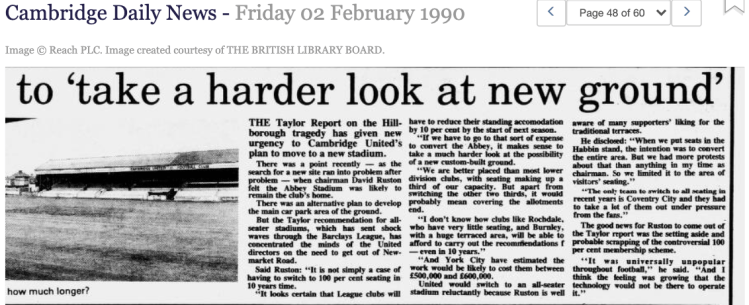
Above – Cambridge Evening News 02 Feb 1990 in the British Newspaper Archive
The article above summarises the impact that the Taylor Report had on English football grounds and how it required some huge changes for a sport still in shock.
Fast forward a year and a bit to one of Cambridge United’s best seasons and we have a team promoted for the second time in a row – this time as champions of the old Division 3 (today’s League 1). I was at the game below – the final game of the season at the Abbey Stadium back in May 1991.

Above – Cambridge Weekly News Thurs 09 May 1991, with calls for a new stadium
The spot most often mentioned at the time was at Teversham village which is east of Cambridge Airport and north of Cherry Hinton. But unfortunately the club could not gain the support of local councils to get the move approved.
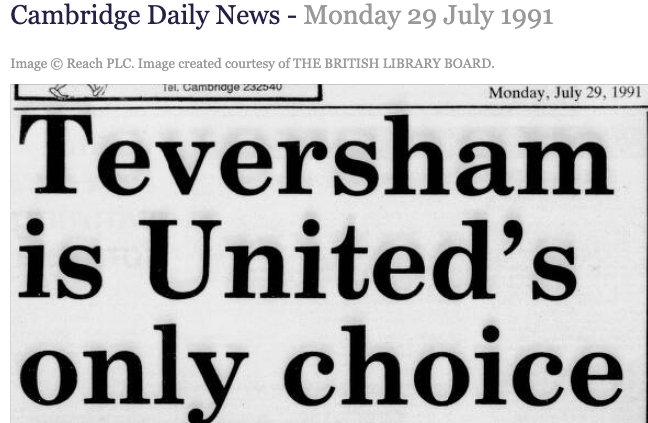
Above – Cambridge Evening News Mon 29 July 1991 in the BNA.
I’m not going to pretend I’m still the diehard fan I was as a child – who had football ‘on the brain’. I wrote this piece on my old blog back in 2012 explaining why. I can still ‘read’ the game but in my adult life there has been a complete absence of. connection. Furthermore, the blatant corruption in the game is something that takes the fun away. I wrote about putting the fans back in control back in 2014 but haven’t really written much about it since.
The Greater Cambridge Shared Planning Service must engage with the club and its supporters soon. The traffic jams and disrupted bus services on match days are unsustainable. In an era of a rapidly-growing city, the club needs a stadium that gives it the space to expand the ground as the population of the city increases. There’s no guarantee that population growth or even being based in a growing city will automatically convert into bums on seats. You only have to look at MK Dons for some lessons learnt there. (i.e. don’t move too far away from your original ground!)
In principle I’d like to see a new ground as part of a wider sporting and leisure complex that also has medium density housing nearby and is also served by suburban and/or light rail. Essentially you want as many local fans to be able to get in by active travel or local public transport, and away fans to be able to get in by train with a short walk to the stadium rather than having to take a fairly long trek to the stadium as at present.
It’ll be interesting to see what the councillors say about it at their meeting next week before the papers go out to consultation.
If you are interested in the longer term future of Cambridge, and on what happens at the local democracy meetings where decisions are made, feel free to:
- Follow me on BSky
- Spot me on LinkedIn
- Like my Facebook page
- Consider a small donation to help fund my continued research and reporting on local democracy in and around Cambridge.

 The Cambridge Town Owl