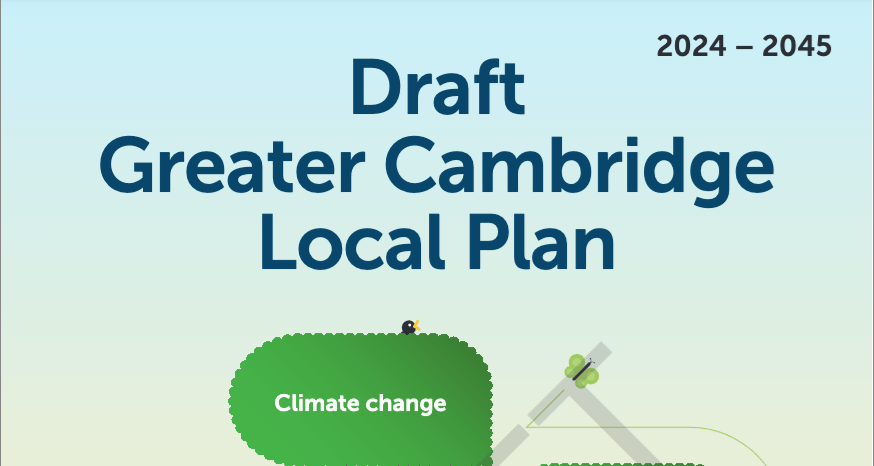
Following the first two workshops in the late 2025 series of events, my next event will be an informal conversation and also slightly shorter. (Unless participants choose to continue talking as they did at the last two events!)
Details:
- Sunday 30 November 2025
- The Rock Pub (note you’ll be responsible for your own food/drinks purchases)
- 2pm-3.30pm
- Free/donations
Please sign up here so I know how many copies of things to bring!
For the first two workshops on the Queen Edith’s/Coleridge border at Rock Road Library last week, and today’s one in Cherry Hinton at the recently re-opened library, we had a total of 18 people plus a few others popping in at today’s event.
The nature of the events I run is that they are community-based and are on a small scale. I’m happy to run workshops for community groups, local campaigning organisations and other collectives if you can organise venues/invitations/publicity. My neurodiverse disposition means that what on paper should be a relatively straight forward series of admin tasks are anything but, while processing and explaining the dense content on really niche public policy issues is the opposite.
The looming consultation launch
Cambridge City councillors have given feedback to council planning officers on outstanding issues with the consultation on the emerging local plan for Greater Cambridge. You can read the list of issues at Appendix K to item 5 here.
South Cambridgeshire District councillors also scrutinised the same set of papers for the joint emerging local plan, and you can read the list of issues they raised at item 5 here. You may want to use this as a guide for help you narrow down the number of pages and the number of issues you want to cover in order to avoid ploughing through the 8,000+ pages of planning policy content!
Councillors will be provided with briefing materials by council officers
Which is also why the participating councillors in my workshops found those a useful practice run because both workshops had first-time participants who had never been to anything like this before, but who also had very specific questions that councillors might want to familiarise themselves with. The first question might sound obvious but it is also fiendishly difficult to give a clear response to if you’ve not done some background reading or if you are not familiar with the essentials of UK Government and Politics.
For those of you who do not know who your councillors are see https://www.writetothem.com/ and drop them an introduction email.
So if that is you, get hold of a cheap second hand copy of either an A-level syllabus of UK Government and Politics, or a cheap older edition of Town and Country Planning by Cullingworth. (You might be able to get away with the 14th Ed published in 2006, or the 15th published in 2010. The 16th edition was published in 2024 but costs a packet and given the Planning and Infrastructure Bill going through Parliament, will be obsolete in a few weeks time!) Note both titles are not to be read as ‘cover-to-cover’, but rather to enable you to select the handful of relevant chapters/sections that apply to the questions you might get.
“What is that fiendishly difficult question?”
***Why is this being done?*** ie. ‘Why is Cambridge being made to grow like this?’
In responding to this I wanted to give participants earlier today a substantive answer that went beyond: “Because the Minister for Housing and Planning said so!”
Hence doing a five minute crash course on how we got to this point.
- The UK is a parliamentary democracy where Parliament is Sovereign. We do not have a written and codified constitution like the United States so their concept of something being ‘unconstitutional’ does not apply to the UK.
- Parliament being Sovereign means it is the supreme rule-creating/law-making institution in the country. If Parliament wants something to happen in public policy, all it needs to do is to enact the necessary legislation enabling that to happen.
- Governments are generally formed following general elections. The convention is that the party who gains the most seats at the general election is the one that forms the next government, and the monarch summons the leader of the winning party to invite them to form a new government.
- Most political parties publish manifestos for general elections on the assumption that the voters will read all of the manifestos and will decide accordingly when they vote – hence a ‘manifesto commitment’ is the will of the people. Labour’s manifesto included policies on planning reform and devolution – with the former including a target to build 1.5million homes in five years. The manifesto also includes clauses on removing barriers to growth in key economic/industrial sectors.
- In order to meet those manifesto commitments, and because ministers believe that their policy objectives are in the public’s interest, they have decided to implement a series of policies that affect Cambridge directly, requiring it to grow and grow quickly.
What struck me with the responses from a few of the participants is that they said while they still strongly disagreed with what was happening to Cambridge, they now understood why it was happening, why the ministers had taken the decisions they have taken, and what are the things that empower the ministers to do this. (Noting that at the next general election a different political party could in principle win and reverse the policies of the previous government).
I think it’s important that councillors can give the explanation above to their constituents if/when asked about the huge growth plans coming from ministers.
Amongst other things it becomes clear to the people asking ‘why?’ where both the power and responsibility for what is happening resides. Furthermore, it also enables local elected councillors to make clear to their constituents what their own powers, remits, and responsibilities are when it comes to drawing up things like new local development plans.
With the emerging Greater Cambridge Local Plan 2030-45, successive pieces of town and country planning legislation means that if councils do not come up with their own ‘sound’ local plans that meet the needs of their residents, ministers reserve the right to step in and impose a government-mandated local plan instead. Hence the repeated calls from ministers to local councils to prioritise getting a new, sound and up to date local plan in place. (Cambridge found out the hard way what happens if you don’t, back in 2014. Hence spending the following four years producing an updated one at huge expense for 2018).
Have maps and print outs to hand – it helps facilitate multiple conversations with people in the same place and enables councillors to act as a facilitator rather than a defender/witness being cross-examined on proposals they might not have had any involvement in producing.
I’ve used large A3 print outs of a range of maps and diagrams to show to residents how council planners assessed different pieces of information to come up with the proposals that were published recently here. For the workshops this involved bringing print outs of the sites developers/land owners/speculators put forward (below – an early iteration).
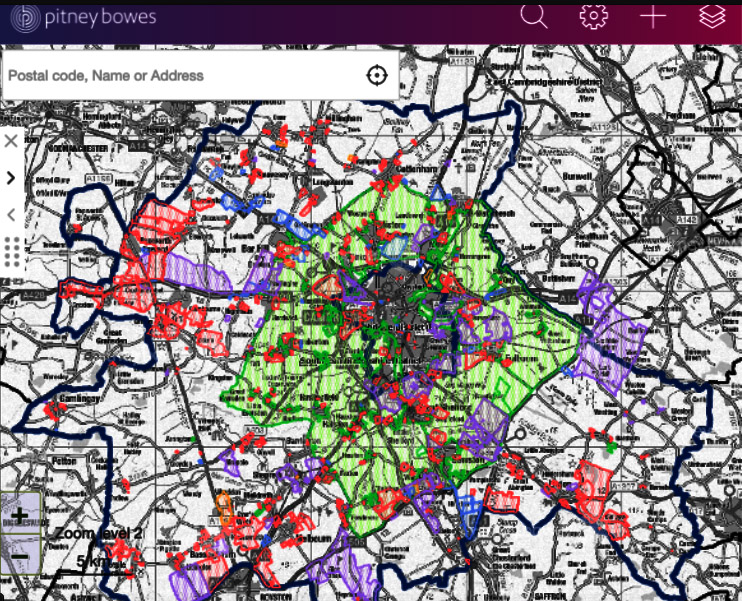
Above – Cambridge in the middle, surrounded by green belt and with lots of proposals for housing and mixed use developments plus a few employment sites
The sites got cross-referenced with maps and studies on geography and topography which provided evidence on what types of land and which areas of the city & district were suitable for building on, and which were not.
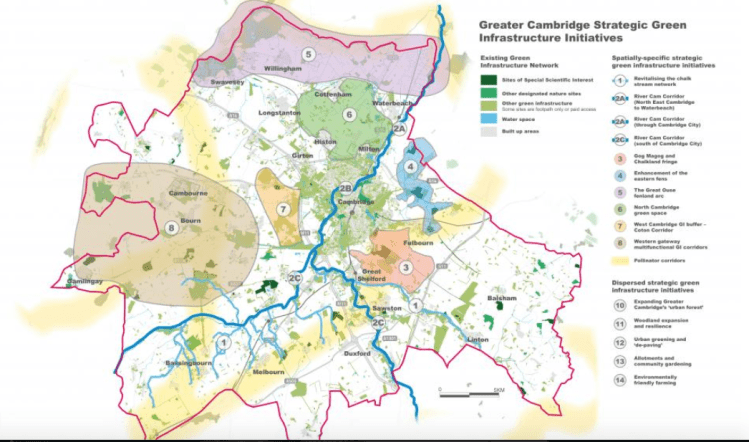
Above – a map of the Greater Cambridge Strategic Green Infrastructure Initiatives
This resulted in the choice of sites and the principles behind them. Planners and councillors chose to use the principle of having a small number of settlements to host large amounts of housing growth and employment land growth in order to protect the many small villages in South Cambridgeshire District. Hence Waterbeach Newtown, Northstowe, and Cambourne/Bourn Airfield.

Above – the proposed settlement hierarchy indicating the new towns that are already emerging from the current and previous development plans

Above – the final set of selected sites going out to consultation on 01 December 2025. Appendix A – Greater Cambridge Local Plan – Part 1 – Introduction and Development Strategy (document in the top row, p17)
Having those as your very basic starting points on ‘how we got to here’ could help residents understand how the sites were selected, and enable them to ask more informed and detailed questions in response.
If you are interested in the longer term future of Cambridge, and on what happens at the local democracy meetings where decisions are made, feel free to:
- Follow me on BSky
- Spot me on LinkedIn
- Like my Facebook page
- Consider a small donation to help fund my continued research and reporting on local democracy in and around Cambridge.

 The Cambridge Town Owl