You can have a listen to Mr Zeichner’s speech here.
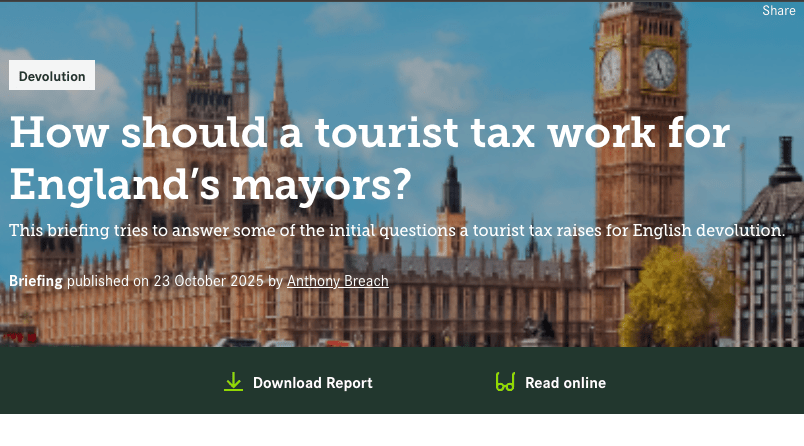
Image – briefing paper from the Centre for Cities on how the tax might work
The Budget 2025 papers are here. Feel free to do some keyword searches to see what comes up.
The consultation on a tourism tax/visitors levy is here
The questions the Centre for Cities briefing addresses are:
- How should a tourist tax be designed?
- Should a tourist tax rate be set locally or nationally?
- Which tier of local government should be responsible for the tourist tax?
- How should a tourist tax be collected from overnight accommodation?
- What should a tourist tax mean for the local government finance system?
The tourism tax / visitors levy consultation has 36 questions for you to respond to
See the consultation document questions at p57 here
Mr Zeichner highlights fragmented public services
It was at this point in his speech (15h14m21s ono) where he mentioned residents in some of the new flats (sounds like the Brookgate ones to me!) where residents were complaining both about poor quality build *and* on crime and disorder in the area. This sounded depressingly like the picture painted by Olly Wainwright in The Guardian back in 2017 which went viral.
“The housing associations turned out in force to meet me—it is amazing what a visit from an MP will do—and they told me about the labyrinth of organisations involved in those issues:
- at least two councils,
- the police,
- those responsible for developing the building,
- those responsible for maintaining the building, and
- those responsible for fire safety. In those circumstances,
“How could anyone come to a sensible solution? I came away very clear about one thing: no one seemed to take responsibility overall, and as a consequence, the residents have a very poor deal.”
Above – Daniel Zeichner MP, Hansard 26 Nov 2025
When you look at the number of organisations involved in managing that part of our city, you can see why residents get frustrated. You can see how local residents are responding to the challenges they face via their Get Involved pages on the CB1 Community Pages.
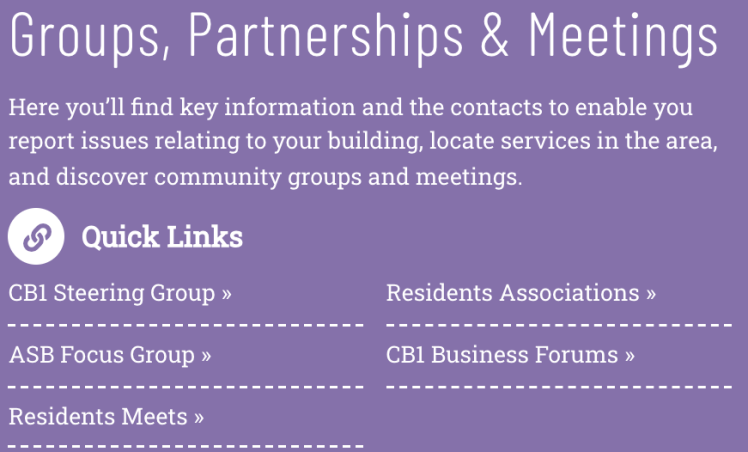
Above – Get Involved in CB1 Community
The reason for highlighting this other than my local MP raised it in the House of Commons earlier, is because we are a fragmented city – made worse by having no central means of communication between institutions and residents.
One other issue Mr Zeichner raised was the collapse in funding of trading standards officers in local government,
“In 2010, local authorities spent just under £172 million per annum on them. By 2020, that had fallen to just over £103 million.”
At the moment I’m sort of doing my ‘social butterfly’ / ‘turning up to the opening of envelopes & front doors’ act to try and keep up with what’s going on. Actually, more often than not I’m logging into livestreams of things because I no longer have the health to get out and about like in decades gone by.
That fragmentation also came up in a local meeting hosted by St John the Evangelist Church opposite Homerton College on Hills Road all about COP30 climate talks where two expert speakers gave their opinion of what happened and what if anything was achieved. In a nutshell Prof Michael Grubb (UCL) and Dr Joanna Depledge (Cambridge University) were not impressed with the final agreement but did find positives in what was happening outside of the main talks and the lobbying pressure from big oil and the countries where most of the oil is extracted.
My question at the end was about applying their expertise and observations locally, mindful of the looming consultation launch on the emerging Greater Cambridge Local Plan – for which I’ve got another event coming up on Sunday 30 Nov 2025.
The Greater Cambridge Emerging Local Plan
My earlier public question about new research findings from the field of neuroarchitecture was responded to by Cllr Katie Thornburrow here.
“Please make comments on design-related policies”
What I wasn’t aware of but was pleased to find out about was how the Greater Cambridge Shared Planning Service got in touch with Dr Cleo Valentine (who did per Ph.D at Cambridge University in the field of Neuroarchitecture) to invite her to help shape the Cambridge Biomedical Campus’s new Supplementary Planning Document – one that refers directly to her research. This was the result of an earlier recommendation I had made. (That thing about being a social butterfly?!?)
“Research finds that the spatial layout of architectural forms and elements such as natural light effect the way we function, with both positive and negative impacts on our physical and psychological wellbeing.”
Above – Cambridge Biomedical Campus Supplementary Planning Document (2025) [PDF, 5MB] Paragraph 4.14 p36
Which pleases me muchly! (Because it means that residents and the public can refer to it for any future planning application and challenge developers to ensure that they have accounted for the research before trying to impose bland, repetitive, boring designs that Dr Valentine highlighted in her Seoul presentation resulted in increased levels of mental stress for those in and around such urban environments. Dr Anna Kim also for Humanise.org found similar in her research.
Community Knowledge and the University of Cambridge
I’ve been appointed to Cambridge University’s new Community Knowledge Working Group and we had our first gathering today. It’s still very, very early stages but I’m glad to say that it looks like it has potential – while at the same time acknowledging the sobering scale of the task ahead of us. To coin a phrase from 20 years ago, part of the challenge is turning those ‘unknown unknowns’ in to ‘known unknowns.’ And one of the big ones relates to something Mr Zeichner told me several years ago when he said that even as Cambridge’s MP for several years and as a Cambridge Alumnus, he still did not know where power resided at the University of Cambridge. The same could be said for the City of Cambridge given the fragmented public service institutional structures and the outsourced and privatised public services that in previous eras were within the remit or oversight of local government. Including utilities such as water, electricity, gas, and public transport.
One of the things I mentioned was the importance of having and using common datasets. I used the example of community centres where, I think on the back of me moaning about it a decade ago at a local area committee, council officers created a G-Map of community centres in Cambridge. (I think the data may need a refresh, but the concept is sound). Such things make it easier for people and community groups to find out suitable premises. The next step for me is creating a system similar to commercial hotel room booking systems, but for community centres. But that would require a significant investment in the institutions that run the community centres due to the nature of automated room booking. Having the skilled and knowledgeable staff able to process bookings as and when they come in is not something to be taken as a given. Whether tourism tax revenue could help ease that burden…well, that could be something to include in a consultation response! Which you can respond to online here.
If you are interested in the longer term future of Cambridge, and on what happens at the local democracy meetings where decisions are made, feel free to:
- Follow me on BSky
- Spot me on LinkedIn
- Like my Facebook page
- Consider a small donation to help fund my continued research and reporting on local democracy in and around Cambridge
- Below – for any of you who want to talk about the future of our city
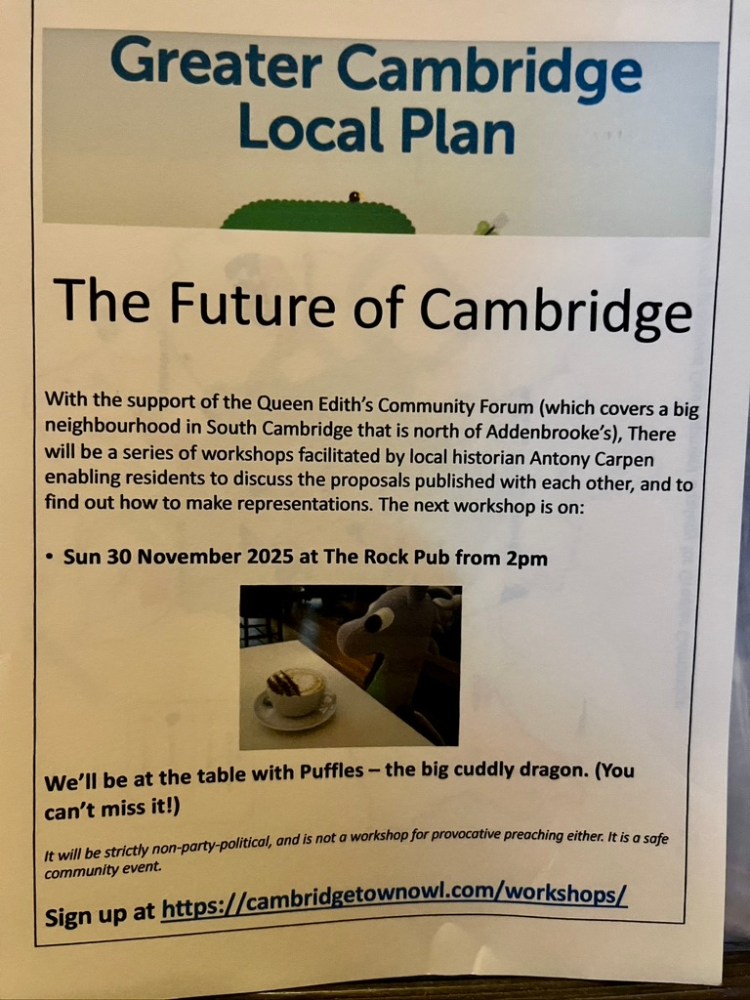
 The Cambridge Town Owl