
Image on Combined Authority pamphlet conflicts with emerging findings in the field of neuroarchitecture, including from one of Cambridge University’s own pioneering researchers
You can read more in the CPCA’s leaflet here
“Modern architects and their commissioning firms uglifying Cambridge again?”
Yep. For those of you who want to campaign on this, join Cambridge Past, Present, and Future. Or nationally have a look at the Victorian Society (although for the latter I can’t vouch for their politics!)
After turning the eastern gateway into Cambridge that is Newmarket Road into a gateway of woe, developers have now turned their sights to the southern gateway – Hills Road.
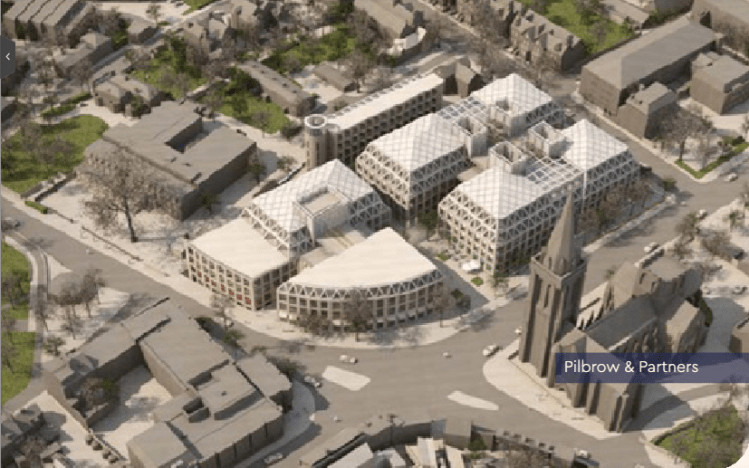
The Pilbrow proposals in a wider setting. Given the option of comprehensively redeveloping that area, I’d have most of the 20th Century-era buildings in that image demolished along with those proposed above, and do something magnificent with the site
What’s really depressing is the firm had an event in Cambridge that didn’t engage local residents or lots of local school children to get their visions and ideas for how the site could be used for our city. My principle for years has been that firms and developers need to involve residents *at design stage* and then demonstrably reflect their ideas in the proposals they come forward with. I have been to too many events where consultants from London have been hired to ‘take the heat’ from local residents before imposing their own pre-designed proposals in a broken planning system that enables them to do so. The Paddocks off Cherry Hinton Road is a textbook example – at no point did the firm or individuals from actually visit the neighbourhood to meet local residents face to face.
“Didn’t you have a plan for a concert hall for the site?”
My original proposal was to have the site turned into a new large concert hall and music complex, playing with a host of ideas including building a new steeple that has a silhouette that matches Marie Yolande Lynn Stephen’s mini-cathedral, but perhaps built in an Edwardian Baroque style rather than Victorian Gothic Revival. (Similar but different, and people would be able to ‘spot the twin towers’ as they head into Cambridge from the south).
Instead we’re lumbered with bland boxes like this by Bennetts Associates below – and if they have their way you’ll have to pass this before you pass the Pilbrow proposals!
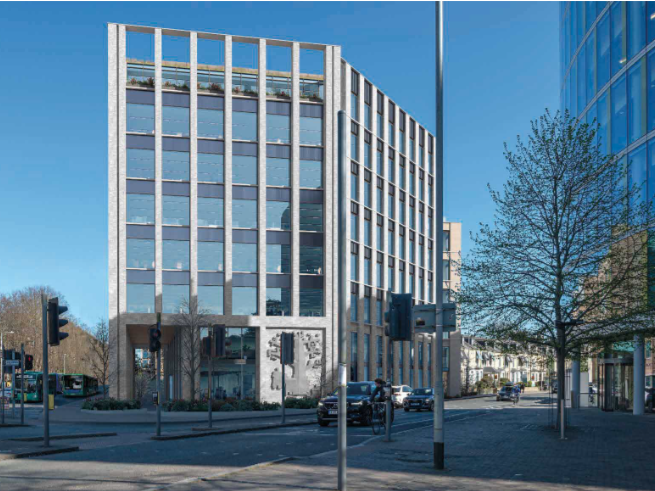
Above – as I wrote in my blogpost on the application: TL/DR? Whatever your views of this application are (See the GCSP Portal here and search Ref: 25/04039/FUL. It’s for “Demolition of the existing building and structures, erection of an office building” on the corner of Station Road and Hills Road”), submit your comments via the portal following the guidance here, or if that’s too complicated simply email your city councillor via https://www.writetothem.com/ and ask them to submit your comment on your behalf.
On neuroarchitecture and recent findings
In the reccently-approved SPD for the Cambridge Biomedical Campus, paragraph 4.14/p36 refers directly to recent research in the field.
“The built form can encourage the interaction between people and place and can respond to the local character, materiality and the historic environment. Research finds that the spatial layout of architectural forms and elements such as natural light effect the way we function, with both positive and negative impacts on our physical and psychological wellbeing.”
Above – GCSP – CBC-SPD (2025) p36
This takes us to a study by Dr Cleo Valentine from 2023
“The studies reviewed from the field of neuroimmunology indicate that chronic or repeated exposure to stress-inducing events may overwhelm the body’s regulatory system, resulting in a process termed allostatic overload. While there is evidence from the field of neuroarchitecture that short-term exposure to particular architectural features produce acute stress responses, there is yet to be a study on the relationship between stress-inducing architectural features and allostatic load. This paper considers how to design such a study by reviewing the two primary methods used to measure allostatic overload: biomarkers and clinimetrics”
Above – Valentine (2023) Abstract
She’s been working hard since then and presented her latest findings in Seoul, South Korea.
“A new study from Cleo Valentine, commissioned by Humanise, explores how the outsides of buildings in Seoul across five architectural periods, vary in the stress levels they cause passers-by.”
Above – Valentine / Humanise (2025) – scroll down and click on the link to see her full 23 page report, and additionally watch/listen to Dr Valentine’s talk with Uemee Jung from 27 September 2025
**Here are some we ruined earlier!**
I put this one together in 2023 – which actually includes things I like! (Which is rare!) We really could do with a decent masterplan for Hills Road because otherwise we risk repeating the design mistakes of Newmarket Road.
Newmarket Road, Cambridge’s eastern gateway of mediocrity (as far as urban design goes)
Here’s Newmarket Road by RailPen – the pension fund that made themselves unpopular by getting the controversial Beehive Centre Redevelopment called in by ministers after heavily lobbying the government just before the city council’s planning committee was due to determine (and refuse) the application.

Above – the white carbuncle at the back from an application that I moaned about back in September 2024
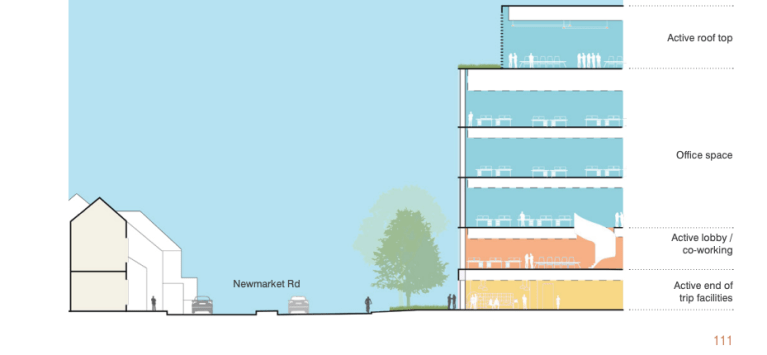
Above – the bit the diagram does not show – the differences in height in the properties on the western side of Newmarket Road vs what RailPen want
I blogged further in September 2024 about the emerging Carbuncle Canyon that Newmarket Road is becoming.

Above – student accommodation on Newmarket Road (I took this in 2017)
One of the reasons why we ended up with such bland identikit ‘could be anywhere’ architecture and urban design was the lack of a Masterplan. My hope is that a new masterplan will be something the new legislation will give local councils the powers to require of developers.

Above – Newmarket Road (top-centre) looking westwards, with the River Cam and Elizabeth Way Bridge top right, Tesco centre-right, and the retail park along the left. You can also see the higher-density apart-hotel-student-flats-type developments that don’t have to make affordable housing contributions, allowing developers to game the system
I don’t have a problem with medium-to-high density. I have a problem with the blandness of what gets put up despite the numerous historical examples of much more aesthetically pleasant medium-to-mid-rise density accommodation the likes of which we have precious little of in Cambridge.
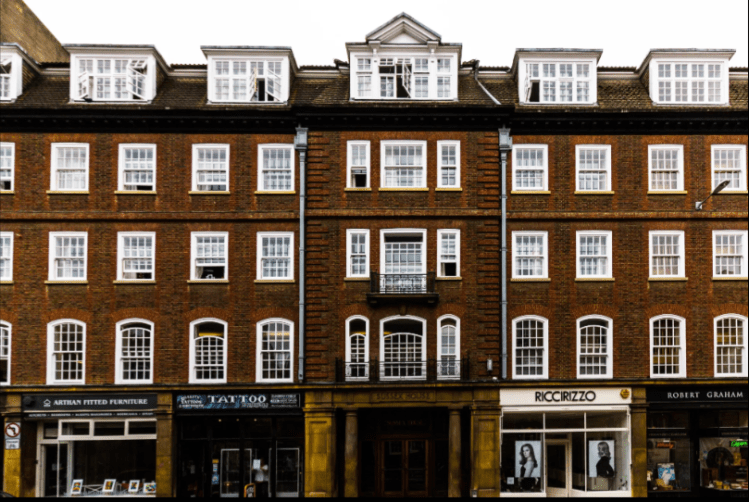
This works for me because there are active street fronts at pedestrian level, the three floors above have got slightly different window styles, and there are further top floor rooms / Mansard roofs breaking up the monotony, and a central entrance that stands out as enhanced from the rest of the building.

Above- the old Robert Sayle Building built by one of our civic heroes over a century ago. I still miss the spiral staircase indoors!
Over to you on the emerging local plan
Now that the documents have been published by the GCSP, the consultation launch on Monday will be your chance to input into the new design standards. Sign up to their first webinar here
And if you can’t wait that long, I’m hosting another informal gathering on Sunday at The Rock Pub in Cambridge – although I will be restricting my comments to explaining what is in the plans rather than giving my subjective/very biased opinion. Because it’s not right or fair for me to impose my opinions on aesthetics of buildings on others. (My civil service training from 20 years ago still kicks in after all this time!)
If you are interested in the longer term future of Cambridge, and on what happens at the local democracy meetings where decisions are made, feel free to:
- Follow me on BSky
- Spot me on LinkedIn
- Like my Facebook page
- Consider a small donation to help fund my continued research and reporting on local democracy in and around Cambridge

 The Cambridge Town Owl