
The minutes from the lates growth company meeting make for depressing reading for light rail supporters
“CGC has accepted a commission from MHCLG, HMT and DfT to lead on a strategic outline business case for a Mass Rapid Transit (MRT) to inform transport solutions in support of the growth of Cambridge.”
Above – from the CGC update here – click & scroll down to the minutes
If they mean buses on a segregated route, just say ‘More Buses’ and be done with it!
The commission from central government has artificially restricted itself to administrative boundaries
“The geographic scope of this commission was confirmed to include the whole of CambridgeCity and South Cambridgeshire councils.”
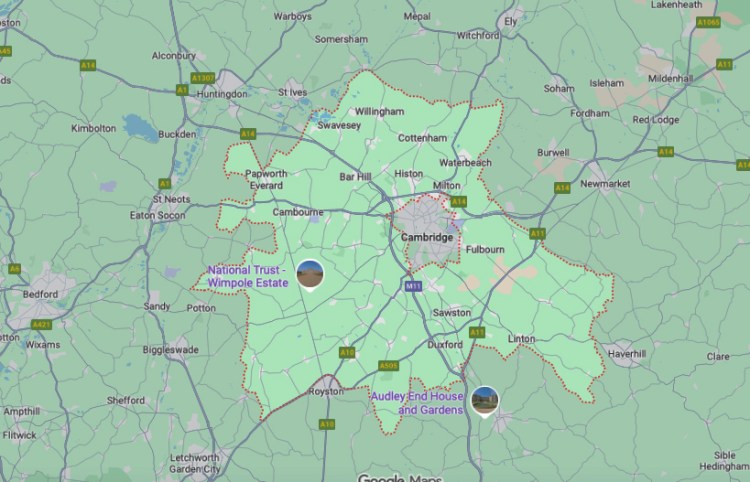
Above – a map of ‘Greater Cambridge’ – i.e. Cambridge and South Cambridge District on GMaps
The boundaries are not longstanding ones. South Cambridgeshire District was only invented in 1974 – just over half a century ago. That district was formed from a merger of the old Chesterton Rural District (The urban district was merged with Cambridge Borough in 1913) and South Cambridgeshire Rural District – the latter now sort of forming the constituency with the same name following the boundary review for the 2024 general election. You can see the abandoned proposals from the Royal Commission on Local Government in England from 1969 (AKA ‘Redcliffe-Maud’) which shows the boundaries in thin black lines of the old rural and urban districts.
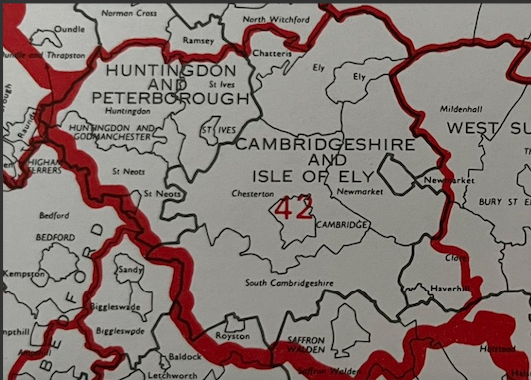
Above – detail from Redcliffe-Maud’s proposals for a Cambridge Unitary
This is what I still think should form the basis of negotiating the new boundaries for a new Great Cambridge Unitary. As you can see, it includes most of the market towns that fall within Cambridge’s economic sub-region and the towns that use Cambridge as a regional centre. This is no accident. You can see from Nathaniel Lichfield’s analysis from 1965 below-left how it was meant to work. Furthermore, below-right you can see from the bus commuting patterns how the two align.

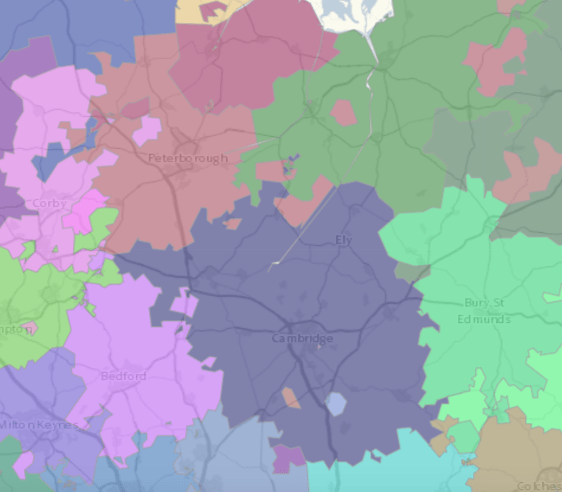
Above-left, Lichfield’s analysis from 1965. Above-right – Cambridge & Peterborough’s bus travel to work area commuting patterns 2011 – from the ONS here
The decision to exclude Haverhill – one of the largest towns without a railway station – makes it much harder to justify a light rail solution
What they should be looking at in my opinion is the proposal from Cambridge Connect Light Rail below.
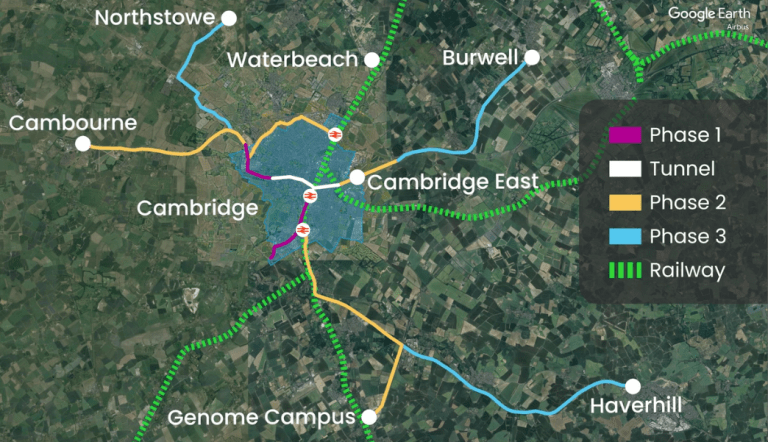
Above – the proposal from Cambridge Connect Light Rail which incorporates both Haverhill and Burwell which are outside the Greater Cambridge area.
Furthermore, bringing Haverhill back into consideration also means there is an option as Rail Future East call for, for integrating Wisbech Rail into a sub-regional public transport system.
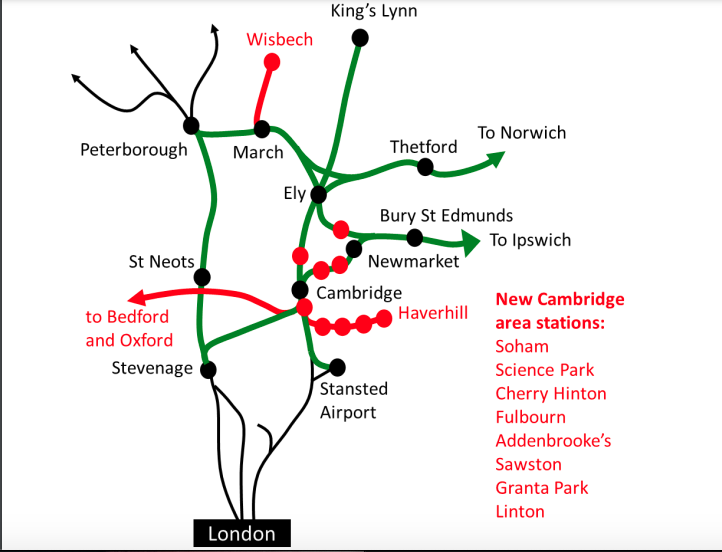
Above – from Rail Future East on the options for Wisbech and Haverhill.
On top of all that we have the Chatteris Reservoir Consultation No.3 which really should make provision for a light or suburban rail spur to bring that Fenland town back into the railway network – which like Haverhill was a victim of the Beeching-era cuts. That way Cambridge ends up connected to surrounding towns that really could do with the economic boost that new rail-based public transport infrastructure would bring.
If ministers allow themselves to be restricted by the same obsolete assumptions and narrow-minded thinking from a pro-highways transport engineering profession that poisoned the discourse of the Greater Cambridge Partnership’s ambitions (leading to the abandoning of the GCP’s primary project, the city access project for Cambridge because senior transport officers incorrectly assumed councillors would rubber-stamp their plans – the local electorate having other ideas) then Cambridge risks bus congestion in the city centre of the type that Smarter Cambridge Transport warned them about back in 2021.
You can tell I’m not a supporter of the Greater Cambridge Partnership. But then I was an independent candidate in Queen Edith’s ward at the city council elections back in 2023 and called for the abolition of both the GCP and CPCA saying they should both be replaced by an empowered unitary council with the independent tax and spending powers to impose on the economic sub-region to pay for the much-needed infrastructure improvements without going cap-in-hand to HM Treasury all the time. If anything, the announcement of the new swimming pool at The Budget 2025 showed half of how the system should function: Cities with great need but not the economic base to fund infrastructure improvements should get central government support. Those that have that economic base as Cambridge does, should be empowered to raise revenues through much wider tax raising powers without needing to go to HMT. Because in the current climate, spending on Cambridge is hard to justify from a ‘headline’ perspective for those other cities suffering from chronic multiple deprivation.
I hope the Mayor of the Combined Authority pushes back on this, and works with neighbouring county councils to get the scope of any ‘mass transit’ for Greater Cambridge extended beyond existing obsolete county boundaries.
Food for thought?
If you are interested in the longer term future of Cambridge, and on what happens at the local democracy meetings where decisions are made, feel free to:
- Follow me on BSky
- Spot me on LinkedIn
- Like my Facebook page
- Consider a small donation to help fund my continued research and reporting on local democracy in and around Cambridge
- Below – for any of you who want to talk about the future of our city
 The Cambridge Town Owl