
I hope someone writes an extended academic thesis on this – as well as someone who is not me writing a shorter, more digestible version of how employment and housing growth has not been matched by infrastructure investment, and how (and why) provision for accommodation for people and businesses has not matched demand.
Note on the latter point, environmental limits to growth, and public opinion as expressed at the ballot box (and during the election campaigns prior to elections) are reasonable explanations.
With the public hearings for the controversial C2C Busway now over, people can now browse through the documentation and reports submitted as evidence
“Why so many bl**dy acronyms?”
From my perspective, all they did was to erode public trust – something that the institutions involved have never got back. In one sense the creation of the new unitary authorities is a chance to wipe the slate clean. Furthermore there was no urgent or important need to come up with all of those acronyms.
- HQPT – High Quality Public Transport – which I moaned about here
- AVRT – Affordable Very Rapid Transport – mentioned in the GCP-Cambridge Ahead-sponsored report here
- CHUMMS – Cambridge to Huntingdon Multi-Modal Study – the original report from the early 2000s that recommended a new guided busway instead of restoring the old railway line between Cambridge and St Ives. You can read the archived executive summary here. You can test your patience by downloading each of the separate archived sections here
By taking so long and spending fortunes on consultants, the changing party political controls inevitably meant that no one person or politician was in charge – or had the vision to complete what they originally set out to achieve
Not surprisingly, what might have started off as a good idea – eg Gordon Brown’s ecotowns.
“The first proposed eco-town will be built on the abandoned Oakington Barracks in Cambridgeshire, which was recently bought by English Partnerships for £100m.”
Above – The Guardian 13 May 2007
Note – English Partnerships later became the Homes and Communities Agency, which itself later became Homes England. Which speaks volumes!
Fast forward five years and Owen Hatherley wrote in the same newspaper:
“Most of Northstowe, if it does appear, will be the work of developers and volume housebuilders, rather than the public corporations and councils that built the new towns”
Above – The Guardian 29 Feb 2012
Which has turned out to be the case. Furthermore, the failure of the private sector developers ended up being a national news story of a collectively-failing construction sector damned in the Grenfell Inquiry Report. Mr Hatherley understandably thought that the bland proposals for Northstowe were as such that it would be just another box-like newbuild development that we’re familiar with today.
“With none of the vision of the slum-replacing postwar new towns, Northstowe is unlikely even to be noticed”
Above – The Guardian 29 Feb 2012
The problem was that the private sector made such a hash of Northstowe that not only was it noticed by the whole country, but it was noticed for all of the wrong reasons
“Northstowe has delivered new homes but many residents are not happy with the lack of community facilities… But more than 1,200 homes are now occupied, with no shops or community facilities, beyond three schools.”
Ben Schofield, BBC East, 12 July 2023
Which is why I said there should be an inquiry into the failures at both Cambourne and Northstowe back in 2023 – if only so that the residents of both towns could have some accountability for what they have been through.
Minister for Housing and Planning Matthew Pennycook takes control
Wasting little time following his appointment as a minister of state (the mid-ranking of the three ministerial ranks), two weeks after his appointment he directed Homes England – one of his department’s executive agencies, to take over as master developer for Northstowe following the negative press coverage before the general election. I’ll leave it to the locals to say how things have been progressing since.
The reason why Northstowe matters is because it is a new town on the guided busway route
And when you look at the old railway maps you can see what opportunities were lost.
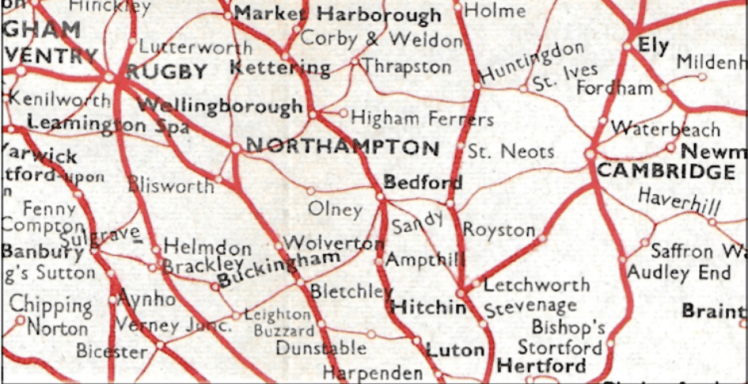
Above – from the RCTS page on the Kettering – Huntingdon – Cambridge line
Further down the same webpage we can see how fast those old branch line steam trains could get from Huntingdon railway station to Cambridge.
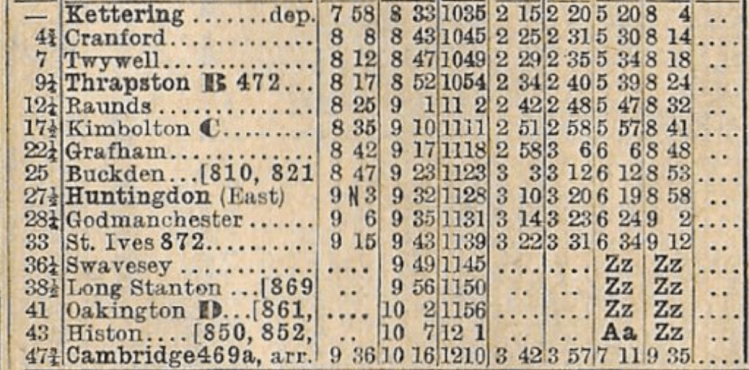
Above – from the RCTS page on the Kettering – Huntingdon – Cambridge line Timetable 1939
So in 1939 you could get from Huntingdon to Cambridge by steam locomotive in around 40 minutes. How does that compare with the Guided Bus service envisioned in the expensive consultants reports?

Above – Busway timetables featuring the flagship T1 Tiger Bus Service
Even given the benefit of starting from the bus station bay and arriving at Drummer Street instead of the further journey to the railway station in Cambridge, it takes an hour. And that’s assuming you don’t get stuck in traffic once your busway route hits Milton Road. Which is a traffic jam in the best of rush hours.
So instead of pushing for a reinstatement of the railway – or even an electrified light rail alternative, we ended up with the worst of both worlds:
- A system that cost far, far more than budgeted for (to the extent that the county council and the main contractor BAM Nuttall had to settle out of court)
- A system that still gets caught up in motor traffic even though it was meant to play a significant part in reducing car-based traffic
- A system that despite very high user numbers in the mid-2010s was still below the target set by the promoters – a county council spokesperson saying that the delay in the build out of Northstowe plus the delay in opening (even though that was several years before!) were to blame.
Also, see the article by Smarter Cambridge Transport on the guided busway from 2021.
It wasn’t all bad news – the unexpected success of the cycleway had notable public health benefits:
“Proximity to the busway was associated with a large increase in active travel commute share and a large decrease in car mode share, a pattern consistent in part with the perceptions of busway users found in the intercept survey”
Above – Health Impacts of the Cambridgeshire Guided Busway (2016) Ogilvie et al, p63/91
The report above helps make the case for any future public transport corridors (busways, rail, light rail etc) to have the service roads doubling up as well-maintained cycleways and footpaths.
“Users said they liked the busway in a major survey from 2017”
I remember this at the time – and actually it’s a really useful survey and is worth reading what the passengers at the time said.
“The vast majority of respondents were satisfied with the Busway and felt it was a success, noting the speed and efficiency of their journeys.”
Above – Systra (2017) for the GCP, para 3.3.1
If I was a regular bus user who used the busway buses to get to college or work along the segregated sections only, chances are I would have responded similar. Having been on the busway on several occasions over the years, going on the concrete rails ***is quite good fun*** when your day-to-day bus experience is being stuck in traffic on Hills Road or Cherry Hinton Road.
The big risk is then misapplying those conclusions to future transport projects.
“Speed and reliability of journey, and frequency of service are key service elements which motivate people to use the service. Even though service frequency was cited as a main reason for using the Busway, around a third of respondents felt that more buses per hour would encourage greater use of the service.”
Above – Systra (2017) for the GCP, para 3.4.3 (my bold in the italics)
This is an important consideration for the C2C Busway whose public inquiry public hearings have just ended. Because if your busway buses are going to get snarled up in motor traffic as they will do when the buses from Cambourne hit Grange Road as is currently the plan, speed, reliability, and frequency of services will all be hit.
The Cambridge Connect proposals that I’ve supported ever since they were launched a decade ago deals with that problem through the underground tunnels – which while inevitably far more expensive than an overground only route, have been proposed by previous and subsequent transport schemes. The way that local government is [under]-funded means that any major transport infrastructure project needs central government funding – just as the first guided bus project did.
Which comes first? The transport proposal or the money?
The problem with the GCP/City Deal was the funding was announced *before* any decisions had been taken on the transport solutions being funded. Furthermore, the midst of austerity was probably not the best Political environment in which to be doing major public engagement.
A quick contemporary political history of how we got to here
In the early 2010s when the City Deal was being negotiated, Cambridge City Council was led by the Lib Dems, and the County Council & South Cambridgeshire District were led by the Conservatives. We got this because party politics. The Conservatives refused to agree to a Cambridge Unitary because they knew they could not control it politically. (This also explained the current Combined Authority that squishes two very different areas with different political cultures and very different economies together – which in part is why it has been so dysfunctional over its existence). Fast forward to 2021 and the Conservatives had lost control of both South Cambridgeshire and Cambridgeshire County, while the Liberal Democrats that had negotiated the deal during the Coalition Government had long been turfed out by the voters of Cambridge back in 2014. With Cambridge’s electoral history of voting *against* the party in government, Labour councillors are inevitably facing pressure from their party political opponents – not just the Liberal Democrats, but the newly-invigorated Green Party who could hold the balance of power in six months time.
“So…coming back to the guided busway, that survey says that passengers like it, but…?”
It needs to be more than that. To judge whether a new piece of transport infrastructure is a success in terms of ‘value for money for the tax payer’, we have to look at what the original purpose of the proposals were. In particular we have to look at the targets and estimated impacts. Because there were some unexpected big successes that were not part of the original proposals.
“Such as?”
The picture gets even worse when we look at the post-lockdown recovery data on strategic road network motor traffic
The Transport Monitoring Report 2024 from Cambridgeshire Insight – it’s worth reading the report in full because it gives a much bigger picture and a broader context too.

Above – the headlines from Cambridgeshire Insight
The fall in bus passengers and the rise in motor traffic on strategic roads is worrying. When we look at the geographical breakdown, it’s grim. It’s the strategic road network in Cambridge and South Cambridgeshire that’s caused most of the rise.
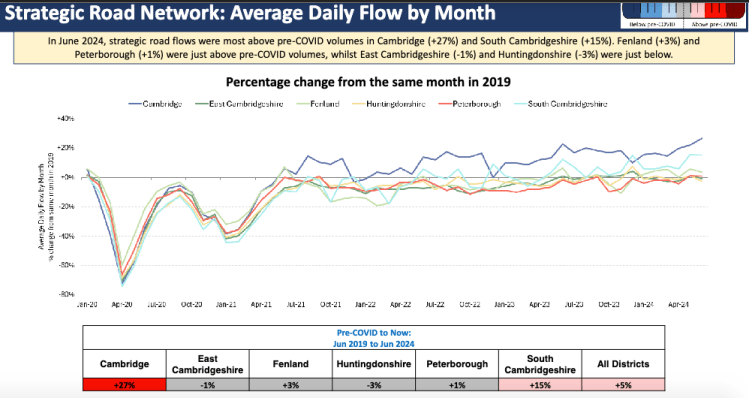
Above – Percentage change in average daily flow 2019-2024. Cambridgeshire Insight
Peter Freeman to face Cambridge City Council
He’s due to anyway on 09 December 2025. My case for light rail is that the growth ambitions of ministers are so great that guided busways will not be enough. Furthermore, the urgency is so great that it would be far less risky to go with untried technology instead of a tried and tested system that is already used in other cities, has multiple possible suppliers and supply chains (and is thus more resilient due to the alternative firms/suppliers available). Let other cities that are not experiencing such huge growth pressures try out new technologies. Not everything new and sparkly has to be in Cambridge.
Food for thought?
If you are interested in the longer term future of Cambridge, and on what happens at the local democracy meetings where decisions are made, feel free to:
- Follow me on BSky
- Spot me on LinkedIn
- Like my Facebook page
- Consider a small donation to help fund my continued research and reporting on local democracy in and around Cambridge
- Have a look at the date for my next workshop on the future of Cambridge

 The Cambridge Town Owl