When I say *clash* I mean minor disagreement in a session where councillors get to scrutinise the decisions taken by executive councillors. So what happened was actually completely normal and councillors doing their jobs. That said…
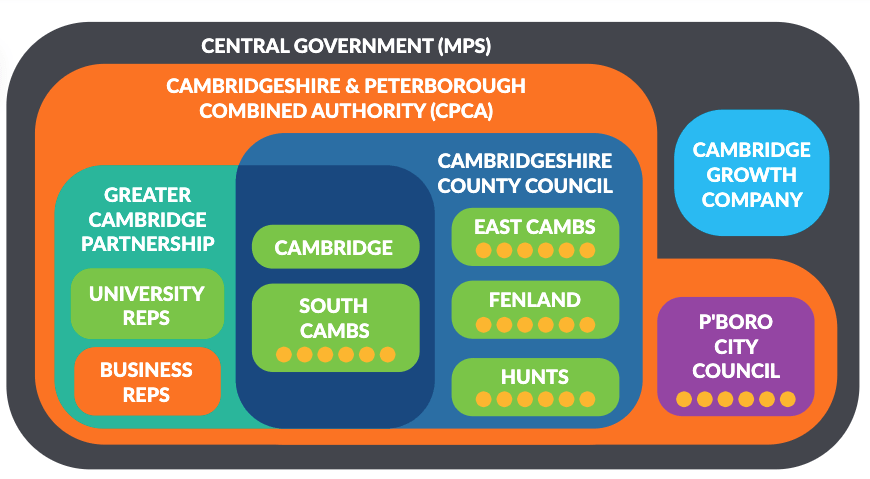
What the exchanges between Cllr Bridget Smith (LibDems – Gamlingay and Leader of South Cambridgeshire District Council) and her Conservative opposite Cllr Heather Williams (Cons – The Mordens) highlighted was how the local governance structures break down – and have been broken for over a decade if not longer.
South Cambridgeshire District Council Full Council
Have a watch of proceedings from 1 hour 10 mins here
Cllr Williams: “Why did the Liberal Democrat leader of the council abstain on the local growth plan?”
Cllr Smith: **Because the Mayor of the Combined Authority refused to remove direct references to light rail**
“Hang on – didn’t the Mayor Paul Bristow win the mayoral election with a clear commitment to a new light rail for Cambridge?”
He did. But then on the same day the Liberal Democrats won an absolute majority of councillors on Cambridgeshire County Council – which has veto powers over his Local Transport Plan – something that he is required to commission and sign off.
We’ve sort of been here before – when the Conservative-led Peterborough City Council vetoed Labour Mayor Nik Johnson’s local transport plan in 2023.
In this case Cllr Smith’s abstention was exactly that. A sort of ‘I don’t agree with it but I’m not going to block it’. Furthermore, one could argue that with the final set of local elections coming up in South Cambridgeshire District before the council is vanquished in the local government overhaul, and with the shadow council for what will become the new Greater Cambridge Council being formed in April 2027, there is only 18 months left for the existing city and district councils to do anything substantive.
“Should Councillor Smith have voted for the growth plan of a Mayor from an opposing political party?”
I don’t know – it’s not my call. (Recall in the 2023 Cambridge City Council elections I called for the abolition of the county and district-level councils to be replaced by new unitary councils, and also called for the abolition of the Combined Authority! And got over 8% of the vote in Queen Edith’s from a standing start)
At the same time, I think there’s a reasonable call for the councils to hold mandating meetings or scrutiny meetings in the run-up to events where big decisions are made by executive councillors on behalf of their local councils. One of the reasons local transport planning in Cambridgeshire is such a mess is because of the multiple failures of the political and governance structures related to the Greater Cambridge Partnership. Those failures were reflected by the collapse of the City Access Project that involved proposed congestion charging that had no electoral mandate from the voters.
If only they had read up on local history!
Exactly.

Above – you can read the paper here
“What did the paper conclude?”
I’ve picked out some key lines from their conclusions. Remember this was written in August 2008.
- “There needs to be one or perhaps two clear objectives for the introduction of any system of charging. If there are too many this will cause confusion and obstruct taking forward the charging policy.
- There needs to be clear policy development and locally driven political support.
- The prospective charging system needs to be simple to comprehend, the charging regime’s operation from a user’s perspective needs to be as near as possible foolproof and/or tamper-proof and the payment mechanisms automatically executed.
- The privacy of individual users needs to be respected and protected.
- To undertake a provincial congestion charging system requires significant investment in the charging system itself and alternative public transport and other modal facilities.
- There needs to be engagement at an early stage with major stakeholders and then with the general public.
- In the Cambridgeshire situation it could be argued that physical demand management measures have been exploited to their fullest.
- There are likely to be many direct gainers and some losers with the introduction of a congestion charging system.
Above – while there were the meetings, the consultations were miserable experiences, turning critical friends into hostile adversaries.
“Our biggest regret is that we didn’t manage to prevent GCP from destroying public trust and goodwill by commissioning frustrating surveys and running tin-eared consultations, only to then progress the schemes they started out with.”
Above – Smarter Cambridge Transport 2021
Not only was the author of that piece, Edward Leigh, later to go on to give evidence *against* the application for the Cambourne-to-Cambridge Busway, but the new Combined Authority Mayor Paul Bristow also did as well – stating that as the CPCA Mayor he had the legal powers under the bus franchising models and legislation to decide what the bus routes would be. He was under no compulsion to use a busway that he didn’t like and that he did not vote for. Hence whatever recommendation the planning inspector’s make by next summer, the party political fallout will be one thing to watch out for.
“How would things have been different in your proposals?”
- One unitary council with boundaries covering the economic sub-region.
- Maintaining the links to communities with enhanced town and parish councils, and possible urban parishes for Cambridge City.
- Far wider and much greater tax-raising powers for unitary councils to help raise revenues for infrastructure and services – independent of Whitehall (and also to help tame the extreme inequalities of wealth/poverty, and exploitation of land value uplifts)
- All underpinned by a lifelong learning renaissance, and a revival in civics and democracy education alongside science education and practical skills that we will need collectively in response to the climate emergency now here.
…amongst many other things.
The point being that as MPs raised in the OxCamArc (I’m not calling it a ‘growth corridor) debate in Parliament earlier, multiple committees and rhetoric of partnership working does not guarantee that the participants will get on with each other. The one thing I have never been clear about is:
***Who is the party political champion of busways?***
Only none of the candidates at the Combined Authority Mayoral Elections earlier this year (2025) stuck their necks out and backed busways.
Which is why I hope that despite my extreme reservations, the mass transit review does not lumber us with more busways.
Food for thought?
If you are interested in the longer term future of Cambridge, and on what happens at the local democracy meetings where decisions are made, feel free to:
- Follow me on BSky
- Spot me on LinkedIn
- Like my Facebook page
- Consider a small donation to help fund my continued research and reporting on local democracy in and around Cambridge.

 The Cambridge Town Owl