
Anglia Ruskin University are going to try and revamp their bits of it – but I’m not confident given the record of their architects given the latter’s back catalogue of building designs that di little but generate range and fury in my neurodiverse brain.
I stumbled across their proposals at this planning committee meeting at The Guildhall. Some of you may want to compare them to the Campus Redevelopment Plan from ARU published in 2009. How do they compare?
The people presenting represented Anglia Ruskin University (of which I am a former student from many moons ago) and the Cambridge Architects Firm MCW, which has a long-term partnership with the former.
This is a tricky one for me to write, because much as I am tempted to do a hatchet-job-of-a-blogpost, I’d rather look at broken systems, structures and processes. The reason being that as with Brookgate, if you magically got rid of them someone else would step in and do the same thing.
“You mean you don’t want a dragon to breathe fire on their works and burn down all their ugly buildings so that someone else can have a go and do better?”
No – think of the carbon emissions for a start. (Local political-social-media-cultural reference from the 2010s)
“So, what’s the story?”
It’s the DFD Masterplan item for Anglia Ruskin – DFD being Development Framework Masterplan.
“There are no papers with it”
That’s why all I’ve got at the moment are fuzzy screengrabs from a low-res youtube live-feed.
Essentially, the story is one that sounds familiar to so many people who find a lot of contemporary public architecture aesthetically displeasing – or perhaps uninspiring. Not surprisingly it has led to the rise of groups like:
….and with the latter, research in the emerging field of neuroarchitecture about the mental stress that too many contemporary designs generate in our brains.
“Neuroarchitecture brings architectural elements in conversation with our bodies and our nervous systems. It reminds us that we are in a reciprocal, ever-shifting relationship with even the most seemingly inconsequential of spaces, and legitimises long-held ideas around art and architecture’s ability to impact our psychology and physiology.”
Above – Insights from Foster and Partners 11 Oct 2023
“So what’s so objectionable?”
The architectural firm are responsible for the grey themed creative quarter at ARU which looks anything but creative unless it involves giving the students lots of spray paints to create their own murals on it.
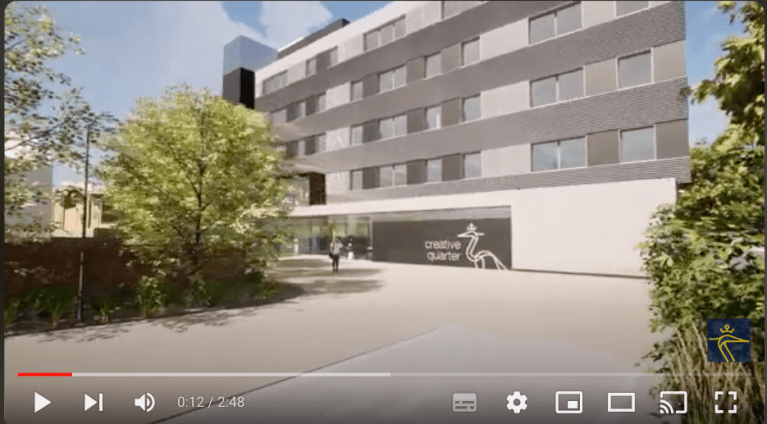
Above – a screengrab of the simulation of walking through the Mackenzie Road/Collier Road entrance by the Mill Road Cemetery
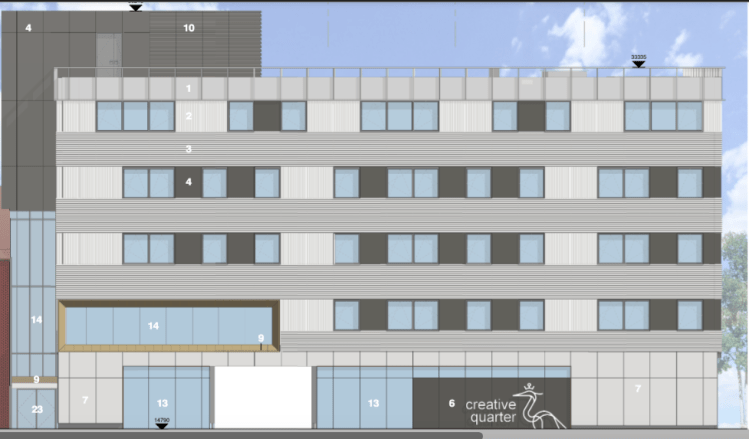
Above – from the architect’s design 23/03907/FUL – can you see the ‘Creative Quarter’ lettering? Take that and the heron icon away and what would you think that such a building design would be used for? Hardly a creative quarter!
I moaned about how ‘orrible the proposals were back in 2023 here and presumably was so infuriated by the proposals that having submitted an initial objection in the planning portal during the consultation phase, I ended up submitting another. Not even the controversial Cambridge Station area developers can claim that accolade!
“What did the Greater Cambridge Shared Partnership Planning Officers do?”
They ignored me – even though I mentioned the bits of planning policy that had been contravened (in my humble opinion) and raised the various statements made by the then Secretary of State Michael Gove about how ‘orrible such grey ugly buildings were. On the other hand, if the design was an architectural response to the politics of Michael Gove, I could have let that one slide!
“Can’t they both lose?”
Sadly not.
Anyway, the industry stereotype (in the eyes of us non-professional opinionated types!) :
(I’m not claiming any factual accuracy on the below!)
- Design firm of smart-casually-dressed professionals
- Middle-aged male architects the majority of the leading partners
- Offices based in one of the most sought-after historical parts of the city for small businesses in very old buildings with lots of nice interesting detailing and built to a quiet human scale. Also interestingly close to if not part of the home of Hugh Fraser Stewart and family (father of musician Ludwig, and anti-fascist warrior Frida)
- And in this case a back catalogue of buildings utterly lacking in colour, filled (in the case of ARU) utterly lacking in historical references and detailing, and instead full of grey, brown, and beige.
- A list of the various architectural awards they’ve won. Which reminds me of what Sir Humphrey Appleby said about the architect of the National Theatre when Sir Bernard said it looked like a carpet sale warehouse.
Which is why I utterly despise those sorts of designs with the fury of a big dragon
But not being a big dragon, there’s precious little I can do beyond the online equivalent of writing a letter to the editor of a local newspaper in green ink.
“What does the National Theatre look like?”
A nuclear power station. According to the then Prince of Wales – now The King.
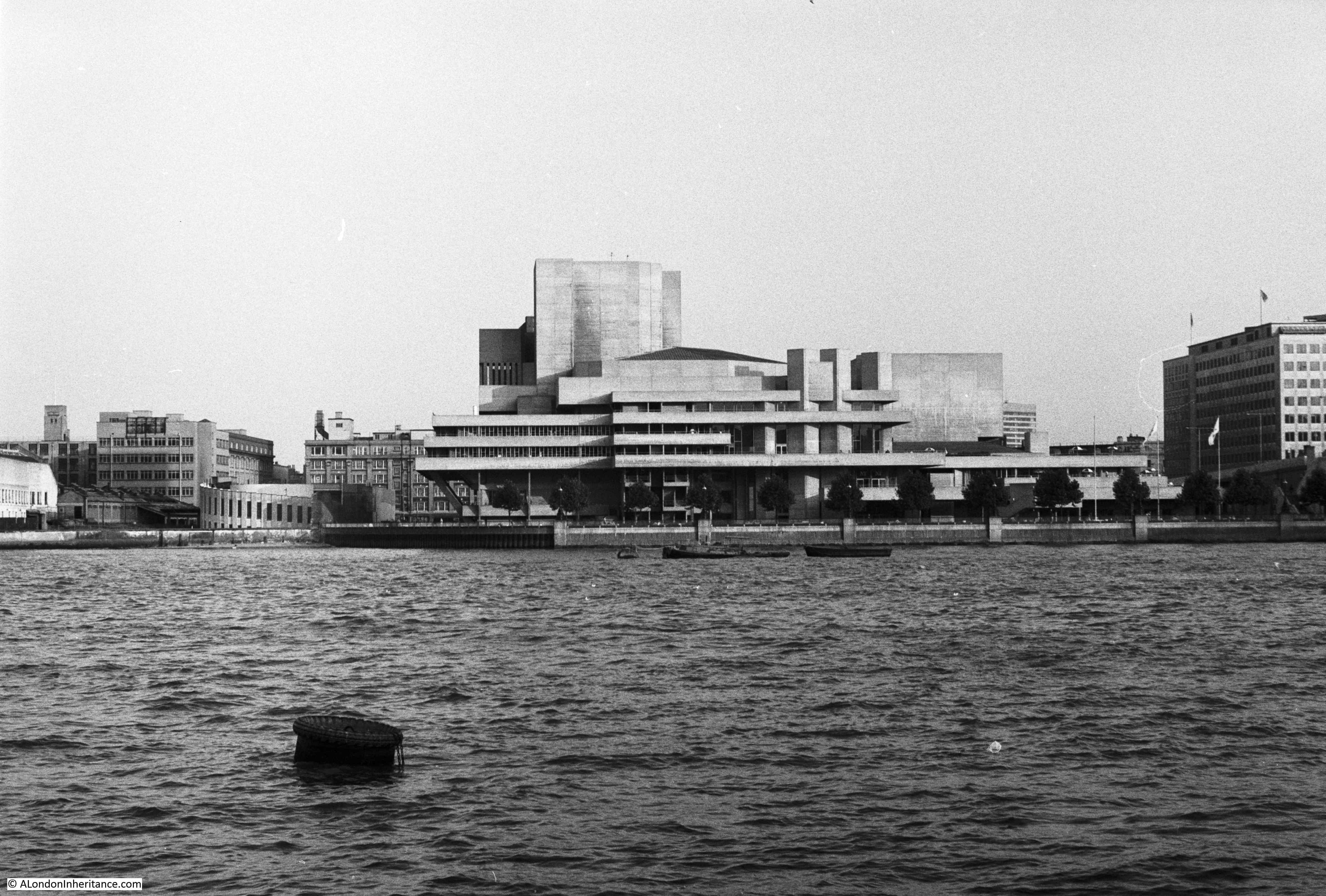
Above – “The National Theatre building has always been a rather controversial design. In 1988 the Prince of Wales described the theatre as “a clever way of building a nuclear power station in the middle of London without anyone objecting”, which is a rather good description.” As described by A London Inheritance.
So, what are they proposing for East Road?
This is their proposed new entrance for the front of East Road next to the ZBC.

Above – from the video presentation to Cambridge City Council around 1h14m.
“In principle I could live with that”
In fairness they did say that this was not the set design – rather it was an example of what they said could be done if the building (the Helmore Building – I’ve had meetings and lectures in here over the decades) were stripped back to its steel frame. Also, as a starting point I think I could work with that.
The image above sort of reminds me of the AI-generated station image Create Streets generated.

Above – Create Streets Full Report p11
The problem being with such images is that such has been the widespread use of them in so many different contexts that understandably many are now dismissed as ‘AI-slop’. And that’s before we consider the environmental footprint and copyright issues, or some of the questionable links to menacing political forces that some social media pages featuring such design styles can lead to.
But perhaps more to the point with the East Road entrance to ARU, how can the whole of that wide street front be made ‘active’ to the extent that the urban design becomes a built in safety/crime suppression feature because the open space at the front has so many people and facilities looking over it?
In the much longer term, ARU looks like it wants to expand its premises either side of the Grafton Centre along East Road as the screengrab below indicates.
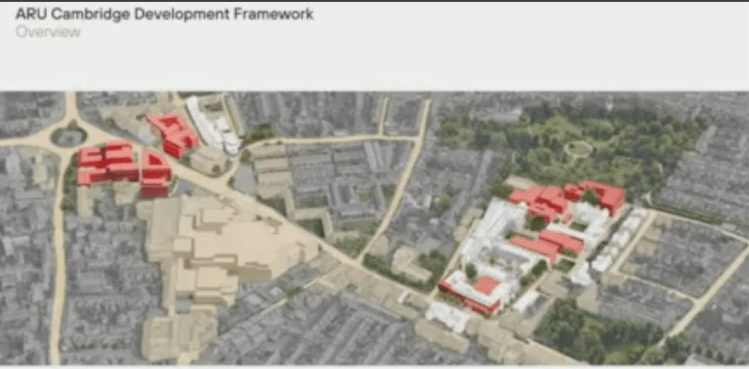
Above – from Cambridge City Council’s Planning Committee – note in the audio Cllr Naomi Bennett (Greens – Abbey) quite rightly questioning the anticipated student numbers in the future given the instability in the higher education sector
Abbey Ward being next door to ARU faces issues on students commuting in and parking in residential streets – the story of so many neighbourhoods with large further and private education establishments whose students are old enough to get driving licenses. Cllr Bennett also rightly raised the issue of transport – especially if the densification leads to more students commuting in. (Hence my calls for a new light rail/suburban rail station at Coldham’s Lane below)

Above – a surburban/light rail stop at Coldham’s Lane Bridge would be sufficient to enable a frequent bus service to take passengers from such a station to East Road.
Alternatively, a segregated active travel route could also be designated – one that could benefit local residents too.
Without doing a hatchet-job on the firm of architects or on ARU, who could do what to reduce the likelihood of another hostile planning application that infuriates residents and ends up being rubber-stamped by the system?
Three things to consider in the longer term
One thing to consider is that East Road is one of the main gateways into our city. And at the moment nearly all of our gateways are surrounded by substandard urban design. And that’s being polite. Can the post-2020s generation do better than the previous ones?
On the proposals featured in the planning committee, one of the first things that stands out is their proposal to do something big at the junction of East Road and Newmarket Road – a challenge that dates back to Holford and Wright – and possibly even further to the 1890s when Parliament approved the construction of not just one, but two new bridges over the River Cam. (River Cam Bridges Act 1889 which made provision for the building of Victoria Bridge, and later Elizabeth Way Bridge).

Above from MCW/ARU – which is worth browsing through to get a big picture overview
This is going to be the main gateway into Cambridge from the east. The challenge isn’t just how to avoid making it even worse than it already is (something that the Kett House Karbuncle proposals are failing at so far.) but how to go about getting input from those who not only live in the area but also work, visit, or pass by on a regular basis. Then have an open-minded artist/architect/designer to come up with something that can harness the best bits of the feedback to come up with something imaginative, iconic, sustainable, and something that people will be proud of to have in their area. Not some asymetric cheapo-clad monolith that could be anywhere. Think of the University of Brighton and the Lewes Road monsters. That’s what they should be avoiding. Again, I come back to Dr Cleo Valentine’s research on all things neuroarchitecture.
The second thing to consider is evaluating previous proposals
This SPD is from 2011 and shows how miserable the old warehouse looked along a very hostile streetscape.

Above – have a browse of the SPD here
What I think is really interesting is how some of the challenges raised in the presentations in December 2025 were covered (and clearly not resolved) in the 2011 SPD
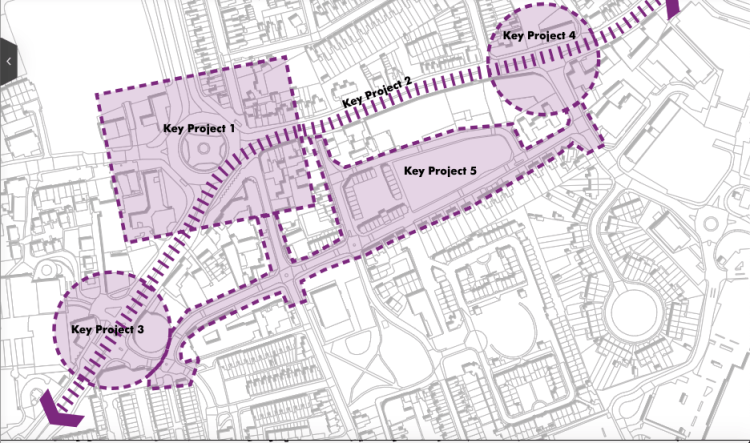
What were we successful at? What were we not successful at and why? What can we learn from the failures to redesign and improve/make more pedestrian friendly the road junctions highlighted in the map?
Key Project 1 is the remodelling of the underpass – which remains work in progress.
Key Project 3 outside the Crown Court – personally I think we should move to a single legal quarter with county, crown, and magistrates courts co-located on a civic site with schools of law and even a police station. As was proposed in the 1950s and 60s on Castle Hill.

Above – from Lost Cambridge featuring the abandoned proposals from 1967
***Give us our upside-down flying saucer from 1986 you scoundrels!!!***
A little bit of local history here: When the Carioca Nightclub on Newmarket Road – previously the old Primitive Methodist Tabernacle (which always reminds me of Ian Hislop’s B side for Spitting Image’s hit ‘Santa Claus is on the dole’ of the same era) got burnt down by a thug, local young people decided that their peaceful campaigns for a new music venue had gone far enough and occupied the old cycle warehouse on East Road that was due for demolition. Police tried to evict them and they had a riot. Which persuaded the politicians of the day that they really should build a new venue somewhere. One of the proposals put forward was to convert the underpass into a new arts and music centre

Above – the rejected upside down flying saucer design from 1986
As a result, we got The Junction which opened in 1990.
“And the third thing”
I think ARU should go far, far beyond the ‘standard’ engagement for their very long term plans and incorporate a new generation of part time & evening classes and civic workshops for city and county residents where we can learn together about the governance of our city, county, and country, learn about the planning system, urban design, civil engineering, etc and apply that learning to our collective responses to the climate emergency. As I’ve written before, we have no idea of the changes we will be forced to make by the climate emergency, and the collective efforts involved. And it will come as a major shock when our circumstances force our hands.
If you are interested in the longer term future of Cambridge, and on what happens at the local democracy meetings where decisions are made, feel free to:
- Follow me on BSky <- A critical mass of public policy people seem to have moved here
- Like my Facebook page
- Consider a small donation to help fund my continued research and reporting on local democracy in and around Cambridge.

 The Cambridge Town Owl