There were seven people from the Cambridge Growth Company there this evening – which is why I was a little disappointed that there were hardly any people in the public seats
TL/DR? Watch the meeting here from Cambridge City Council’s stream
*Note to Cambridge City Council, please could you upload the CGC slides to the meeting papers?
It wasn’t so much a chance to grab the ear of the Chair of the Growth Company, rather a chance to speak to his growing team of specialist advisers, who by the sounds of things are not going to give developers a blank cheque for profit maximisation and cost-externalisation at the expense of local residents. That said, his instructions from the Minister for Housing and Planning are crystal clear.
A reminder
“We have previously agreed several high-level principles that the Cambridge Growth Company must adhere to when developing plans for ambitious and sustainable growth in Greater Cambridge. When it comes to the growth strategy, development on a more dispersed geographical footprint is perfectly acceptable, but one or more contiguous urban extensions of the city [of Cambridge] must be core components of the vision the Growth Company brings forward, in order to maximise the benefits of agglomeration.”
My PQ was related to what the overall future vision was going to be – because I’m still not sure what it is, let alone who is responsible for it. Other than perhaps the Minister for Housing who wants a much bigger city providing much more wealth and much higher tax revenues for the exchequer.
“Given the huge scale of growth that ministers are proposing for Cambridge, what considerations have Cambridge City Council and the Cambridge Growth Company given to the regional level facilities that Cambridge does not have but more than likely will need, including but not limited to:-
- a new urban centre as recommended by John Parry Lewis in his report on the Cambridge Sub-region in 1974
- a new large concert hall as mentioned by the CPCA Mayor
- a new large lifelong learning centre mindful of the skills crisis
- new world class transport hubs.”
At the end of my remarks I fired a barb at the Kett House Karbuncle developers because I’m finding the prospect of that horrible building being one I’ll have to go past almost daily, to be destabilising.

Above.- A design that IMHO shows nothing but contempt for the city of Cambridge
“Why are we having a development corporation again?”
Cllr Jamie Dalziel put that very question to Peter Freeman.
Have a listen to Mr Freeman’s response here
Interestingly, Mr Freeman indicated that small/routine planning applications would be dealt with by the Greater Cambridge Planning Service as normal. Furthermore, routine roads issues including potholes/maintenance would carry on with the county council.
The Q&A session was really useful – and superbly chaired by Councillor Katie Porrer
It’s actually really difficult to chair a meeting on a topic that is both highly controversial and intellectually dense – and be able to summarise who said what mindful that three party political groups and one independent councillor were represented. Furthermore, chairing such meetings is mentally intense – something now way beyond my capacity these days. Even with the 20 minute break it was a good 3 hours or so of exchanges. Having to concentrate for that long is tough going. Especially in this era when people can scroll back the official footage to see who said what.
I posted lots of stuff on BlueSky but my neurodiverse-brain is so frazzled I can hardly remember a thing, so feel free to browse through the posts here. (I turned up to the meeting having had very little sleep the night before which is never a good thing).
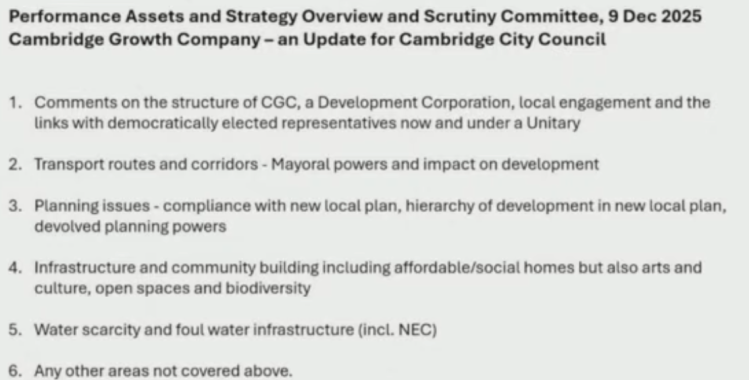
The themes of the questioning were as below:
Above – screengrabbed from the council’s YT Channel
- Comments on the structure of the Cambridge Growth Company, and on the looming development corporation. Local engagement and relationships with local councillors both now and under a unitary council
- Transport routes and corridors – tensions with the Mayor’s policies vs Greater Cambridge Partnership esp busways vs light rail
- Compliance with the emerging local plan
- Infrastructure, community facilities, affordable and social homes, arts, culture, open spaces, the environment
- Water scarcity (supplies) and sewage capacity
- Other areas not covered
Things that stood out (based on prompts from my social media feed above!)
Anglian Water have now become a major risk to delivery
There is a ministerial level task force working on water scarcity, as Peter’s deputy, Beth Dugdale mentioned here. (Although what that means I’m not really sure in terms of practicalities). I was surprised to find how Anglian Water were not being co-operative with Peter Freeman – first of all not offering to absorb some of the cost increases associated with the relocation, and secondly imposing objections on major planning applications. It reeks of pursuing a very narrow commercial agenda irrespective of the merits or otherwise of moving the water works. Note that Mr Freeman also predicted that at some stage the plant would have to move and/or a new sewage processing plant would have to be built given the size of the growth demanded by the Minister for Housing.
Former Mayor of Cambridge Cllr Jenny Gawthrope-Wood cites concerns that developers will try and water down commitments on social housing and sustainability
Mr Freeman said the Development Corporation has far more influence than a local planning authority because the land involved passes through its ownership/hands, or the developer itself would have been appointed by the Development Corporation to develop that particular plot of land. Which means if they suddenly say they cannot do it, they risk losing the contracts.
The proposed Development Corporation will be supporting the standards in the emerging local plan, not undermining them
One of the significant concerns that councillors had was that the Development Corporation would impose lower standards than what councillors had voted on in the draft local plan. Which means that the examination in public – where developers and their expensive barristers and consultants try to water down the standards (I filmed lots of them trying to do so in the run up to the 2018 local plan for FeCRA!) will be a critical period. I’m hoping this time around the councils will be using their own in-house equipment.
Transport infrastructure and the differing policies between the Greater Cambridge Partnership and the Combined Authority Mayor remain an issue
Have a listen to the former Mayor’s question here – the context being that Mr Freeman gave evidence in support of the Cambourne-Cambridge busway and has also given support for the CSET busway, while Mayor Paul Bristow was elected on a manifesto that favours light rail. Mr Freeman is hugely concerned by the continued delays and the time taken for both – hence the sense of ‘The plans are there, get on and build them’ rather than going back to the drawing board with light rail. What Mr Freeman and team won’t know the background of were the multiple failings of the GCP and the tortuous journey to get to the point of a public inquiry. It should not have taken over a decade to get to this point.
It’s still very early days in thinking on things like community infrastructure, arts, sports, and leisure
Have a listen to Cllr Patrick Shiel (Labour – Arbury) here on what I thought was a good question that should be of interest to children and young people in particular.
I followed this up in conversations with CGC officers on how we can go beyond the traditional discrete consultations with children and young people and work with schools in the run up to the start of academic years to enable a more continuous engagement over a period of time – especially where building work is happening near by that will take a number of years. Could this be built into the emerging citizenship curriculum when the guidance and syllabuses come out?
On the arts, the CGC are on the lookout for contacts in the arts sector – hence pointing officers towards CamCreatives and former councillor Hilary Cox Condron.
Local history matters
Additionally, Cllr Karen Young (LibDems – Queen Edith’s) highlighted how large the area of land was likely to be – and the complications associated with it. Are there lessons from previous corporations? (Peterborough (1968-88) is one such here).
The Development Corporation does not want to repeat the mistakes of the Greater Cambridge Partnership
Have a listen to the questions from Cllrs Hugh Clough (Greens – Newnham) and Beth Gardiner-Smith (Labour – Romsey). Beth Dugdale responds for the CGC.
Peter Freeman spoke highly of Copenhagen and how it had been transformed over 30 years.
Have a listen to his comments here. Which made me wonder how the governance structures in Denmark differed from the UK on the central-local relationship. Hence asking Karen Melchior, a former Danish diplomat who I got to know during my London days (she was based at the Danish Embassy in London) who lives there. Karen is also a former MEP who was part of the Liberal Democrats’ group so already knows some of our local politicians. (Cllr Lucy Nethsingha (LibDems – Cambourne, formerly Newnham) having served as an MEP in the final European Parliament before Brexit). My point being it’s useful to have the input of someone familiar with both systems of government (and cities) if Mr Freeman intends on using Copenhagen as something to aspire towards.
The big picture question the decision makers need to provide an answer to
“What does this new ‘Greater Cambridge’ need to have, and where, in order for our expanded city to become greater than the sum of our parts?”
Because as Cllr Dave Baigent (Ind – Romsey) said, we’ve got to get away from our addiction to the motorcar. For example that means having a public transport network that isn’t just a series of A-to-B networks. Rather it is one that it so well inter-connected that it creates incentives for people to use it to take part in things that they might otherwise not even think about taking part in. Whether it’s that last-minute gig ticket at a community performing arts venue like The Junction, through to going to the Cambridge Ice Arena/rink on a regular basis because public transport means it becomes a point-to-point journey.
Hence one future task I’d like to see is a pack of very large and lavishly illustrated maps that show different infodata superimposed onto the same geographical area. And that’s not new. Does that sound new? It shouldn’t. Over 90 years ago this is exactly what William Davidge did under the auspices of Dr Alex Wood – whose name should be familiar to Cambridge Labour Party members.

Above – proposed protected green spaces and new roads and bridges as proposed by Davidge’s report. (See here for the accompanying text)
One of the barriers that the committee and Mr Freeman discussed (but did not have a substantive response for) was the problem of health care facilities being built but not occupied by the local health services. Which is a fragmented public services issue. This is something that I think the development corporation and Mr Freeman could use their influence to lean on. Because I got the sense from his team that they were willing to address the ‘too difficult to deal with’ issues put back for decades and in a way not done before. That doesn’t mean them taking on those issues, but forcing those responsible for them to deal with them.
We live in interesting times.
If you are interested in the longer term future of Cambridge, and on what happens at the local democracy meetings where decisions are made, feel free to:
- Follow me on BSky
- Spot me on LinkedIn
- Like my Facebook page
- Consider a small donation to help fund my continued research and reporting on local democracy in and around Cambridge

 The Cambridge Town Owl