This follows on from my October 2025 blogpost when we all heard the news
Ten years ago you would have had an event full of live tweeters/bloggers for an event like this, with feedback coming in from outside. It speaks volumes of social media and the chaps at the top that the tools and cultures needed to sustain these activities are no longer fit for purpose.
The event was run by former Guardian investigative journalist Shiv Malik and team
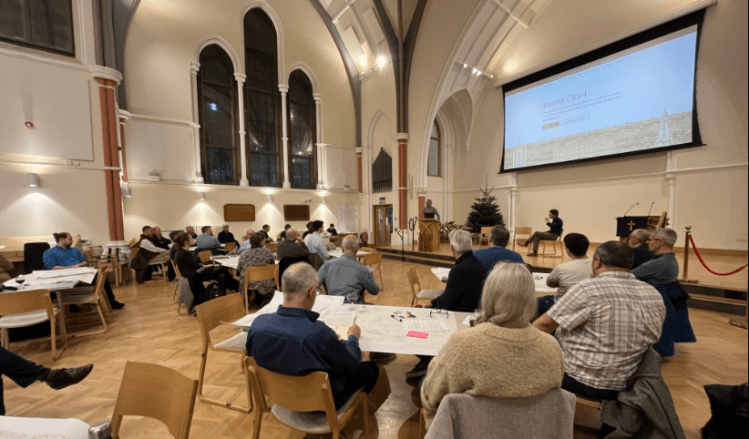
Above – a photo from the venue – Dr Alex Wood’s old chapel (Downing Street Church in Cambridge). Is Bluesky less popular than I’d like to believe, or was I the only person interested in the topic?
For those of you who didn’t get the Alex Wood reference, the Cambridge Physicist, pacifist, and former leader of the Cambridge Labour Party used to preach here. He was also the politician who oversaw the composition of Cambridge’s first regional development plan that was written by William Davidge in 1934 for the old Cambridge County Council (as Cambridgeshire County Council was sometimes called). Hence the link to an event which covers so many of the same issues.

Above – Davidge’s report included a series of maps formed from the administrative county council boundary covering a range of different themes.
This map shows the first cases of land designated as being protected from development. You can see the impact the early Cambridge Preservation Society (today’s Cambridge Past, Present and Future) had on protecting the town (King George VI made us a city in 1951) from urban sprawl that affected Oxford.
What the Forest City event in Cambridge was trying to do had some similarities in trying to get an idea of some principles needed in order for their vision to be developed and realised
But let’s be clear from the start: very, very few proposals like this go on to become built to completion
The British Newspaper Archive is full of articles about plans for new settlements that vanished into thin air. The odds of this or any other scheme succeeding – even those with government backing, are not high. The living nature of towns and cities is that there is no ‘ending’ – not without a violent catastrophe. (War, act of deity (eg volcano), or something like the climate emergency).
“So, what happened then?”
We turned up, listened to some speeches, asked lots of questions, did some group work around very large print maps, and went home.
It wasn’t meant to be a big corporate bash or a slick big-budget event. The concept is still in its very, very early days.
Think of me organising and running an event along the lines of…I don’t know, how to build a new urban centre for Cambridge on the airport site anchored by Cambridge East Railway Station, a new large concert hall, a lifelong learning college, and a new city hall for the unitary council. That.
If that makes things sound a little bit disorganised or unclear, that’s because at this early stage it’s meant to be. Furthermore, it’s worth asking (from a political literacy perspective) what the sequence of actions are when it comes to building the next generation of new towns. (As an aside, one of the most useful things Mr Malik and co could do is to set out clearly what the political processes involved are, and how similar/different they are to the site selection for the new towns and urban extentions. i.e. Who £benefits?)
The most important statements from Mr Malik at the event for me were:
- His statement that ‘There is no starting from scratch’. The area of land (West Suffolk east of the A11) they are looking at is one with nearly 10,000 people scattered across the area, with villages that have long and unique histories. Therefore any proposals will have to work with those that are already there.
- His statement that ‘Chalk Streams are a personal red line’. If the proposals cannot safeguard the chalk streams – a globally-unique environment (just not precious enough to prevent water companies from polluting and over-extracting from them), then he’s out.
Who turned up?
There were people who had travelled from across England to get to the event – which was striking. Alongside that there were a scatting of people who were curious locals, through to people from the villages and towns of West Suffolk, including Haverhill.
Although I ran out of ADHD spoons so missed the workshop bits, it was clear from the choices of the participants where the strong interest was (technology and infrastructure issues) and where it was lacking. When it comes to event organising, you can only work with the people that turn up. That said, that there were only around six women out of the 40+ participants spoke volumes about the ongoing challenges the construction sector has about diversification. And it’s not just the physical building, but the consultancy and associated suit-and-tie-based professions (for want of another term) too.
The big milestone for the Mr Malik and consortium is getting Government backing to form a development corporation which would be responsible for getting the new forest city built
And the amount of work required to get to the stage where ministers are considering such things is considerable. Even more so for a new city of the size they are proposing.
“How does this compare with the Cambridge Growth Company?”
The previous evening I was at The Guildhall watching Peter Freeman and his team taking questions from Cambridge City Councillors – a meeting that lasted over 3 hours. (Watch the video here – Cambridgeshire people concerned about what is involved, it’s worth watching in full. Then follow up with any Qs to your councillors). The questions that Mr Freeman and colleagues answered may also inform participants (for/against/neutral) of the issues that they would have to address should their work progress.
Three things for the supporters and opponents of the proposals could explore
1 – Very early risk assessment: AKA How could all of this possibly go wrong? What does failure look like? What does catastrophe look like? How will you manage these?
2 – The people interested/involved inevitably reflect the interests of those involved in getting the project to where it is. Which issues, skills areas, interests are not covered/ missing?
3 – How does face-to-face meeting and events change the dynamic? Could be within groups of supporters, groups of opponents, or even events where supporters and opponents are debating each other.
Given how intense things are inside Cambridge’s 1935-era boundaries, and given the looming consultations on the CPCA’s Local Transport Plan *and* the Cambridge Growth Company’s first proposals, I’ll leave it to others closer to the area to keep a watching brief on this.
“Do you not have an opinion on it?”
Given the timescales involved and the huge challenges of growth local to me, I don’t really have the headspace to take on anything new and research it to the level where I’d want to give an informed opinion. In the grand scheme of things, the barriers are huge. It would be interesting to see what an initial high-level corporate risk register would reveal. (See p184 here for the grim risk register that Addenbrooke’s / Cambridge University Hospitals NHS Foundation Trust faces and you’ll see what an undertaking such an exercise is.) And that’s before figuring out how to respond to each one. Think water capacity, sewage capacity, capacity of the construction industry on labour and on raw materials, and then building all of the things that need to be built at zero carbon and you start to get a picture.
If you are interested in the longer term future of Cambridge, and on what happens at the local democracy meetings where decisions are made, feel free to:
- Follow me on BSky
- Spot me on LinkedIn
- Like my Facebook page
- Consider a small donation to help fund my continued research and reporting on local democracy in and around Cambridge

 The Cambridge Town Owl