Over the years I’ve tried to avoid commenting on the internal issues of the University of Cambridge – preferring to focus on the past, present, and future of ‘town’ which I’m much more familiar with. But this issue goes to the heart of what the University both is, what it thinks it is, and what it wants to become.
Image – from the campaign to save the Cambridge Vet School
Cambridge School of Veterinary Medicine’s assessment issues
Back in November 2024 the Royal College of Veterinary Surgeons gave the University of Cambridge’s Department of Veterinary Medicine notice that all was not well following an accreditation visit – meeting only 27 of the 77 accreditation standards. The RCVS extended their conditional accreditation rating last month following a more recent inspection. The latter link has a further link to the more recent inspection report, including a spreadsheet assessing how the School was judged against a range of criteria.
Regular readers of this blog may be familiar with my interest in institutional risk registers whether it be for specific workstreams (eg major public infrastructure projects) to the day-to-day running of institutions, to the success or otherwise of individual government policies. This stems from a case study in Parliament when the then Public Administration Select Committee experimented with crowd-sourcing questions on social media, something that sadly you could not do nearly as effectively today. The result was a stung Cabinet Minister who was told (following Qs I submitted via my old Puffles2010 Birdsite account) that all policies contain risks and ministers must ensure policy risk assessments are done.
So I was surprised to see that one of the top recommendations from the RCVS inspectors involved maintaining a risk register, and showing how that risk register influenced the making of effective and timely interventions to manage those risks.
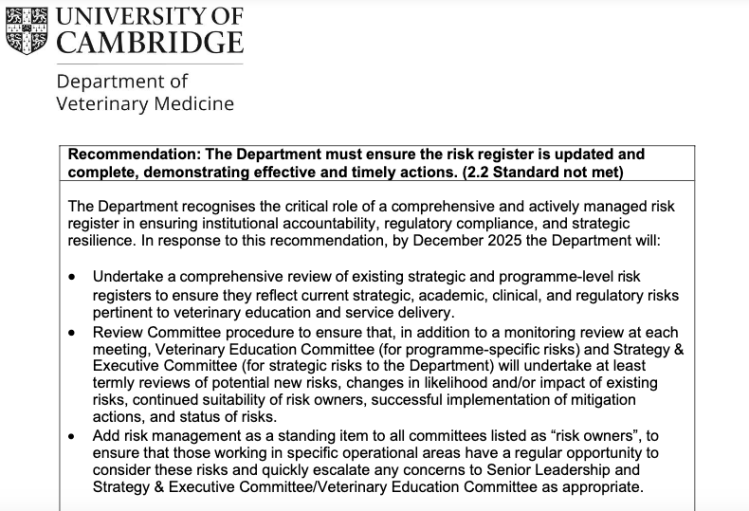
Above – RCVS (2025) report of the 2025 University of Cambridge accreditation event, p25 (Click and scroll to the foot for the link)
The Vet Times picked up on the inspection.
“Last year, the RCVS made 55 recommendations of improvement needed for the course to meet its accreditation standards, and in November it granted the vet school programme conditional accreditation for a further year with 20 still outstanding.”
“What would the result of closure be?”
This is something Varsity picked up on – with several senior University figures writing to the Prime Minister highlighting the consequences.
“What do they expect the Prime Minister to do?”
Something.
“But that’s not how it works – central government doesn’t get to decide what schools of study universities/higher education institutions open/close”
Well…either they know this – hence the letter being an ‘open letter’ released to the media and generating publicity (which in the social circles of Whitehall then set off informal conversations about something being done), or it reflects a wider need of public policy crash courses needed across higher education. I have run several such workshops for Cambridge University students and researchers over the years (Anglia Ruskin, if you want similar, hit me up or head to The Cambridge Room as some of your students have already done) and have been struck by both 1) how little the students were taught at school about politics and democracy in the context of the government of the UK, and 2) how quickly they picked up and ran with the materials I provided them with in the course of the workshops. Actually, 2 shouldn’t have surprised me – it’s Cambridge University and these were self-selecting workshops of students who chose to participate. i.e. highly talented motivated learners.
Location, Location, Location
Or to put it differently: “That is a very high value piece of real estate that you have got there – can we maximise the economic and financial returns from this unique asset?”
Former Queen Edith’s councillor Sam Davies MBE (Cantab – Peterhouse) picked up on this.
“How much land are we talking about?”
It’s a school of veterinary medicine. So they are going to need some open green spaces nearby.
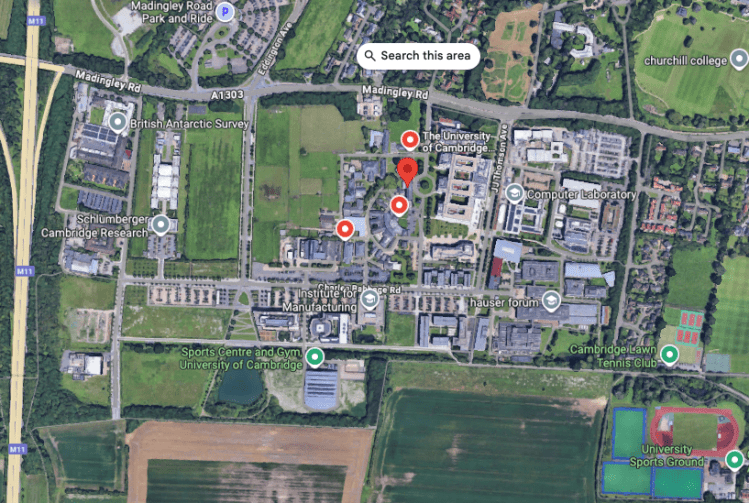
You can see the ‘real estate professionals’ crunching the numbers with their spreadsheets already.Flatten the veterinary medicine buildings and you can double the size of the existing buildings on the West Cambridge site between Madingley Road and Charles Babbage Road.
“Don’t they have a swimming pool to build first?”
Yes – and the latest Greater Cambridge Infrastructure Study says the city and district will need even more swimming pool facilities. Which is why I hope the students will get cracking with ramping up campaigning for this and other sports facilities that they are owed by their institution.
Furthermore, the new swimming pool is part of their University of Cambridge Sport and Physical Activity Strategy 2023-27

Above – University of Cambridge Sport and Physical Activity Strategy 2023-27 (p12)
Can any students or Cambridge University members ask the Pro-VC for Education for a progress update on this capital project please?
The “Land Grab” accusations
The Times attributed the quotation to Prof James Wood OBE, the former head of department. Irrespective of whether you agree with the assessment of the motives or not, the visual contrast between the open fields next to the School of Veterinary Medicine buildings against the ‘Cambridge Vernacular’ boxy buildings of the West Cambridge site (of the type I love to loathe) in a city experiencing a sci-tech land price bubble is hard to ignore.
That then creates a challenge within University of Cambridge circles on realising significant financial gains vs maintaining the purpose of the institution. Does it put the purpose of the institution as a University responsible for teaching and research ahead of financial considerations? Or is it a financial asset and land management institution with the teaching of students being a sideline activity?
The future of the School of Veterinary Medicine may well be one of those decisions that future historians look back on as one where the decision-makers approached a fork in the road and had to choose which road to go down.
If you are interested in the longer term future of Cambridge, and on what happens at the local democracy meetings where decisions are made, feel free to:
- Follow me on BSky
- Spot me on LinkedIn
- Like my Facebook page
- Consider a small donation to help fund my continued research and reporting on local democracy in and around Cambridge

 The Cambridge Town Owl