Alongside their inclusion in the Combined Authority Mayor’s Local Growth Plan, might we be getting somewhere with this after 65 years of trying? Also, what does contemporary history tell us about new facilities and amenities for Cambridge?
I wanted to come back to this issue that I wrote about in my extended previous blogpost which I deliberately framed in an anti-poverty context given the proximity of Abbey Ward.

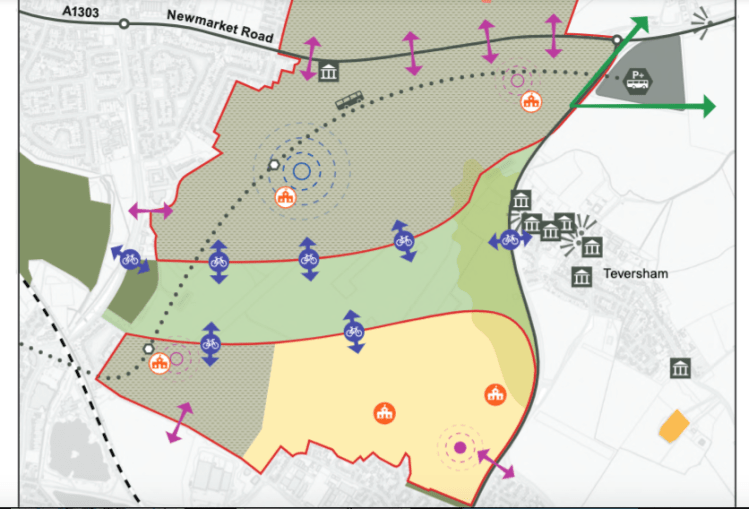
Above – from p207 / 113pdf in the Site Allocations Paper here
On the site uses, the emerging policy for the airport site states that the uses/activities will include:
“A range of supporting services and facilities to meet the day-to-day needs of those living, working, visiting, travelling through and attending education there, including education, health, community and retail uses. These uses will be delivered at a series of walkable and wheelable neighbourhood centres;”
and
“Provision for such a wider range and scale of cultural, leisure, education, shops, community and faith facilities as will meet the needs of Cambridge East and the immediately surrounding area, as well as those of the wider city and sub-region, that will complement and not compete with Cambridge city centre, which may include civic uses, a conference centre, concert hall, arts centre or leisure facilities”
Above – Policy S/CE: Cambridge East
The text on built form needs to be tightened up so we don’t end up with Brookgate-style boxes as at Cambridge Railway Station and Cambridge North Station. As others told me at the time, Cambridge should be demanding ‘better than acceptable’ that the applicants for the hotel at Cambridge North Station submitted for rubber-stamping at the planning committee back in November 2017.
How can the text of the local plan be tightened up to prevent developers and their professional advisers from ‘value-engineering’ awe-inspiring designs and turning them into the brutalist monstrosities proposed in the 2008 draft spatial masterplan (that Marshalls told me a couple of years ago had been pulped, and that they were starting again).


Above – one of the worst examples of property professionals putting picture postcard buildings from centuries ago next to the sort of urban environments that recent research is showing can make people ill.


Above – channelling my internal neurodiverse rage (which goes from 0-90 in a flick of a switch) in the style of Zoey from KPop Demon Hunters. (See a short explainer here, and a longer one here. Anyone who has met me will know that unless I’m hyperfocussing, I have the attention span of a goldfish).
How to amend the text?
Maybe there could be a line in the emerging local plan saying the equivalent of: ‘Independent health assessments incorporating techniques pioneered in the field of neuroarchitecture that show facades and building designs are likely to generate mental stress in the human brain should be rejected.’
At the moment, the consultation document states
“8. Adopt a distinctive and contemporary approach to urban design which:
- a. promotes the highest standards of sustainability and liveability;
- b. reflects Cambridge’s identity by respecting the city’s design traditions while embracing modernity; and
- c. embraces innovative approaches to foster an inclusive, vibrant and diverse community of all ages, creating a strong sense of place and belonging.
“9. Through the masterplan for the site, agree an appropriate scale, layout and density of development that:
- a. supports liveability, in a compact, walkable and sustainable urban form, maximising the opportunity provided by the site;
- b. provides appropriate connections between neighbourhoods, public spaces,cultural and educational facilities, promoting active travel and public transport use;
- c. creates and, where appropriate, reinforces local character and architectural quality, providing smooth, well-designed transitions in scale to respect and complement the surrounding context.
“10. Through the masterplan for the site, agree appropriate variation in building form, scale, height, massing, and density to shape a distinctive city district by:
- a. providing taller buildings in appropriate locations to mark key spaces, enhance wayfinding and complement the Cambridge skyline;
- b. utilising innovative approaches to development typologies to define character area; and
- c. responding to key views and approaches to the site.“
My ‘quartet of ornate twin towers’ concept
On the taller buildings challenge see James Littlewood of Cambridge Past, Present and Future in this blogpost by CPPF.
In my blogpost from Sept 2024 calling for a new urban centre for Cambridge as it grows, I wrote that we should take inspiration from some of the unbuilt masterpieces such as Peck & Stephen’s unexecuted twin towers for their guildhall proposal that was rejected in 1860.

Above – Peck & Stephens in The Builder, 14 Jan 1860
Furthermore, one of my favourite local artists Maureen Mace reminds us of the ornate twin towers theme
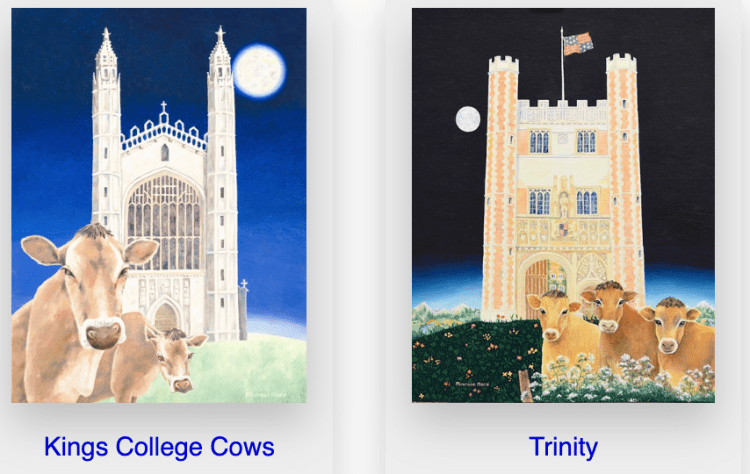
Above – Kings College Cows, and Trinity, by Maureen Mace which you can purchase here
(I particularly like here trees collection too!)
Just as importantly I’d like to see what children and young people see as awe-inspiring and breath-taking in terms of the built environment and the interaction between it and nature – mindful of the growing bodies of research.
On experiencing awe and wonder
I wrote about it in the second half of a blogpost on Mayor Dinah Pounds’ election as Mayor of Cambridge 2025-26.
Given past form, I don’t think we can leave it to the developers, the construction industry, and/or the politicians to build that new urban centre. It will take far more than that – in particular artists and musicians. Which may seem counterintuitive given the sci-tech branding we seem to have these days.
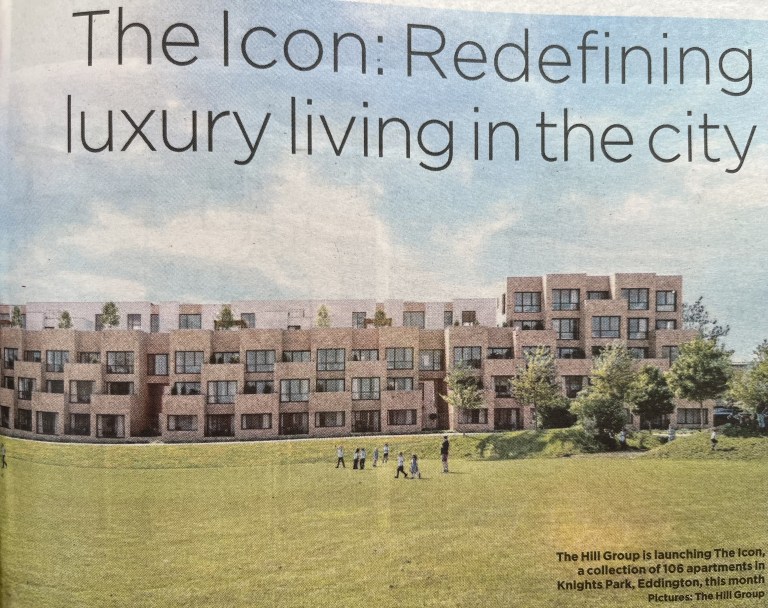
Because if Eddington’s building design is the most imaginative that the sci-tech sector can come up with, then maybe the airport site should aim to be something significantly different to, and far more imaginative than the vast majority of construction schemes we’ve seen over recent decades.
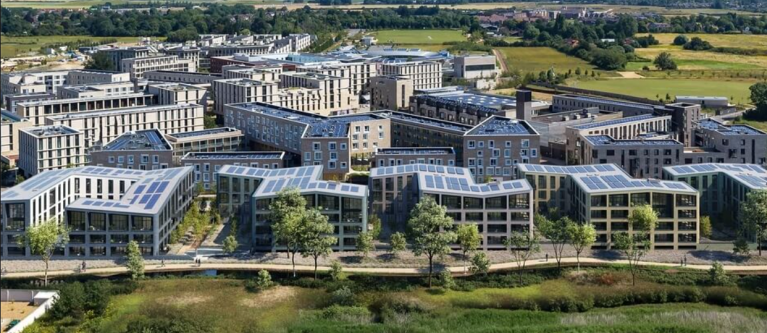
Above – some of the more recent building designs in the foreground at Eddington (proposed for their expansion)
One of the challenges then is targeting the arts and music communities in and around our city to get them interested both in the designs of new facilities and amenities, as well as the future of our city more generally. Which is easier said than done. Especially when it involves Politics, and lots of heavy, dense reading!
If you are interested in the longer term future of Cambridge, and on what happens at the local democracy meetings where decisions are made, feel free to:
- Follow me on BSky
- Spot me on LinkedIn
- Like my Facebook page
- Consider a small donation to help fund my continued research and reporting on local democracy in and around Cambridge

 The Cambridge Town Owl