In June 2021 the House of Commons Library published this briefing on loneliness in society. Nearly five years later how far have we come?
Image – Tackling loneliness hub which is being funded by the Government (which includes this blogpost by the Minister)
I’m writing this in the context of my own experiences past and recent, and also…
Above – The Men’s Health Strategy published in November 2025 by the Dept for Health & Social Care.
In 2022 I wrote about the risk of Cambridge becoming like Monaco, and becoming a Lonelygenic city. This was in relation to a paper in The Lancet about loneliness being “a feature of urban planning and societal systems that have not prioritised peoples health and social needs”
“We call for research to establish a foundation of evidence that measures lonelygenic environments, which could vary from place to place, and to integrate that evidence into optimising loneliness reduction strategies that work for everyone.”
Xiaoqi Feng, Thomas Astell-Burt in The Lancet, December 2022
Luke Mintz wrote this extended piece on BBC News about loneliness.
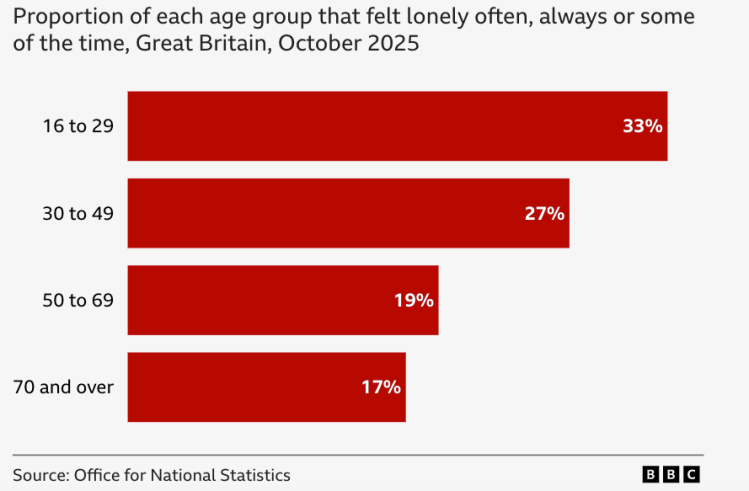
Above – Luke Mintz BBC News 18 Dec 2025
Which is why it is ever so frustrating when institutions that deal with loneliness by bringing people together are forced to close
As happened to Cambridge Community Arts
…Which also provided a challenge for Peter Freeman of the Cambridge Growth Company
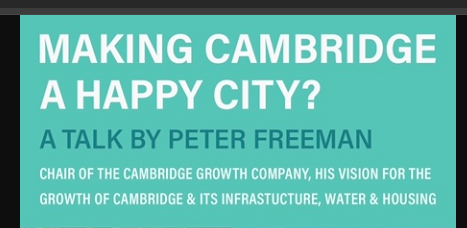
Above – see links to Peter Freeman’s speech at the above event
And of my own experiences…
I’ve listed some in this piece dating back to 2011, although the blogpost headline that summarises it best is:
And that was in 2018.
“Have things got better?”
Absolutely not.
If anything they’ve gotten worse. The only thing that has improved is my ability to understand ‘how I got to here’ and ‘why I got to here’. Mainly through the prism of research *and* social advances in neurodiversity.
What others have written
“Too many, and unsatisfying social connections may actually increase loneliness, as we may feel less understood.”
Antonia Ypsilanti for the Tackling Loneliness Hub
One for anyone with hundreds of social media followers but with few close meaningful day-to-day connections.
“Human beings, Dunbar found when he conducted his research in the 1990s, typically have 150 friends in general (people who know us on sight, and with whom we have a history), of whom just five can usually be described as intimate.”
Above – Rachel Cooke 21 Feb 2021 on Robin Dunbar’s research
“A new study of more than 2,000 people reveals Brits require 34 hours of commitment (2,040 minutes) to transition a new acquaintance into a friend. What’s more, each interaction needs to last on average 3 hours and 4 minutes to be mutually beneficial”
In reviewing Dunbar’s book,
“Dunbar argues that our social connections may have a profound impact on our health and wellbeing, perhaps more so than lifestyle risks like lack of exercise”
Talia Drew in The Psychologist, 27 July 2021
“The scattering”
In my local history research I often go to through past papers of the Cambridge Evening News from the late 20th Century. Every so often people and events from my own childhood crop up. Which makes me reflect on ‘the scattering’ that Luke Mintz mentioned in his piece. I.e. school/college leavers all going in their separate directions. This was something the institutions *did not* prepare us for. In my case it was three separate scatterings (School, sixth form college, and university) in the period of just over six years – the end of A-levels being the hardest emotionally as the structures that held so much in place suddenly vanished.
Yet similar is true when a large workplace with lots of workers goes through a major redundancy process – something which I wouldn’t wish on anyone. Combined that will the collapse of so many civil society institutions due to austerity, then the lockdowns, means that our communities don’t have the social capital needed to absorb and support those taking the hits.
Which is also why I think there are some really big issues underpinning loneliness that the public policy world in Whitehall and Westminster are reluctant to take on – not least because doing so up-ends their worldview. The concept that building owners must make a financial return on their ‘investment’, or ‘sweat their assets’ inevitably means that the premises for independent social and community groups to form and organise in become much harder to find – as we see in Cambridge vs Brighton here. Furthermore, as one of the staff at my local – a recent college leaver told me, there’s hardly anywhere for teenagers and young adults to go to in Cambridge where you can just ‘be’ – and not have to buy something.
The other problem she told me about is that despite the best efforts of Form the Future, too many employers expect teenagers to have work experience already, and don’t have opportunities for career starters. While the likes of FtF can negotiate opportunities with individual employers, they can’t do the equivalent of forcing all of the supermarkets and fast food outlets to bring back their staffed ordering points and staffed checkouts. The Tackling Loneliness Hub has a blogpost on the importance that shops can have in tackling loneliness.
Losing a sense of belonging in a rapidly-changing city
I touched on this back in 2022 in this blogpost which looked at the failures of institutions in 1990s Cambridge through to integrating new arrivals and newbuild estates into the life of our city.
Life as a continuous experience, or as a series of separate episodes?
This is a concept that the philosopher Galen Strawson explores, coming up with the concept of Episodism. Earlier in April 2025 Lewis Connelly explored the contrast between the Episodic and its opposite the Diachronic.
“Strawson uses it specifically to describe individuals who conceptualize their lives as a continuous, unfolding narrative—like a single character with a clear beginning, middle, and end. These diachronic individuals strongly identify with their past and future selves, believing themselves to be the same person throughout time. In contrast, episodic individuals experience their lives as discrete moments without significant psychological continuity. Strawson suggests we can recognize among our friends and acquaintances whether they are diachronic or episodic.”
Connelly (2025)
In my case I’ve been living through one concept despite a very strong desire to live it through the other.
In a nutshell I’ve wanted to live a life that has a continual thread from people who I knew in very early childhood all the way through education, careers and social lives. But in order to survive in a neuro-normal world I’ve ended up having had a very episodic existence. Hence my sense that I never found my tribe. This cognitive dissonance I feel was further compounded by what I saw happening in and to Cambridge in my post-civil service years.
I think it was one of the underlying hidden motivations to start researching Cambridge’s local history. Undiagnosed chronic illness combined with the result of the EU Referendum had left my previous civil-service-related world unrecognisable. (In hindsight I should have broken away far sooner). On top of that, there were so many unprocessed things from my more distant past that I had not dealt with or found answers to. Hence going down that route. That ‘episodism’ arises again in Cambridge’s local government history. It took a huge amount of work by a number of us to remind the city of the achievements of the women who made modern Cambridge – something that we were able to commemorate in 2018 and something we should make a much, much bigger deal about in 2028 with the centenary of equal suffrage.
For those of you who wonder why I can be *really intense* about some of the town planning and development planning issues on the present Cambridge, it’s because I don’t want current and future generations to endure what my generation had to deal with at the end of the last Millennium.
‘Millennials should not be middle-aged’
So says Helen McPherson. on TikTok here, and on IG here. (The responses make for interesting reading). This is sort of where I am – because my mental health breakdown in 2012 that left me with CFS/ME brought to a very abrupt end any prospect of switching into a new full-time career/profession the sort of which you could put down a deposit on a house for. And when you’re not seeing the same group of people day-in-day out for extended periods of time, it gets to you. Especially if it’s involuntary. Own house, own car, own career – I’ve only had the third. Don’t ask about relationships!
What’s both reassuring and disturbing is that I am not alone in experiencing this.
And that is what Westminster and Whitehall are struggling with.
- The narrative that Millennials are the first generation in recent times to be worse off than their parents (contested, but with huge caveats on growing wealth inequalities)
- The inconsistent Political responses (in particular from TeamNigel) to the rising number of ADHD assessments and neurodiversity in general.
Moving forward – there’s only so much urban planning can do
Town and infrastructure planning in and around Cambridge are hugely important factors, but alongside them has to be a radical overhaul of local public services that allows for far greater local co-ordination, local oversight, and raising of revenues from new, wider local taxation measures on the excess wealth generated here.
There’s no point in building the new community facilities if no institutions are able to finance the running of them. This has been a huge issue with the Nightingale Pavilion in Queen Edith’s, Cambridge which former councillor Sam Davies MBE had significant problems with because while the funding from developers was there, the administrative capacity to process the work and the community development staff capacity was not. And there was no reasonable method for local government to raise the revenue from the lavishly wealthy science park owners or some of the tenants to pay what was essentially chicken feed for them to keep it going. Victorian style-charity was found not to work back in the Victorian times. (Or rather as Eglantyne Jebb described in 1906)
And we won’t get those local governance issues address properly without getting more of us literate in democracy, politics and civics. We once had a plan for that.

Above – Politics for Adults (1983) by ACACE – also abolished by ministers in the same year!
If you are interested in the longer term future of Cambridge, and on what happens at the local democracy meetings where decisions are made, feel free to:
- Follow me on BSky
- Spot me on LinkedIn
- Like my Facebook page
- Consider a small donation to help fund my continued research and reporting on local democracy in and around Cambridge

 The Cambridge Town Owl