This was in 1994 and were the feelings of former Perse School headmaster Martin Stephen in an interview with the Cambridge Evening News shortly before his departure for Manchester.
“I think there is more loneliness in Cambridge than any other city I have ever known”
Martin Stephens in the Cambridge Evening News 21 July 1994, in the British Newspaper Archive
The article continues:
“Parents have often commented to him on the loneliness they are experiencing. He has lived in Leeds where was at university and met his wife, [and then lived in] Cumbria, Hertfordshire, and Leicestershire.
“Dr Stephen sees the population of Cambridge as a large collection of what he calls parallel lines, which by their nature cannot cross.
“People working in Cambridge University, on the [Cambridge] Science Park, at Addenbrooke’s Hospital, in what he calls the M11 Electronics, old Cambridge business, Cambridgeshire County Council… they are all groups he believes exist in their own worlds without contact with others”
Ends/
This was a side column in a broader look at his views on education in the 1990s in the context of the abolition of grammar schools in the 1970s, issues of selection by academic ability, and of boarding vs day-schools.
“How does this compare with the Cambridge of today?”
Three years before the interview, in 1991 Cambridge’s population in the annual census was recorded at just over 101,000 people. In 2001 it rose to near 109,000 people – all of these within the 1935-era municipal boundaries. Today that figure is most likely over 150,000, the 2021 census estimate being just over 145,000.
I’ve picked up on it today in the context of a Reddit/Cambridge thread about how today compares with 1990s/2000s Cambridge here.
Additionally, the responses to this post from a couple of years ago on social isolation for adults moving to Cambridge to work in high-skilled professions (often from abroad) was particularly striking.
“I stopped making friends who came for M.Phil or Phd;s. If they ask for my contact, I tell them sorry. 6 years in this city and I cant make social investments that come with a pre-defined expiry date”
One of the things our institutions and societies struggle with is succession planning for the annual turnover of people
It’s a bit like a lottery at times because a society can be dormant for years, then out of nowhere a handful of people arrive from out of the blue and turn things around. At their best their efforts can be self-sustaining even after they move on. At worst, longstanding institutions and annual events can evaporate.
Why didn’t I see anyone in town who I was at least acquainted with over the past couple of days?
This was what has hit me hard recently. No familiar faces at all. At the same time – and perhaps more positively, there seemed to be a lot more families, and people coming in from surrounding villages. The cold weather not putting off the foot-traffic of teenagers making the trek from the railway station to the city centre. But when I look at what’s there for them – especially the younger generations, it feels significantly diminished compared to what was there for previous generations of teenagers and young adults. Part of it is a technology thing. Music record shops in particular are the genre that stand out.
Furthermore, the scale of the land price bubble means that the sort of independent shops that many people and politicians say they would love to have are simply priced out by the refusal of the most powerful group of politicians (Treasury Ministers) to consider policies that might break these otherwise failing markets and rigged systems that transfer wealth from asset poor to asset rich.
Cambridge City and Cambridgeshire County Council responses to loneliness in society
Reminded that loneliness is so significant an challenge that it has become a public policy issue – see Parliament’s briefing on it here. Additionally, see ministerial responses more recently as mentioned in my previous blogposts.
More locally, see the following reports:
- Campaign to End Loneliness Cambridgeshire (2018)
- Cambridgeshire County Council’s loneliness and isolation pages
- Cambridge City Council’s Single Equality Scheme 2021 – with the Loneliness section from p29
The challenge that both doomed institutions have faced – and their successor unitary council will face, is the very limited powers and competencies to deal with a challenge that goes far, far beyond the limited resources they can muster.
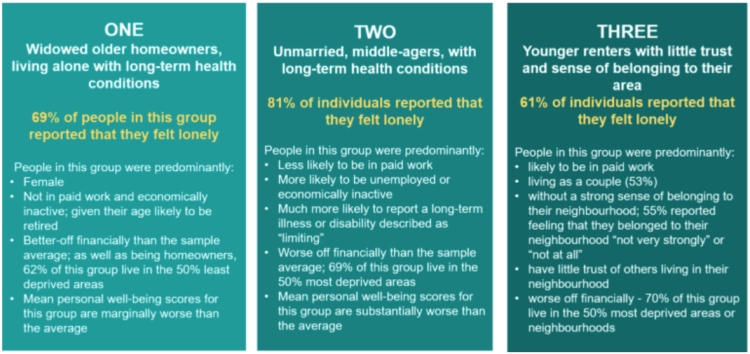
Above – Cambridgeshire Insight
I fall into the group two in the middle – an unmarried middle-ager (much as I don’t want to think of myself as one!) with long term health conditions.
Why the emerging local plan consultations matter
ICYMI the landing page is here. See also the digital story version here. You’ve got a month to get your views in.
One thing missing from the studies in the appendices is anything on designing out loneliness and isolation.
Hence the importance of the Loneliness Lab and similar professional outfits looking to influence ministers through their own professions on taking on this shared problem.
“With no reference to the importance of social issues and tackling loneliness in the Government’s White Paper ‘Planning for the Future’, it was a crucial opportunity to help shape how our built environments are formed, how developers and local authorities can engage with local communities, and what ‘design codes’ should be factored into housing and public space plans over the coming decades.”
Planning Review Submission from Loneliness Lab in 2020 under the previous government. I don’t know if the collective has continued its work, but it’s worth browsing through their earlier publications only the problems have not gone away.
The Social Connection Report (2024)
Above – Placing Social Connection at the Heart of Public Policy in the United Kingdom and Australia (2024) UCL/Sydney
I wrote about this in January 2025.
In the latter part of that post it’s no accident that I highlight:
- The importance of excellent public transport access
- The need for new institutions and facilities that our city currently does not have – and at a scale we have never experienced
- The need for a new generation of groups, societies and activities – and spaces for them to be active in
- The need to get the governance institutions properly empowered and resourced to manage the competing interests and ensuring that the things needed to ‘design out loneliness’ are properly funded.
Food for thought?
If you are interested in the longer term future of Cambridge, and on what happens at the local democracy meetings where decisions are made, feel free to:
- Follow me on BSky
- Spot me on LinkedIn
- Like my Facebook page
- Consider a small donation to help fund my continued research and reporting on local democracy in and around Cambridge

 The Cambridge Town Owl