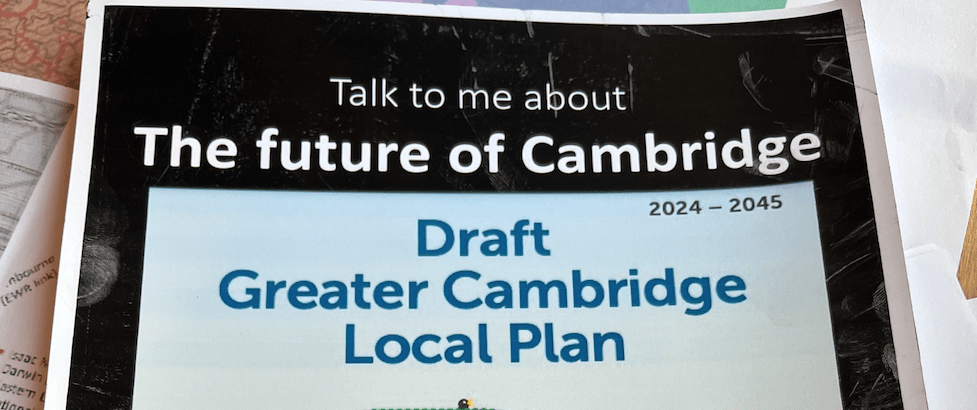
In a nutshell there isn’t enough of it, and there are some easy wins that Cambridge City Council and the Greater Cambridge Shared Planning Service are missing out on.
At the foot of the poster I state who I am (“With local historian Antony Carpen”) because I don’t want anyone to get the impression I’m speaking on behalf of any institution. It’s hard enough keeping track of my own opinions with a neurodiverse racing mind without having to worry about institutional ‘lines to take’!
If you haven’t seen the consultation landing page, it’s here
As for offline things…
“Where could we have posters and in what form could they take?”
In terms of locations:
- Bus stops – there are so many unused notice boards (Esp at Drummer Street and Addenbrooke’s) that could be used)
- Supermarket community boards and convenience stores – most of them would be more than happy for council-branded notices
- Leisure centres – especially if they can tailor the messages towards the research papers that recommend the sorts of things being proposed.
Incorporate one of the maps
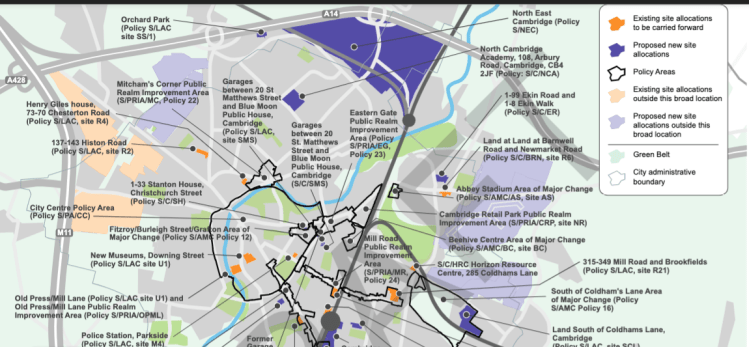
Above – Detail of Cambridge proposals Appendix A Part 2 from the document pack
Something like this would be suitable for city centre convenience shops. For the supermarkets on the edge of the city, the diagram for South Cambridgeshire would be more suitable. Others could incorporate questions such as asking what facilities not included in a list of sporting amenities in the infrastructure delivery plan could be included in later drafts for consideration. For example I’d like to see a new roller rink in Cambridge similar to the one in Bury St Edmunds that is also suitable for speed skating and rollerderby – providing a long-overdue home for the Rollerbillies.
“How did today go with the maps and conversations?”
I arrived 40 mins before closing time on the coldest day of the year (it has only been four days…) but it allowed me to make a quick vlogpost for Vloguary 2026 to summarise the one conversation I had with one of the members of staff who studies biomedical sciences.
In the grand scheme of things, taking along a handful of folded printed A3 size maps, diagrams, and tables with the printed piece of card inviting dialogue will do little outside of my neighbourhood. I’m neither expecting nor aiming for a snowballing effect. The only people who might be tempted to try similar are local election candidates either trying to win seats with active campaigns, or their incumbent opponents trying to keep them out! (It just so happens that where I live happens to have a properly-contested election at city level for the first time since Puffles was a candidate. (I jest – this has been an emerging target seat for The Greens over the past 18 months).
Being meme-bombed on neurodiversity, community connections and loneliness in society on social media
This has been one of the other drivers having reached an age/time of life where you don’t really have to care what other people think of you. (And/or in my case lacking the functional hours due to chronic fatigue amongst other things).
I’m not a fan of meeting up with strangers for the sake of it – never have been
I found that out at Freshers’ week at university when I left Cambridge for the first time over a quarter of a century ago. Six months later when I went to my first Model United Nations conference (where I had the time of my life surrounded – for the first time in my life by a genuinely multinational crowd of participants) I asked one of my fellow students why, after having had a night out in a locals’ secret of a restaurant in Athens, Greece which one of the local students participating had taken us to, why freshers’ week wasn’t like that. Her response was that drinking to get drunk appeared to be the only purpose. It didn’t surprise me in the years that followed as fees kicked in harder, that students started demanding far more variety of activities (esp ones not involving alcohol) than just drinking to get drunk.
Providing a shared activity or shared challenge as a means of community-building
In normal times trying to make community engagement activities – especially those involving asking for new ideas, are very hard going. And with good reason. The crumbling public services over the past 15 years in the face of austerity has meant that trust has collapsed in politics. If people’s experiences involve not only the failure of central government to provide for the basics, but also things that to the public don’t look like common sense (Eg building lots of new homes but not providing for the new GP surgeries and dental clinics), then being asked to do either tick-box consultations or short-term cosmetic improvements that seldom last, risk putting the public off further.
This is why amongst all of the other stuff going on, Cambridge has to talk about governance
This in part is reflected by the recent update from the Cambridge Biomedical Campus
“The Addenbrooke’s A&E department sees 3-4 times as many patients every week as it was built for. We are pushing for investment in these services and a new acute hospital to be delivered as soon as possible. This will both accommodate the demand from our growing population and provide a world class hospital to compliment the life science businesses we are hoping to attract.”
Ed Watson for the CBC Ltd, 23 Dec 2025
This is basically the recent confirmation in the news last month of the proposals several of us found out about at the September CBC Public Open Forum. The point remains that we have reached the stage where issues such as the provision of GP surgeries and dental clinics should not be ‘for someone else to deal with’. The co-ordination of tasks, functions, and sequencing has to be far better in future – and furthermore the consolidation of existing institutions should not be ruled out in the longer term. Hence the interesting work by the Local Government Information Unit on what things might be like in 2050.
This is where we can ask: “What will it all look like when the major work is done?”
There has to be an end point at some stage – either a planned one or one that the environment imposes on the politicians, planners, and pro-growth lobbies should they try to grow beyond the long term environmental carrying capacity. (You could argue that we’re already there and have not yet felt the real impacts of it yet).
Draft Greater Cambridge Local Plan for consultation
Consultation runs from: 1 December 2025 9:00am – 30 January 2026 5:00pm
If you still haven’t seen the consultation pages, they are here
If you are interested in the longer term future of Cambridge, and on what happens at the local democracy meetings where decisions are made, feel free to:
- Follow me on BSky
- Spot me on LinkedIn
- Like my Facebook page
- Consider a small donation to help fund my continued research and reporting on local democracy in and around Cambridge

 The Cambridge Town Owl