Jane Hutchins, the director of Cambridge Science Park was filmed for an interview with BBC Look East on 07 Jan 2026
…and quoted in this piece for BBC Radio Cambridgeshire.
“[Jane] Hutchins accepts that growth can cause conflict with local communities adding “we as a sector need to be better at telling people about the benefits and jobs it brings – not just for scientists.
“We need people in accounting, marketing, cleaners, landscape gardeners. And it’ll be a place for the public to use,” she said.”
Above – BBC Cambridgeshire 07 Jan 2026
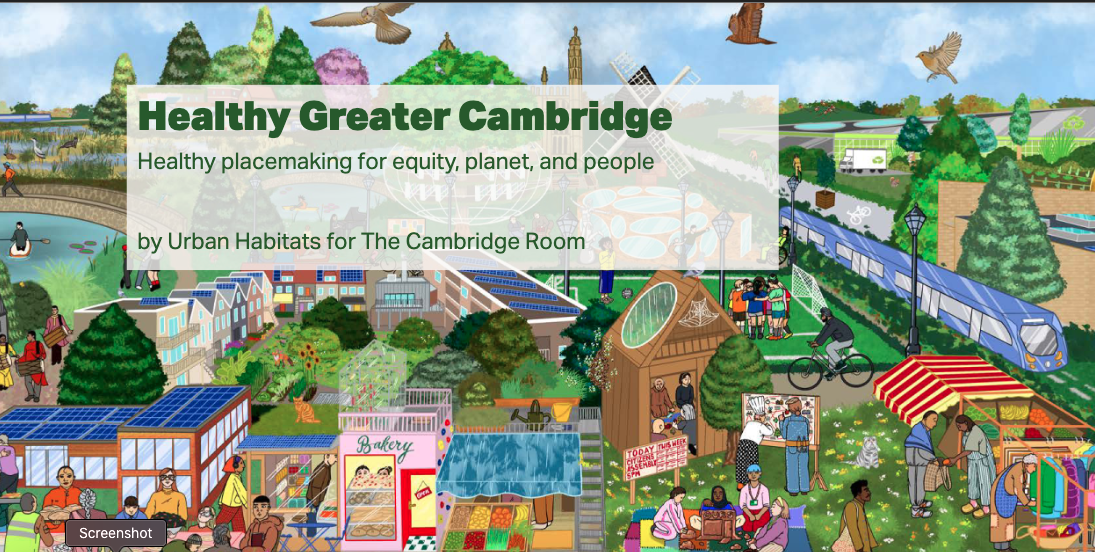
Image – a reminder that a future Cambridge needs to be a healthy one – and that means designing out inequalities
Wealthy Cambridge Science Park next to King’s Hedges communities – some of the most economically-deprived in Cambridgeshire
Back in summer 2023 I met Ms Hutchins at that year’s Wide Open Cambridge series of events – and asked her about the poverty on her institution’s doorstep. In that same blogpost I referenced the Cambridge Ahead Young Advisory Committee’s report – which is still relevant to today. Essentially the values of younger generations – growing up fast, are less tolerant of the chronic inequalities that we still see today.
The most recent updates.
Some of you will have read about the plans put to Cambridge City Councillors a couple of months ago, setting out their bid to get new proposals included in the emerging local plan.

The 55th Birthday of the Cambridge Science Park
The reason for the media coverage was the anniversary of the Science Park. It was also featured on BBC Radio Cambridgeshire earlier with Dotty McLeod on 07 Jan 2025 – and I was interviewed for it. Have a listen here from 3h 10mins in.
Tackling inequality on the doorstep of this engine of wealth-creation
I made the point about how the Science Park could help fund a new swimming pool and leisure centre on the Milton Road Garage site (which I last wrote about here following a significant planning application on the Science Park site which will densify the building’s footprint – an application subsequently approved *with a Grampian Condition*)
“What’s a Grampian Condition?”
Cllr Katie Porrer explained this in her cross-examination of Peter Freeman and Cambridge Growth Company colleagues. Named after the Scottish council involved in the planning application concerned that ended up in court, it’s a condition that says ‘you can build your building, but no one can use it *until* whatever the issue the condition relates to has been resolved. In principle this can be for things like:
- You can’t use/occupy the building until the water company has confirmed it can supply potable/fresh water and/or has the capacity to receive the additional waste water. (Anglian Water has imposed this condition)
- You can’t use/occupy the building until an electricity substation bas been upgraded
- You can’t use/occupy the building until a key piece of public transport infrastructure has been completed and is operational (eg new railway station)
Such conditions are now routine in large Cambridge planning applications because of issues raised by Anglian Water – issues now being dealt with by ministers following escalation by Peter Freeman.
Cambridge has had embargoes on large developments before. Will history repeat itself?
This was an interesting line of questioning from Dotty McLeod when she commented that the disagreements on whether Cambridge should grow in the 1960s & 1970s sounded like history repeating itself.

Above – ‘City in Shackles’ was the theme that the Cambridge Evening News ran with during the era that Prof John Parry Lewis was producing his highly controversial report which made the case for almost doubling Cambridge’s population between 1975-2000
This was also the time the old Anglian Water Authority imposed a moratorium on planning permissions for new large developments because of the lack of capacity at the Milton sewage works – which is where we are today half-a-century later!
But then the politicians could not say they were not warned. The outgoing Borough Surveyor and Chief Engineer Mr T.V Burrows spelt it out in clear language in 1965 to the Public Works Committee. It was his report on the Sewage Treatment Works for the City of Cambridge.

Above – I found a copy for sale at G.David so bought it and digitised it here – what are the lessons from history for today?
“…growth can cause conflict with local communities” – is that a communications issue, or a much more substantive issue?
I’m not going to tear a strip out of Ms Hutchins over the soundbite that the BBC used. The way such interviews work is that over 90% of whatever is recorded ends up on the digital cutting room floor, and only a small snippet is used for broadcast purposes. She is more than aware of the issues around inequalities in Cambridge and in King’s Hedges in particular – because she told me back in 2023. The next steps for those in the Cambridge Science Park community has to involve more dialogue with local residents and local community institutions.
One option that I raised at the Cambridge Science Park consultation back in September 2025 was on a lifelong learning centre providing those opportunities for local residents. (See the end of this blogpost).
This deals with both the substance and communications issues – the latter of which Ms Hutchins was quoted on.
“…need to be better at telling people about the benefits and jobs it brings…
In this current age of an imploded local media ecosystem and a social media world full of disinformation, where do you start? Buying advertising space online risks giving money to the very people enabling the disinformation undermining your sector. Important as the Cambridge Independent is (I buy the paper copy weekly as I have done ever since it launched in…2013 I think), its coverage will never match that of the 20th century local newspapers. That also has huge issues for public engagement in the future of Cambridge.
The Science Park representatives told me last September that the emerging option on lifelong learning…
“is creating a facility that can train up more people to meet the skills shortages in technical areas, and where existing employers can donate the expensive equipment to fit out such new facilities in the knowledge that those completing the courses will be able to move seamlessly into new jobs or existing vacancies nearby.”
Understandable from a commercial perspective, but from a civic and social perspective, the guided busway stop for the Science Park could be completely revamped in partnership with the surrounding land owners and turned into a district centre with two major anchor facilities: a swimming pool leisure centre and a new lifelong learning centre.

Above – From G-Maps here. The red balloon icon (where I think a new swimming pool could be built) is just below the guided busway stop for the Science Park
Note that one of the longer term proposals is to convert the guided busways into light rail lines as part of a new Cambridge Mass Transit system – something repeatedly suggested by the Leader of Cambridge City Council, Cameron Holloway when expressing support for the current busway applications.
Part of any revamp could involve putting Milton Road (a trunk road) underground / lowering the existing road and building on top of it to reduce the traffic noise substantially, and creating a new district civic square that creates a major public transport and active travel hub anchored by the leisure facilities and the lifelong learning college. The even bigger challenge is persuading the architecture profession and the construction professionals not to design to current contemporary fashions. (See Humanise here about re-humanising our cities). Because If Cambridge is to grow, can we get the development plan to insist on visually healthier buildings?
Please?
If you are interested in the longer term future of Cambridge, and on what happens at the local democracy meetings where decisions are made, feel free to:
- Follow me on BSky
- Spot me on LinkedIn
- Like my Facebook page
- Consider a small donation to help fund my continued research and reporting on local democracy in and around Cambridge.

 The Cambridge Town Owl