
That also means getting rid of academies and the multi-academy trusts, and moving away from inflexible systems of commissioning and contract management.
Before I start – quick note about new workshops scheduled. Image from the Trials of Democracy
This is the position of the National Education Union, the largest teaching union in the country and one of the largest trade unions overall.
It also links to the complex relationships between teachers, teaching unions, and employers. This is coming to a head in Cambridgeshire over facility time where for whatever reason, the participation of academies has fallen off significantly in recent years. (For an explainer on facilities time, see the Trades Union Congress from 2011 here)
“Academy buy-in rates in Cambridgeshire were historically high, 97.3% in 2022–23. In 2023–24 buy-in reduced significantly to 50%. In 2024–25 and 2025–26, buy-in is 59%, with 63 academies either opting out of the agreement or failing to respond to requests to participate.”
Above – Cambridgeshire Schools Forum 16 Jan 2026, item 4
“The case studies show that, where workplaces are unionised, employers and trade unions who work efficiently and constructively together can improve workplace performance for the mutual benefit of the employer and the employee.”
Above: Reps in Action (May 2009) GovUK p7
In the case of Cambridge, the following secondary schools/FE schools are in the United Learning Multi-Academy Trust (one of the largest in the country – their list of schools is here – I can’t find it on their website)
- Parkside
- Coleridge
- Trumpington
- Cambridge Academy for Science and Technology
This blogpost isn’t about facilities time – which is a highly Politicised issue. Instead it stems from my continued lobbying/campaigning to get Cambridgeshire to improve its provision on adult education and lifelong learning.
That said, I remain to be convinced that the concept of Multi-Academy Trusts is the best method of providing education for children. And it’s on the Conservatives for failing to create suitable inspection regimes for the Multi-Academy Trusts – the current Labour Government announcing that new inspection regime last week.
Ministerial buzz-phrases, from Localism to Devolution to Place-making – these are meaningless if locally everything is fragmented
And in Cambridge we have found this out the hard way.
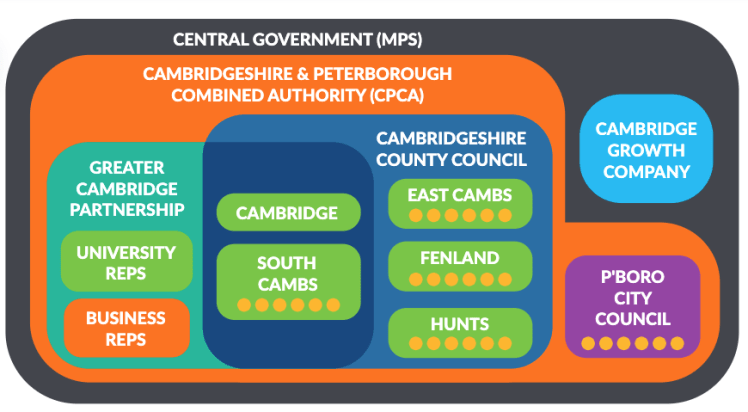
Above – the soon-to-be abolished structure of local government that sits within the Ministry of Housing and Local Government silo, from CamCycle.
The above diagram does not include local services such as:
- GPs/Doctors, Dentists, health clinics – which fall within the Department for Health and Social Care silo
- Many Primary and all secondary schools – centralised by the then Education Secretary Michael Gove in legislation where MPs voted to give themselves **more constituency casework**
- Magistrates courts – centralised and run by Ministry of Justice
- Police and the Probation Services – reporting to the Home Office
- Public transport – privatised by the Conservatives in the mid-1980s, still to be franchised in dreadfully convoluted processes.
One thing to remember on the party political and contemporary history side is that Margaret Thatcher’s reforms in the 1980s had the additional incentive to break the back of the entire trade union movement – which she succeeded in doing. One reason for this is that she was a senior minister in the previous Conservative Government of Sir Edward Heath and saw how in her party’s view the trade unions effectively brought down a democratically elected government, and that could not be allowed to happen again.
The move to outsourcing and commissioning
I wrote about this here. Until the 1980s many local public services were provided for directly by local council officers and civil servants. Today many local public services are provided for by private companies or institutions ‘under contract’ to a local council or public service commissioning organisation. Take local health care where (with the exception of general practitioners/GP Surgeries)
“The buying of health and care services. It is a continuous cycle of activities that includes agreeing and specifying services to be delivered over the long term through partnership working and patient feedback, as well as contract negotiation, target setting, providing incentives and monitoring. It is all about making sure that health and care services effectively meet the needs of a given population with the resources available.”
Cambridgeshire and Peterborough Integrated Care System
My emphasis on ‘with the resources available’ which in this case are set centrally. Local councils have minimal powers to tax excess wealth and have very limited powers on what they can impose taxes and fees on. Combine that with a planning system that works from an assumption that planning permission should be given unless there is a legally valid reason for it to be refused, and you end up with lots of new developments without the doctors and dentists that communities need.
Real Devolution with a proper system of Total Place governance
Nearly a year ago the Minister for Local Government in the House of Lords confirmed the Treasury’s view. I wrote about this in Feb 2025
“Their Lordships returned to the issue of Local Government Finance and replacing council tax with something more progressive – have a watch of the video here and ask yourself if it sounds like the Minister is reading out a series of ‘lines to take’ in response, or whether she really believes in what she is stating as Government policy on local government funding.”
Peers from four of the main parties asked about the unfairness of the existing local council tax system, but the minister refused to move, sticking to the Treasury line
Abolishing multi-academy trusts and bringing schools back under the oversight of local councils
The debate on the effectiveness of Multi-Academy Trusts is covered in this briefing from the House of Lords Library, which summarises the issues very well. You can’t take the ‘politics’ out of the provision of health and education services because their provision is an inherently political issue. Even the decision not to provide state-funded health and education services free at the point of use funded by general taxation, is a ‘political’ decision. (It’s the ‘Party Politics’ that puts people off – especially when decisions are seen to be made on ideological grounds in opposition to the will of local communities).
At the end of the House of Lords briefing, the authors assess the 2019 Ofsted study based on interviews of those working in Multi-Academy Trusts. For each of the positives listed, I question whether those are unique to the MAT set-up or whether they could be achieved under alternative systems such as local council oversight. Such as sharing data with other schools and moderating it together. That’s not unique to MATs. Furthermore, some of the supposed benefits have negative knock-on impacts on local communities. For example ‘economies of scale in contracts such as cleaning and catering’ inevitably means lower pay for people already in low paid jobs. You only have to read the Living Wage Foundation’s report on the impact that very low pay has on people. What might be a budget-saving line in a spreadsheet might be the difference as to whether a parent who is a contract cleaner goes hungry for the evening because the school they are contracted to clean at is paying poverty wages.
As for ‘centralisation and loss of decision-making power, and slower decision-making’ part of the challenge here is how responsive parents (and through them the children) want their schools to be to their concerns. Centralisation means more hoops to jump through.
There are no mechanisms for empowered local councils to raise resources locally to provide additional funds for schools and for community activities out of school hours
This is a particular frustration of mine and has been for years in one of the most chronically unequal cities in the UK.
Cambridge has two excellent further education institutions in the south of the city, and neither of them are used for adult education or lifelong learning.
This is despite the fact that Long Road SFC used to have an extensive programme of continuing education courses – so much so that in 1998/99 I did A-Level History there as an additional A-level during Monday evenings, and got a B for my troubles! Why on earth did they stop providing such a programme?
As for CAST – originally the University Technical College, their landing page points to their MAT’s adult education pages which are mainly provided on other sites, conveniently for me Coleridge Community College. But my wider issue is this. The CAST building is a new building with state-of-the-art facilities. (Or it was when I visited over a decade ago I think it was). I couldn’t understand why there were no evening classes for us adults to give us 1990s teenagers the chance to spend time in modern science laboratories (fitted out in partnership with some of the big science firms on the Cambridge Biomedical Campus in the vicinity).
The barrier?
The Government has not provided the Combined Authority with the funding to enable it to commission United Learning to provide for such things – the Government’s priority is basic skills.
And therein lies the problem
There’s no real democracy or democratic processes going on here. This is textbook bureaucracy and contract management. A technocracy if you will.
The policy decisions are taken in Whitehall:
- The types of, and levels of taxes that can be levied locally and by which institutions (HM Treasury ultimately, but with MHCLG being ‘the face’ of central government towards local government)
- The types of courses and workshops the Combined Authorities can ‘bid for funding for’ – knowing that there’s so little discretionary funding available that no other provision is available
That also explains why local council and combined authority meetings are so dull content-wise: Much of the time the councillors around the table are not discussing substantive policy issues that make a real difference to people’s lives, they are going through the motions of a bureaucratic process that is glorified contract management. The only difference is that they can claim for expenses while members of the public cannot.
This also means that as things stand, the Combined Authorities are little more than delivery agents for central government priorities
The Cambridgeshire and Peterborough Combined Authority has:
- No power to impose new levies on firms to cover the costs of upskilling the county’s workforce
- No power to impose contributions on developers through the planning process even though developers have to come up with proposals on how they will help provide jobs and training – something that’s often contracted out to consultants to write up for them (is anyone measuring the success rate of these reports?)
- No separate funding for the provision of services or the construction of new facilities to meet specific demands/requests from local residents
This is despite the continued rhetoric about Cambridge being so important to the nation’s economy – note these scenarios from The Government from two months ago (Nov 2025). Are ministers serious about keeping those inflexibilities given their population growth forecasts for the next 20 years?
The Oxford Economics report (Nov 2025) for The Government shows the population of Cambridge City and South Cambridgeshire District together could double by 2045 (from 2021)
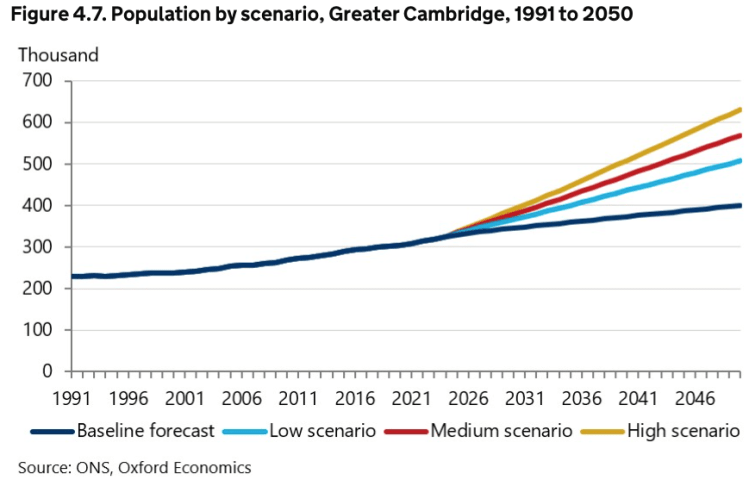
Above – Oxford Econ (2025) Fig 4.7
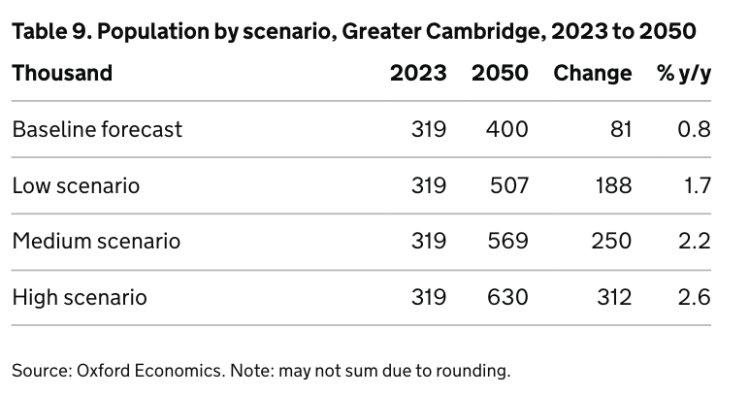
Above – Oxford Econ (2025) Table 9
With such a rapidly-growing population, I cannot see how fragmented local public service organisations will be able to cope with the huge changes in demand for their services, let alone have the institutional infrastructure to cope with a rapidly-rising population. (Here’s my infrastructure wishlist from a 2021 blogpost that’s probably obsolete by now!)
Which is why Cambridge urgently needs some open conversations (one that involve the public) about how our city (i.e. the new unitary authority area) should be governed.
Food for thought?
If you are interested in the longer term future of Cambridge, and on what happens at the local democracy meetings where decisions are made, feel free to:
- Follow me on BSky
- Spot me on LinkedIn
- Like my Facebook page
- Consider a small donation to help fund my continued research and reporting on local democracy in and around Cambridge.

 The Cambridge Town Owl