*I like big maps and I cannot lie, you other brothers can’t deny…* But when the only place the public can find it is tucked away in the Cambridgeshire Collection, I wonder why councillors did not insist that copies were distributed and pinned up in community centres and public transport hubs. (You should be able to access the big map online here)
But first this…
Two new free workshops on the future of Cambridge coming up!
- Sat 24 Jan 2026 from 11am-1pm: Future of Cambridge – sports, leisure, and arts facilities 2024-45. At Rock Road Library Community Room. Free/donation. Please sign up here.
- Sat 31 Jan 2026 from 11am-1pm: Future of Cambridge – A new concert hall for Cambridge. At Cambridge Central Library Conference Room on 3rd Floor. Free/donation. Please sign up here.
As always, they are free to all because I don’t want anyone put off participating because of money/expense. Hence inviting those of you more fortunate/affluent to help cover my room-hire costs and printing costs, which inevitably stack up. The positive feedback that comes with the A3 print-outs is more than worth it because the conversations between the participants seem to light up with a large sheet that people can write on. Which is both wonderful to see (and helps the workshops be participant-influenced) and important in improving people’s knowledge of what is happening.
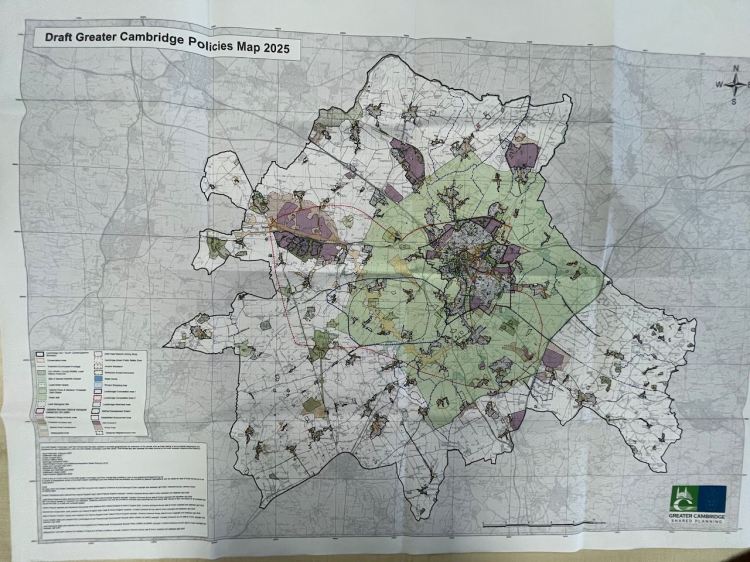
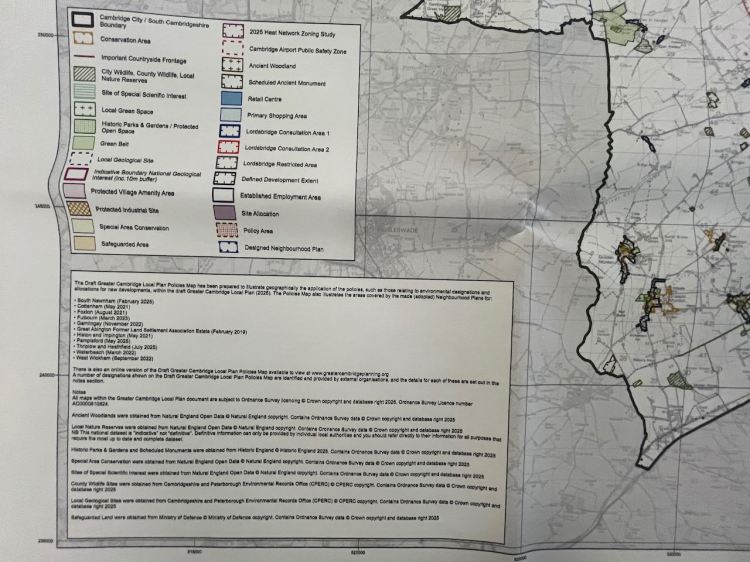
Above – it’s ***Huge*** (A-Zero size) which also means it is large enough to have a number of people around a table looking at it and discussing it. You can try downloading it here directly, or failing that do a ‘Control+F’ for ‘Policies Map’ in the documents’ library list here
Which is essential for public events. As both a historian and someone who rocks up to local public consultation events like the proverbial Zed-list celebrity turns up to the opening of a front door or the opening of an envelope, maps have this ‘bees around a honeypot’ effect – as happens every time I unfold a copy of the main Holford-Wright report maps from 1950. That said, in the case of comparing the current local plan proposals with previous eras, the most interesting one was the first county regional development plan for the old (and much smaller) Cambridgeshire County Council – sometimes called the ‘County of Cambridge’. Until 1964 the administrative County Council covered Cambridge Borough/City, what is now South Cambridgeshire, and the southern section of what is now East Cambridgeshire District (previously Newmarket Urban District). Which is why I tried to make the case for those pre-1960s boundaries as being a starting point for negotiations on boundaries for a unitary council
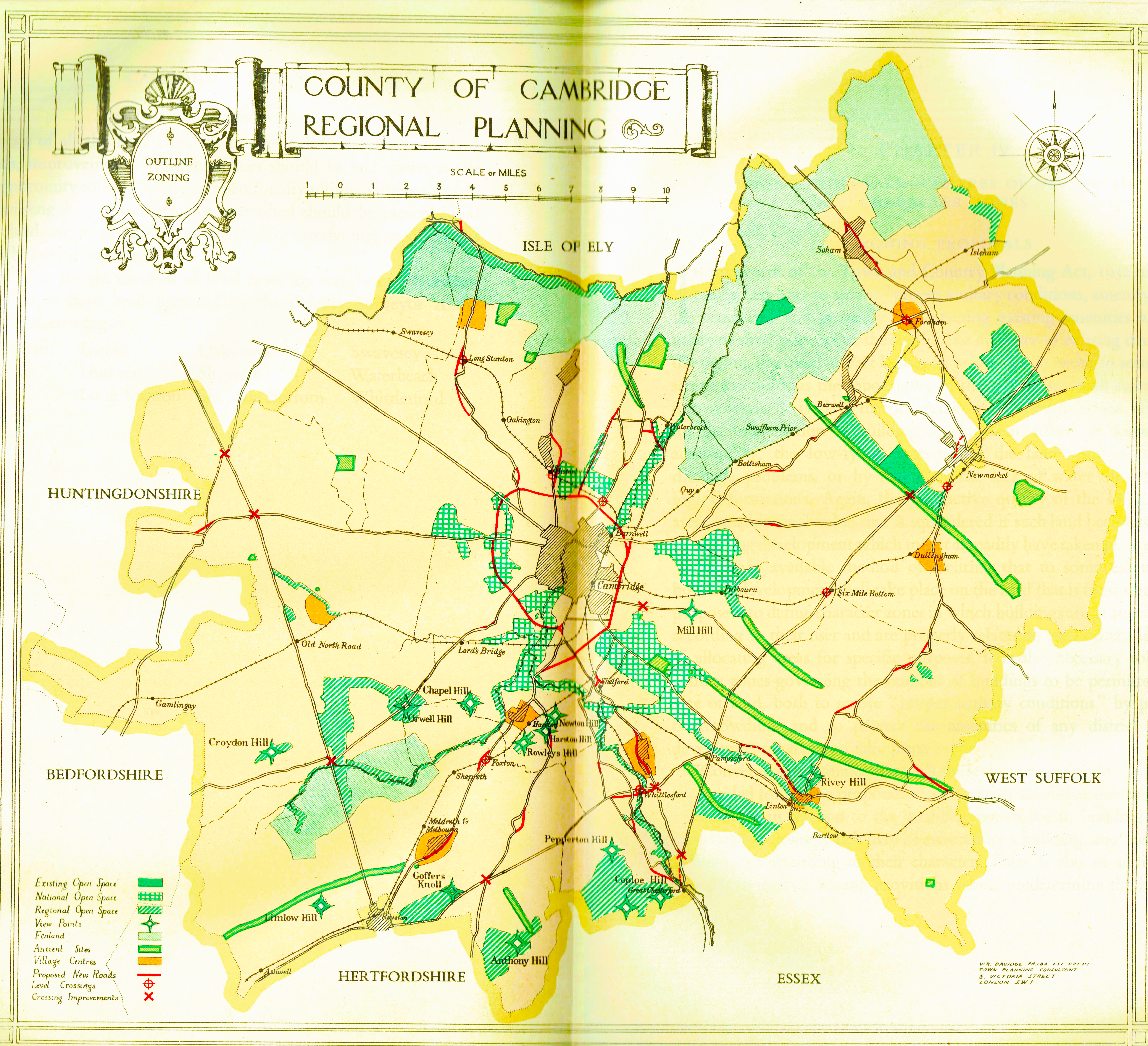
Above – Davidge (1934) p88 – proposed roads and just as importantly, protected green spaces. See if you can spot Foxton, and the old Varsity Railway Line. Cambridgeshire Regional Plan (1934) by William Davidge, with that civic titan Dr Alex Wood being the Chair of the Regional Planning Committee.
If you’ve ever heard of ‘Alex Wood Hall’ or read about it on a Cambridge Labour leaflet, it’s the same Alex Wood.
Cambourne looks like it will become half the size of Cambridge – area-wise
Compared with the diagrams in the consultation document, the ‘to-scale’ maps show how much development is proposed in this emerging local plan. Which should also concentrate the minds of those taking on our collective water supply crisis. How do we get our overall consumption down? The Government awarded Anglia Ruskin University with a £500,000 grant for water efficiency improvements earlier, but in reality all settlements (villages, towns, and cities) need to undertake huge retrofitting operations. That public policy task will be substantial.
Cambourne now has a busway integration plan
I’m still concerned that the aesthetics of the architecture are going to be of the type that research in the field of neuroarchitecture as featured by Humanise in autumn 2025 increases the level of mental stress in people living and working in the shadow of such bland and repetitive building design. As someone of a neurodiverse disposition, I’m particularly concerned that such designs present a higher risk to us.
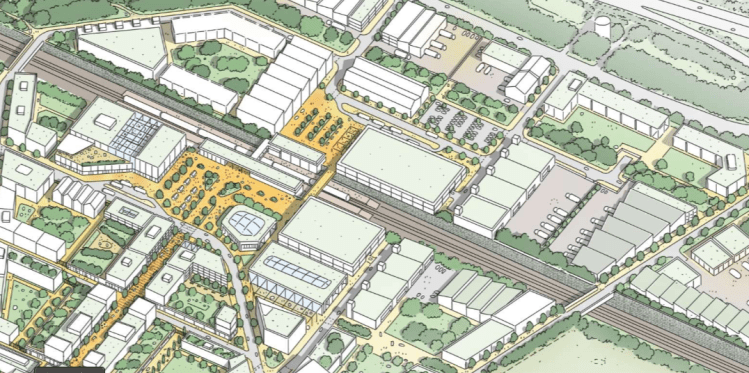
Above – concept illustration from the C2C Busway Integration Report – which you can read here.
Looking at it from a different angle and a more detailed look, I think the local residents current and future deserve far, far better from the architectural and property professions. It makes me wonder whether having wide open fields which people can do almost *anything* with is harder to get right rather than renovating an historical area with lots of derelict old buildings, forcing planning and design professionals to be far more innovative and creative than they might otherwise be.
That traffic ain’t goin’ nowhere. Fast.
The Cambridge Growth Company teamed up with Cambridge Ahead to launch a survey of sci-tech workers to find out about their experiences of life, commutes, traffic, and things. Which is an interesting choice of cohorts.
I’ve asked the CGC to commission another similar survey focused on those of us in the bottom twenty-fifth percentile of incomes because we’re the ones less likely to be able to afford a car. (Note the figure later in the article on the significant minority of households in Cambridge that do not have a car or a van). I’ve also pointed people towards the reports on sports and arts that form part of the documents library. (The ‘Infrastructure Delivery Plan’, and the ‘Cultural Strategy’ which I blogged about last December). I remain continually grateful to my merry band of subscribers who help support my various costs (feel free to join them!) and that over the past couple of months have allowed me to invest in some new equipment and some ‘new old books’ that should be useful reading for today’s policy makers about lessons learnt by previous generations. I’ll be featuring some of them in some new short videos over the next few months.
“If it’s wealthy and affluent people Cambridge needs to use light rail, then surveying them won’t necessarily be a bad thing – will it?
It might be good for Cambridge Connect light rail supporters (including me!) because as people from the business sectors have told me over the years, people with wealth won’t want to travel on a bus – they’ll stick with their cars. Give them light rail and/or trams and they will use them.
“A developed country is not a place where the poor have cars. It’s where the rich use public transportation“
Attrributed to Gustavo Petro, former Mayor of Bogota, Colombia.
“Don’t you believe that Cambridge should have the best? If you walked into a municipal public transport showroom you would select light rail! It’s lovely, it’s elegant, it’s beautiful, it’s quite simply the best – and Cambridge should have the best! In the world of municipal mass transit it is the Savile Row Suit, the Rolls Royce Corniche, It is the public transport system Harrods would sell!”
Parodying Sir Humphrey Appleby in Yes Prime Minister (performed brilliantly by Nigel Hawthorne even though the brands might have changed! That and Sir Humphrey was talking about replacing one system of WMDs with another – Trident!)
Instead, the C2C document states:
“The new route is proposed to provide a reliable, frequent and easy ‘turn up and go’ service stopping at a number of locations, including Cambourne, Bourn Airfield, Scotland Farm travel hub, Hardwick, Coton, West Cambridge and the city centre. It is currently expected to provide up to eight buses per hour in each direction, with direct services to key locations including:
- Cambourne to Cambridge city centre, station, and Biomedical Campus: Every 10 minutes (six buses per hour).
- Cambourne to Cambridge Biomedical Campus via M11: Every 30 minutes (two buses per hour).“
Above – C2C Busway Integration Report (2025) p5
As things stand those claims are laughable. Especially in rush hour. On social media Cambridgeshire County Council regularly publishes transport map diagrams such as the one below-left earlier this morning. Also note the significant minority (over a third) of households that have no cars or vans in Cambridge via the 2021 census.
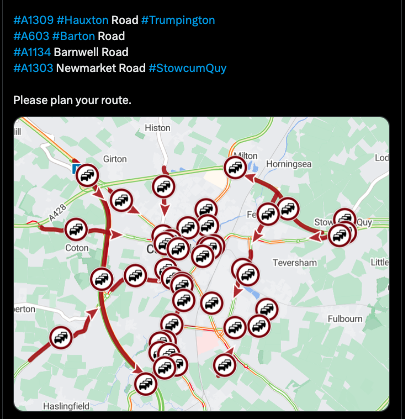
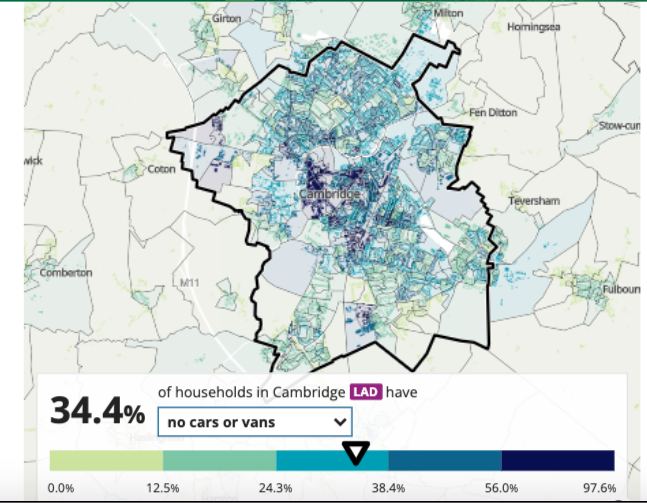
Above – can you see where the Cambourne to the Biomedical Campus via the M11 is likely to get stuck at in the morning rush hour? And how are the buses meant to get from Grange Road to the city centre and then onto Cambridge Station and Addenbrooke’s?
It’s not like we didn’t warn them. The Greater Cambridge Partnership’s own independent auditors warned them back in 2021.
“[The Cambourne to Cambridge Busway Project] …offers no solution apart from the City Access program of soft measures to restrict on-street parking and reallocate road space to active travel. The assumption is that these measures will be enough to enhance bus speeds and provide more reliable journey times across the city. However, no detailed modelling of the likely impact has been conducted so it remains uncertain whether bus accessibility will improve.” [Audit Comment A4].
Greater Cambridge Partnership meeting papers 01 July 2021, p385

Above – note the not insubstantial audit of the proposed Cambourne-2-Cambridge busway. An electoral backlash in 2023 forced senior officers to abandon the congestion charging proposals because they had failed to keep the public ‘onside’ about their proposals. (Exposing far greater issues such as political and civic literacy, the lack of city-wide local media, what is in my view a culture of contempt towards the public from the transport engineering profession, the lack of genuine widespread participation in the future of our city…amongst other things).
That’s not to say light rail is a guaranteed solution – as the National Audit Office noted in its report in 2004, which I wrote about here.
- “Complexity of the delivery chain, where delivery of light rail schemes depends upon several partners to be fully effective;
- Capacity of delivery organisations, where local authorities that promote schemes need to have the capacity in terms of staff with the right skills to deliver new light rail systems;
- Targeting of resources to improve public transport where there is greatest need, and for the most effective use of resources; and
- Monitoring and evaluating performance, to determine the extent to which schemes are delivering the expected benefits, on time and within budget.”
Above – NAO (2004) Summary para 3, p1 / p6PDF
The biggest difference between the UK and EU is…compensating utility firms.
“The costs of diverting utilities are lower In England, promoters have to pay 92.5 per cent of the costs of diverting utilities. In Germany, promoters contribute less, while in France they pay nothing.”
Above – NAO (2004) p9 / p14pdf
Ministers have to come up with a way to get those costs down. Otherwise nothing will change. The other problem the pro-busway people have is that the Mayor of the Combined Authority has said he is under no duty to use the busway should it be approved. As the law empowers the CPCA Mayor on deciding routes under bus franchising. we could end up with a stretch of road that no one uses, and terminates in a part of Cambridge that few want to get off at.
For those of you who like discussing transport things, have a look at:
The Cambridge Cyclescape Boards
The Cambridge Area Bus Users Group
Cambridgeshire Sustainable Travel Alliance
The Combined Authority’s first committee meetings of 2026
The papers are now out for:
- Transport Committee 14 Jan 2026 (just one public Q on buses from Simon Middleton – the meeting on 04 March 2026 is due to feature a light rail update from Tim Bellamy, Asst Transport Director)
- Skills Committee 19 Jan 2026
- Growth Committee 21 Jan 2026
Not much happening at The Guildhall other than a pre-application briefing on another Biomedical Campus carbuncle (4000 Discovery Drive – I despise the design with a passion)
As for Cambridgeshire County Council, they appear to have had all of their fun stuff taken away and seem to be little more than a commissioning organisation with little policy remit left. (Have a browse through their meetings here). I don’t envy the councillors or council officers involved in winding down that institution. I hope those officers that would like to stay on in the new unitary council are able to do so. It’s a horrible process to go through.
If you are interested in the longer term future of Cambridge, and on what happens at the local democracy meetings where decisions are made, feel free to:
- Follow me on BSky
- Spot me on LinkedIn
- Like my Facebook page
- Consider a small donation to help fund my continued research and reporting on local democracy in and around Cambridge.

 The Cambridge Town Owl