The very low turnout at Queen Edith’s Nightingale Pavilion earlier was disappointing, but perhaps inevitable in the face of a fragmented city with no widely-read/used single point of civic information sharing.
Part of the context here is the collapse of the once-mighty Cambridge Evening News. In 1994 when I had a paper-round, the proprietors could rely on daily sales of over 40,000 copies.

Above – Cambridge Evening News 17 Feb 1994 in the British Newspaper Archive
Fast forward just over 30 years to 2025 and the daily newspaper now costs more than the weekly Cambridge Independent, and has a miserable circulation of just under 1,500.
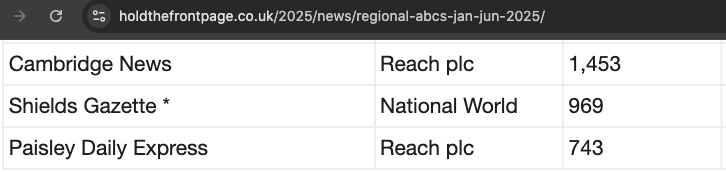
Above – Hold the Front Page – regional ABC Jan-Jun 2025
Which makes me wonder for how much longer will the ReachPLC-owned publication will survive in print form.
I don’t know what the answer is to the lack of a single, widely-used local shared point of communication and news-finding
Which is hardly much of a progress update as I was asking similar questions this time a decade ago! Just over 18 months later and the Cambridge News paid a very high profile price for ReachPLC’s heavy cuts to staff.

Above – me with hair (and far fewer greys too!) with an edition of the Cambridge News that should never have gotten out of the printing presses.
A few months later in early 2019 the Cambridge News’ circulation was down to just over 7,000. How on earth ReachPLC make any revenue from their online presence is a mystery. Furthermore, it’s not the first time that the firm has been criticised over accuracy – as communications expert Dan Slee wrote in 2020.
“It is evident that where there is a vacuum of credible local information, misinformation, disinformation and division can thrive.”
Above – Review of Local Media: Part 1 (July 2024) OfCom, p4
A thriving local media is essential for creating an informed local populace
…especially one that is confident and empowered to take part in consultations – knowing that their views won’t simply be ignored.
Back in the early 1990s the old Cambridge Evening News broke down the proposals for local government reform into ***five parts***
I blogged about that case here.

Above – the Cambridge Evening News 20 May 1991 from the British Newspaper Archive, p12
Given the huge scale of the draft Greater Cambridge Local Plan 2024-45 Consultation (which I’m dubbing ‘The Future of Cambridge’ – because that’s what it is all about), we could do with similar in-depth analysis that is also accessible *and* readable for a general audience.
“What did local residents ask planners about at the Queen Edith’s event?”
I think we were lucky to get into double figures on a cold, dark, damp January evening. But then there were no posters about – the publicity these days being almost entirely online. This is why any future community development strategy for Cambridge has to involve figuring out how to cascade information to city residents that have few common shared sources of information. That’s no criticism of the likes of the Cambridge Independent – which I still by weekly from the local post office. Old habits die hard! Also it’s not a criticism of the town planning staff who also did not have the large paper media resources they needed to deal with some of the questions from the residents. It was only when I rocked up with an A0-sized map of Cambridge that the more open, shared conversations between the residents were able to happen. Prior to that they were looking at a laptop screen.
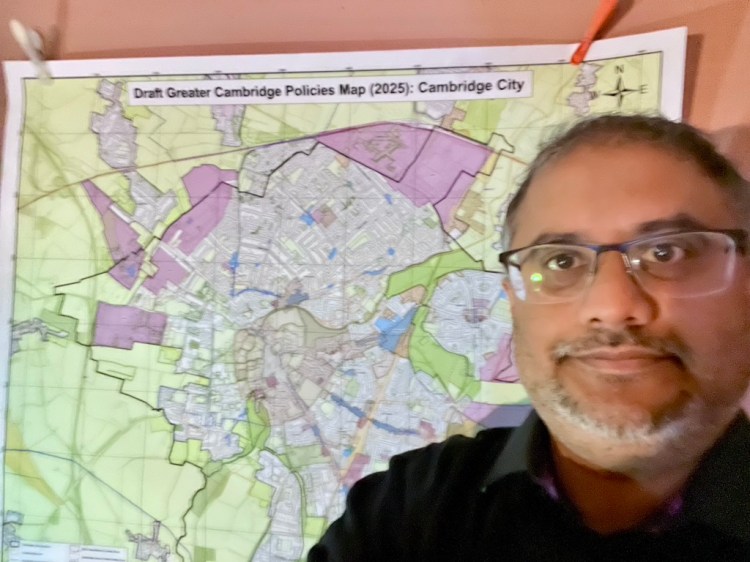
Above: “I like big maps and I cannot lie…”
The problem for local residents especially those on low incomes is that each A0 print-out costs £20 a copy. The people who really needed the larger format versions – the elderly and/or people with visual impairments, are often the ones who can least afford the large format printing.
“No, *what* did the residents ask about?”
Immediate solutions to chronic hyperlocal problems
Lime Kiln Hill was picked out as one of several notorious traffic-jam-spots as well as a road that is far too narrow for motor vehicles. Quite understandably local residents wanted something done about it *now* and not in 2045. The problem? That old city/county split. There was very little that the planner could say about an issue that was not the responsibility of their employer. Yet the reassurances they provided about ‘working closely with…’ did not provide the residents with the reassurances they wanted.
Talking to the planners in the last half hour (by which time most of the local residents had gone), I asked them what they needed from local councillors, and community activists with no job title/description like me. They said they needed the sort of hyper-local neighbourhood level intelligence that as town planners they could never hope to have with a third of the county to cover in great detail. In the case of Lime Kiln Hill local residents had significant concerns that an already narrow road that routinely clogs up with traffic needed widening in advance of any substantial new developments being put in. It’s at that level that residents and councillors need to highlight issues.
Water supply and sewage capacity
Mindful of yesterday’s farcical news about the Fens Reservoir being delayed, again residents were not convinced about the explanations on our current water stress. What made things harder for the planners was that both water supply *and* sewage capacity are key dependencies for the future plans, but they are *not* something that they are in direct control of. The only reassurance they could give residents were that they were working closely with the institutions involved.
Schools, doctors, dentists, and community centres
Part of the problem here was the relative vagueness of the proposals at this stage. In the case of Queen Edith’s ward, the plots of land identified for housing have been carried over from the current local plan 2018-30. What residents are experiencing here is what I call the Fallacy of Composition effect. The idea that for developments A, B, and C you can provide them each with community centre design D, or small swimming pool design E, and assume that all will be well. The problem arises when you look at ‘Large Development A+B+C’ and realise that the combined needs of all of them together is greater than the sum of the local needs that you have provided for.
Because of the piecemeal nature of South East Cambridge’s expansion, no one has been in a position to look at that part of Cambridge as a whole and reassess the collective community needs. Much of the community infrastructure with the exception of the secondary schools and Addenbrooke’s Hospital dates from the latter 20th Century. There has not been a substantial expansion of the community facilities to account for things like the densification of individual plots of land from single detached homes with very large gardens to blocks of flats / a larger number of smaller homes, increasing the population density.
The planners are caught between a rock and a hard place here because at some stage the Cambridge Growth Company with the authority of the Minister for Housing will be publishing their proposals for the growth of Cambridge.
A reminder
“We have previously agreed several high-level principles that the Cambridge Growth Company must adhere to when developing plans for ambitious and sustainable growth in Greater Cambridge. When it comes to the growth strategy, development on a more dispersed geographical footprint is perfectly acceptable, but one or more contiguous urban extensions of the city [of Cambridge] must be core components of the vision the Growth Company brings forward, in order to maximise the benefits of agglomeration.”
My concern is that some of the reassurances that planners have given with their existing draft plan on areas of green belt not allocated for development, will be included by the Growth Company as development land in the minister-approved plans. The site most likely for inclusion in the Cambridge Growth Company plans that are *not included* for development in the current draft local plan proposals is the land north of Cambridge Science Park. I wrote about the Science Park’s submission to the Greater Cambridge Local Plan call for sites here.

Above – (Click here and the full document should download) the proposed Green Loop (presumably an active travel link) would connect the CSP North (in the white blocks in the middle) to the long overdue Milton Rowing Lake.
Sadly their main consultation site https://cambridgescienceparknorth.co.uk/ does not contain the document linked above
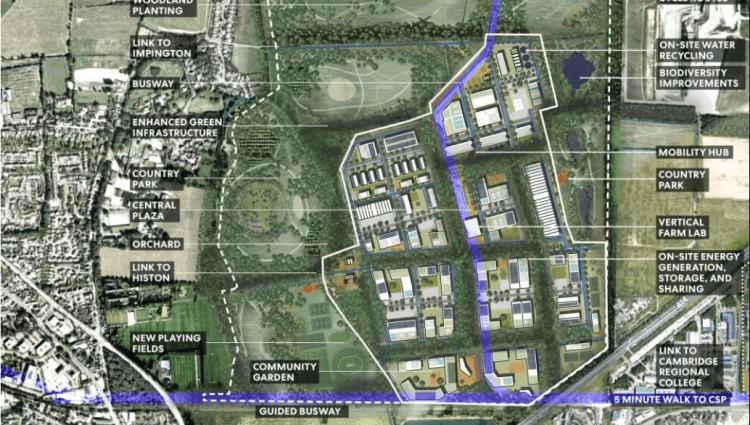
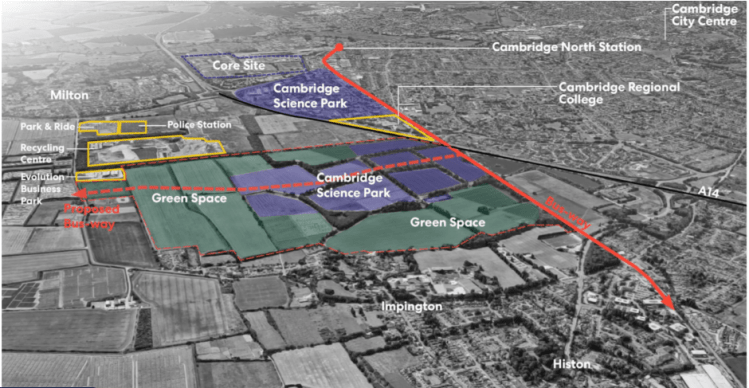
Above – the background info page has a couple of useful diagrams to show their ambition for growth
That said, I remain of the view that the growth ambitions need a comprehensive light rail network as a core part of an integrated public transport network
“Don’t you believe that Cambridge should have the best? If you walked into a municipal public transport showroom you would select light rail! It’s lovely, it’s elegant, it’s beautiful, it’s quite simply the best – and Cambridge should have the best! In the world of municipal mass transit it is the Savile Row Suit, the Rolls Royce Corniche, It is the public transport system Harrods would sell!”
Parodying Sir Humphrey Appleby in Yes Prime Minister (performed brilliantly by Nigel Hawthorne even though the brands might have changed! That and Sir Humphrey was talking about replacing one system of WMDs with another – Trident!)
We didn’t get onto micro-vehicles
…but I covered it at the end of this blogpost – mindful of the latest announcement from the Combined Authority.
“What’s that?”
Their Micromobility survey which you can fill out here
In the free text fields I moaned about the lack of docking stations and the poor management/co-ordination by VoI Tech. I also called for the legalisation and regulation of e-scooters too, as I wrote here.

Above – in my more advanced years I quite like this one! A seated e-scooter limited to 15.5mph – at least it sort-of matches the Cambridge Blue colour scheme and is less visually intrusive than bridge orange!
I’ve also mentioned the opportunities that micro-e-cars can provide – something that for short journeys could reduce the amount of damage to roads as well as reducing noise and air pollution.
Above – Electroheads on the Citroen Ami
Any takers?
If you are interested in the longer term future of Cambridge, and on what happens at the local democracy meetings where decisions are made, feel free to:
- Follow me on BSky
- Spot me on LinkedIn
- Like my Facebook page
- Consider a small donation to help fund my continued research and reporting on local democracy in and around Cambridge

 The Cambridge Town Owl