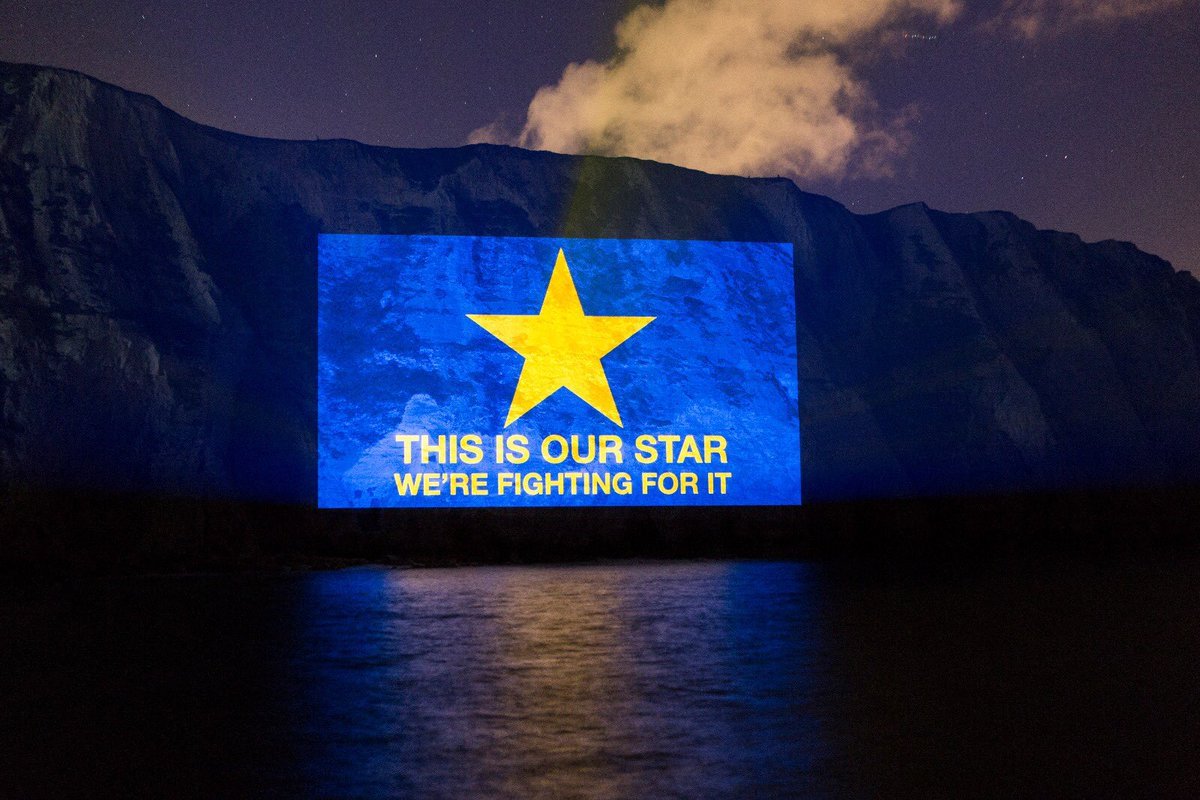
Dr Stella Creasy MP explains succinctly what recent events over Greenland mean for the UK, and why the UK Political Establishment needs to completely rethink its approach to the EU in the contest of national security, not just on economics and trade.
I try to avoid international politics these days because it depresses me, but the recent news and also the powerful summary from Labour MP Stella Creasy on what the Government needs to do may be of interest to pro-EU people.
You can see the video of the MP for Walthamstow on FB here, and also on IG here.
“Sweden is currently having intensive discussions with other EU countries, Norway and the United Kingdom to find a joint response,”
The responses from some of the more prominent pro-Leave talking-heads has been quite something – from tyre-screeching U-turns to incredulity that their political inspiration could do such a thing. Even the Leader of the Conservative Party has spoken in support of the Prime Minister on Greenland, as her party goes after the disgraced former Communities Secretary who has followed the flow of former Conservative ministers into the land of TeamNigel.
Accordingly, Labour’s centralised command and control system has deployed their MPs active on social media to publicise the number of ex-Conservatives who have jumped ship – this example being from the Grimsby MP Melanie Onn who lost her seat in the 2019 General Election, only to win it back at the 2024 general election.
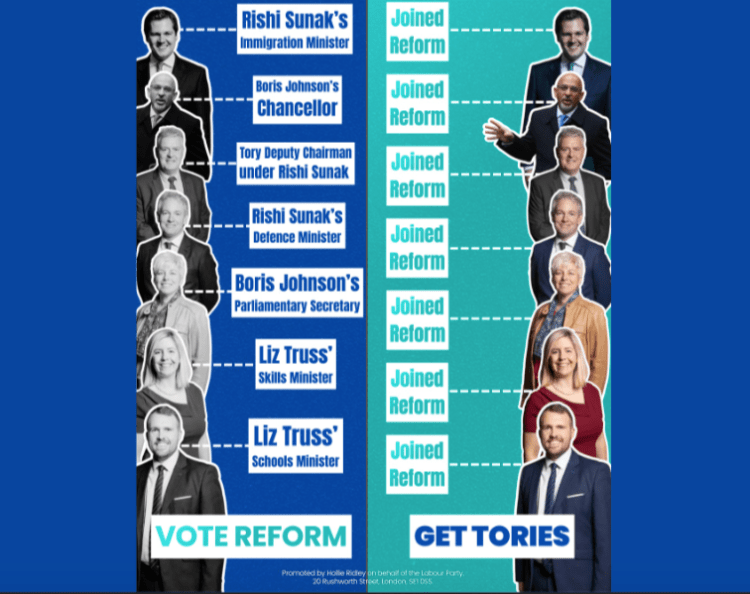
Above – Melanie Onn MP on FB, 16 Jan 2026
It remains to be seen how influential such advertising is, but TV talking-heads looking at the so-called ‘red wall seats’ of 2019 mentioned that those areas that suffered under Margaret Thatcher’s economic and social security policies in the 1980s are more likely to take notice of that flow of Conservative politicians than perhaps traditional Tory voting areas such as northern Cambridgeshire.
The parallels with previous eras of history
Being a historian by disposition, the area of history that I studied for my Post-Graduate Diploma at Anglia Ruskin University just before joining the civil service (2002-04) was Post-WWII European History. It was a highly-regarded course titled “Historical Studies: Contemporary Europe” and would have been ideal for people trying to get their head around the events happening in the run up to the catastrophic EURef of 2016. In a nutshell it was the bit of history after WWII that my generation never got to study – in part because the years after 1945 were still within living memory of a critical mass of the population, my late grandparents included.
The main parallel I can think of was the First Moroccan Crisis of 1905/06 as the growing German Empire clashed with France diplomatically, forcing the hand of the British Government to intervene to prevent France being humiliated on the international stage. The unstable German Emperor Wilhelm II – the nephew of King Edward VII of the UK (the former was the eldest son of Edward’s older sister Vicky, the widow of Friedrich III, the tragic 99 day Emperor), wanted to oppose France’s growing control over Morocco, and threatened war if France did not back down. France conceded to an international conference, but King Edward VII was furious. Edward was hugely influential in the international politics of the era (the Tsar of Russia was also his nephew by marriage, while the Tsar’s wife Tsarina Alexandra was his niece – the daughter of Edward’s younger sister Princess Alice).
The conference took place in the Spanish port city of Algeciras – which is on the western side of the Bay of Gibraltar. The UK had one of its largest naval bases on the other side of the bay. The British Government made a point of anchoring their entire Mediterranean fleet and Atlantic fleet in the harbour. As the author Robert K Massie said in his epic, Dreadnought, The Kaiser’s representatives were faced with a stark fact. It didn’t matter how big the German Army was, it could not walk on water. Any colonial concession in Morocco would be completely dependent on the UK’s tolerance. Hence Germany came away with very little. As Massie noted, the Entente Cordial of 1904 (which had its 120th anniversary in 2024) brought an end to centuries of often hostile relations – but few anticipated that international events would result in a much more concrete alliance between the two.
Fast forward to today and Denmark requested other NATO members for support – hence the reconnaissance teams from a number of countries who are now threatened with tariffs. Just as Kaiser Wilhelm II was an unpredictable and destabilising influence in pre-WWI international politics, that parallel sounds familiar today.
“[NATO Secretary General Mark Rutte, the former Dutch Prime Minister] is one of a handful of European leaders who have been able to win the ear of the unpredictable US president.”
Above – AFP for RTL Today, 16 Jan 2026 on the challenge facing the NATO Secretary General.
The impact of Brexit, the double-election of the current US President, and the outbreak of war in Ukraine changed the EU beyond recognition compared with the pre-EURef years.
That’s my take anyway – and it also reflected a huge miscalculation by the pro-Leave governments that followed the catastrophic referendum, some of the leading proponents of which were calling for the break up of the EU. As an aside, Prof Paul Whitely of the University of Essex wrote an interesting piece on the causes of the UK’s Leave vote, he cited:
- EU Membership not being seen to deliver for the UK – the flames fanned by the tabloids in the mid-2000s resulting in far right parties gaining seats in the European Parliament. The failure of the pro-EU politicians to speak out powerfully against this and make a stronger case for membership for me was also a cause. Furthermore, Labour’s failure to invest enough in new housing and public services in the run-up to and following the 2004 ascension of the A10 countries – including eight former Warsaw Pact countries that until 1989 were aligned with the Communist-run Soviet Union.
- The Banking crisis followed by the recession, and then George Osborne’s self-inflicted austerity in part enabled by Nick Clegg’s Liberal Democrats for which that party would pay a very heavy political price over the following 15 years.
- The collapse of governments and regimes in the Middle East, creating a significant geo-political crisis that extremist movements and outlets fanned the flames of as people sought refuge in Europe – and still are.
- A more nimble and radical campaign from the pro-Leave side that as we later found out did not ‘play by the rules’, against an utterly uninspiring Remain campaign led by business figures and career think-tank people with no prominent inspiring figure to be the leading figure. The once significant Liberal Democrats had been crushed at the ballot box (and financially) in 2015, and Labour were led by the Euro-sceptic left wing campaigner Jeremy Corbyn who understandably did not want to appear on a platform with David Cameron and George Osborne – both of whom lacked credibility to make the case for staying in the EU having spent much of the previous decade criticising it.
One of the other longer term components was the failure of the pioneering citizenship curriculum and the new GCSE in Citizenship to make any visible impact on things like political participation – even though the standards of materials in my view was generally very good. (Have a browse through some of the past editions in the internet archive here – and note the clear and concise sections on the UK’s relationship with the EU which in a few pages busts a number of myths.)
While some of the larger countries – France and Germany in particular could survive the breakup of the EU, what the UK politicians never understood was just how important the EU was to the smaller countries. Which was demonstrated in spade-loads when successive Conservative governments tried to bully the government of the Republic of Ireland, only to find they had broken 500 years of UK foreign policy objectives: To maintain the balance of power in Europe. Or rather as Sir Humphrey Appleby satirically said in Yes Minister, to have a disunited Europe! Instead, the UK acting in the manner of a colonial power of old thought it could easily get its way. But the whole of the EU swung behind Ireland – hence the fudging of the border issues.
“The British government published several so-called “position papers” on the Irish border during the early stages of Brexit negotiations.”
Above – AJ News 13 December 2017
The alleged statement from an unnamed Conservative MP to the BBC that the people of Ireland “should know their place” inevitably went down like an iron brick.
Above – Joe Politics – 11 December 2018
Did the UK take for granted the benefits of having longstanding international diplomatic infrastructure across the world?
To put it more clearly, if Greater London with a population of around 9 million people were an independent country that was a member of the EU, it would be a mid-ranking country by population size alone. (See EuroStat here).
Bulgaria, Finland, Denmark, Ireland, Croatia – they all have populations that are smaller than that of Greater London. It’s even larger than Scotland’s population – the latest estimate from the National Records of Scotland being around 5.5million.
Being a member of the EU means not having to bear the full expense of having diplomatic representation across the world and in key international institutions. Because so few people are familiar with the way the EU works (again a citizenship education issue), and because the EU-sceptic press have been so successful in blaming ‘Unelected Brussels Bureaucrats’ for crazy policies, the fact that member states sent permanent civil servants over to EU institutions to represent the interests of their countries (as well as national representatives working for the EU civil service itself) was something they were never aware of. Therefore the concept of these distant Brussels Bureaucrats imposing things on an unsuspecting UK public was one that stuck – even though it was not true. The UK was hugely influential in shaping EU policy through EU institutions. Unfortunately few in politics and the media publicised this.
Existential military threats
Historically and culturally, the England-bit of the UK does not have a long and deep-rooted collective experience of being occupied by an invading foreign power. Furthermore, English history curricula does not cover the histories of past battles fought between England vs Ireland, Scotland, and Wales. Furthermore, in the UK Parliament the total number of MPs representing constituencies in England is and has been far greater than constituencies of the rest of the UK put together. A source of political friction especially in the 1980s and 1990s as Conservative governments were seen to be imposing policies that the people of Scotland in particular, had not voted for. Hence the 1997 manifesto commitments for devolution for those three nations – a process that remains unfinished when it comes to governance institutions for England.
Much of the rest of Europe on the other hand does have fairly recent experience of living under occupation. One of the things that has been visible in more recent times is the use of social media by NATO – in particular their video content showcasing the armed forces of member states deploying to the much smaller, more exposed member states on the eastern edge – in particular the Baltic states. As one of the pilots in one of the videos stated, different countries have different specialisms and capabilities. Hence the smaller nations hosting rotating deployments not only from larger countries, but more recently member nations who might not have had long histories of diplomatic relations. For example Portugal and Romania only restored diplomatic relations in 1974 (following the Carnation Revolution), the latter only joining NATO in 2004, going onto host army and navy units from Portugal in the early 2020s
International political institutions in an era of once-in-half-a-century instability
That’s where we find ourselves. A few things to note about what’s happening state-side. The first is that US and UK political systems are not the same. The UK does not have an equivalent structure or culture of constitutionally-protected tiers of the state. The UK has a system of Parliamentary Sovereignty. If an incoming government with a large parliamentary majority wanted to repeal the devolution settlements in Scotland and Wales and had a manifesto commitment underpinning it, all such a government would need to do is to table the legislation and whip their MPs to vote for it. (Hence the concerns in some quarters about a possible TeamNigel government making use of existing powers in a whole host of areas). Hence the reports on calls from state and municipal tiers of the US State to intervene against what the federal tier is doing, may not be clear to a general UK audience.
The other point to remember is that the UK tends not to cover what opposition political parties in foreign countries are doing unless there is a significant election coming up (eg general election) or if there is a revolt. Combined with the party-political structures in the US of not having a designated ‘Leader of the Opposition’ means that unlike with UK domestic politics, we don’t get the format of “Government says X, official opposition says Y, and one of the smaller parties says Z – over to you Des!”
Instead for more informed takes you have to go to the domestic media in the country concerned – one example from the US being PBS which is a non-profit free-to-air broadcaster. They carried this exchange about recent events domestically and on Greenland.
Additionally, there are individual accounts on social media (hence I don’t like it when mainstream broadcasters and/or opinion pollsters asking where people get their news from/how trustworthy different news sources are, use ‘social media’ as a catch all. This summary from Foreign Policy Analyst Richard Fontane is useful on comparing the WH statements vs the facts on Greenland. Coming from the other side of the party political divide is the former US Labor Secretary Robert Reich.
Coming back to Stella Creasy’s recommendation…
Events are moving very quickly across multiple spheres – the northern coast of South America, Canada’s reorientation towards the EU, the continued war in Ukraine, Palestine, and now Iran. It may well be that over the next few weeks and months events create a significant shift in public opinion towards much closer co-operation with the EU than either side could have anticipated. Whether that will have any impact on the local elections in England remains to be seen. I wouldn’t be surprised if both the Greens and the LibDems – both boosted by significant financial support stemming from their increase in allowances from their significant percentage increases in MPs, went after TeamNigel over this in the local campaigns.
Food for thought?
- Follow me on BSky
- Spot me on LinkedIn
- Like my Facebook page
- Consider a small donation to help fund my continued research and reporting on local democracy in and around Cambridge

 The Cambridge Town Owl