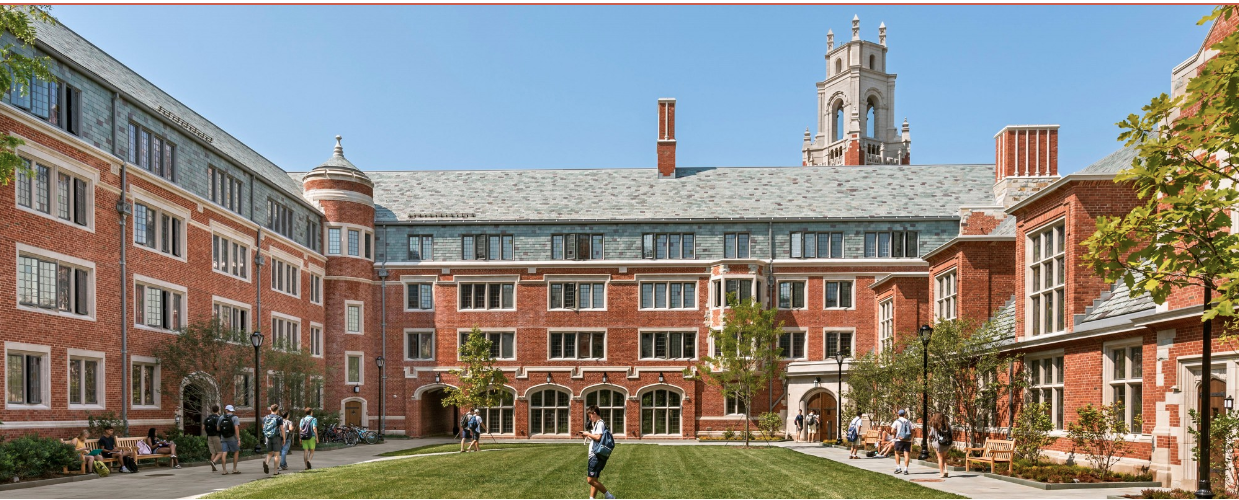
Robert A.M. Stern was one of the partners that built new residential colleges at Yale in the mid-late 2010s. They were striking not least for taking their inspiration from existing pre-20thC buildings.
Image – Yale Residential Colleges RAMSA
How do you take on a challenge that involves designing 1.4miles of building fronts?
That’s what the architects were taking on as explained in this IG video from Robert A.M. Stern Architects (RAMSA).
What struck be about the video was the process more than the end results – some of which work really well for me, and others which do not. Which is as it should be.
“A fully-researched inventory of every design element on the existing colleges… …on the original gothic ten, we categorised corners chimneys, niches, gargoyles, and grotesques”
Ken Stern, RAMSA 27 December 2025 on IG
You could do similar on some of the church buildings too – such as the big Catholic Church on Hills Road funded by heiress Yolande Marie-Louise Duverney [AKA Mrs Lyne-Stephens]. Whose life story should be more prominent in Cambridge given the impact the result of her donation has on Cambridge’s skyline – the view from Lime Kiln Hill only recently been ruined by Brookgate’s boxes on Station Road.
Depressingly the architects designing the new buildings opposite the big Victorian Gothic building have taken almost zero inspiration from the building opposite.
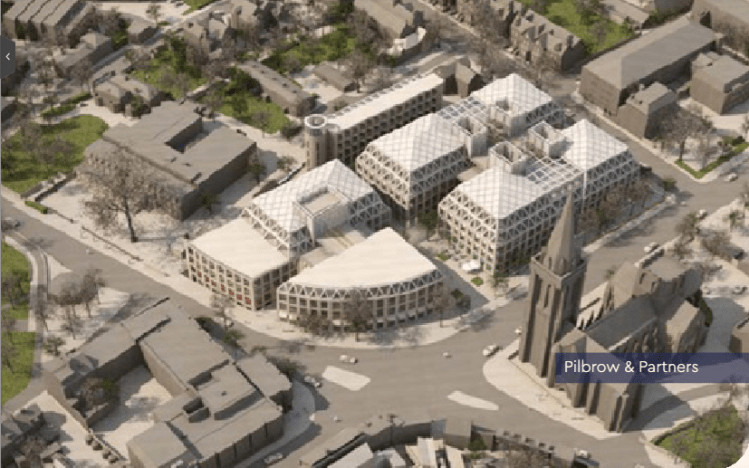
Above – I gave Pilbrow and Partners a metaphorical kicking over this.
The alternative design processes used by RAMSA at Yale
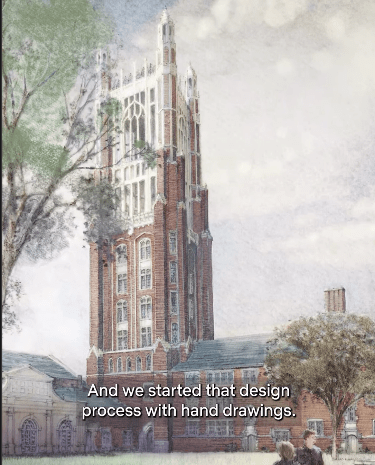
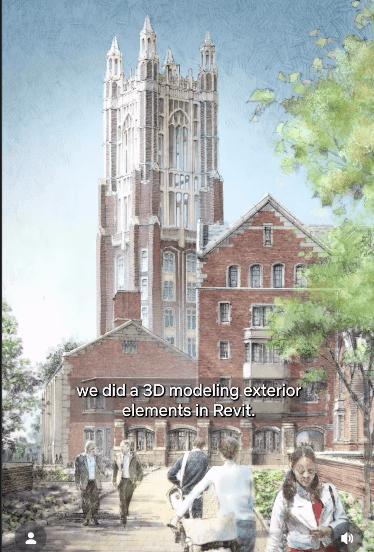
Above: “We started that design process with hand drawings… …we did a 3D modeling exterior elements in Revit”
What was interesting was the use of hand carving in the creation of mo[u]lds for some of the detailed pieces that repeated in other parts of the building design.
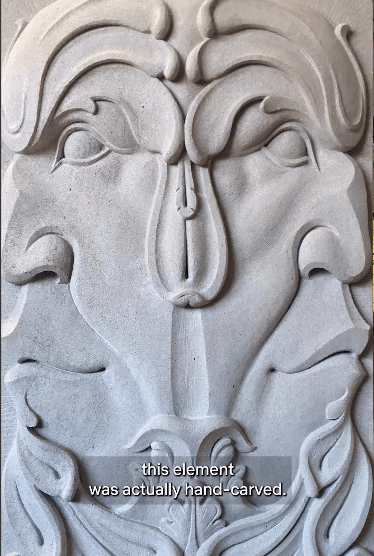
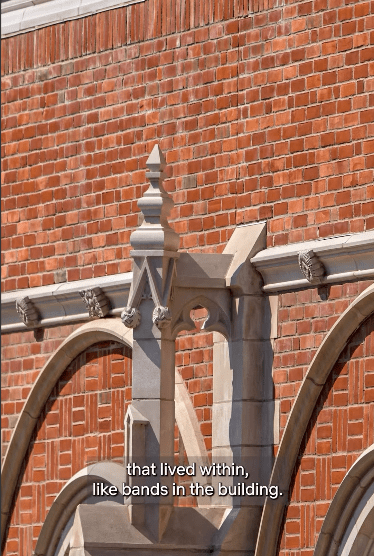
Ken Stern, RAMSA 27 December 2025 on IG
One of the things that a number of people in/familiar with the construction industry have told me is that new technologies are making some forms of ornamentation cheaper than some of the techniques used for bland, boring, minimalist designs that has been the built environment fashion in industry for the best part of 75 years in Cambridge.
What’s troubling for me about Cambridge is that I find it very, very difficult to find case studies of recently-built buildings that are both accessible to the public (and thus myself) *and* are of the type where I would choose to go to during the day just to be in its presence. There are one or two that are genuine improvements on their predecessors – such as the current Parkside Pool opened in the late 1990s. I really like the woodwork of and the curvature of the roof. The problems it has had over the years have not been the fault of the architects. Instead it’s politicians – primarily ministers not bringing in new and more effective systems of local taxation and local government funding to enable councils to build more facilities and amenities to keep up with the needs of their residents and with consumer demand from visiting tourists and language school students. (Note one option on how the latter can help fund new facilities and activities for children and young people)
Automation using renewables-powered machines to carve exquisite designs on a mass scale – positive or negative?
The show 60 Minutes featured one example in Italy which explored the issue of machine-carved marble sculptures.
“A fleet of marble-sculpting robots is carving out the future of the art world. It’s a move some artists see as cheating, but others are embracing the change.”
Above – 60 minutes (12 Nov 2024)
Where does the balance reside? Especially if the automation means the loss of human skills (fewer people coming into the trades, existing firms unable to compete with machine-powered firms).
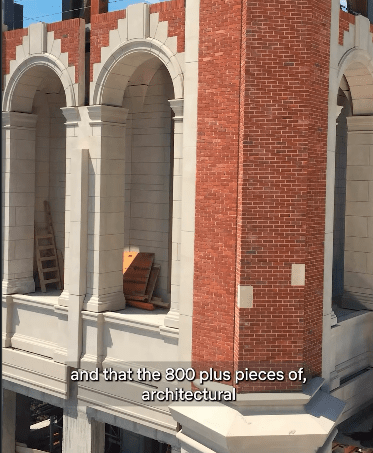
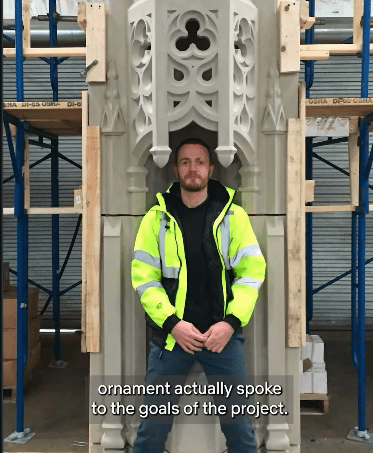
Ken Stern, RAMSA 27 December 2025 on IG
Taking the above-two as an example, should such detailing all be handcarved? Or machine sculpted? or a combination of the two?
“You need to have an understanding of sculpture to program the machine in the way that you want”
Above – Giacomo Massari of Robotor, 60 minutes (12 Nov 2024)
This was in response to Bill Whitaker who presented the above episode – that part of the footage also extracted to FB as a reel here.
What was interesting about that part of the footage was that the final part of the detailed carving was not done by machines, but by skilled craftspeople. The challenge you could say is working out where to draw the line between ‘man and machine’. The first three minutes of the episode cover the huge quarries from where the marble – the raw materials, are mined. Hardly controversial to be using huge machinery to excavate and move huge quantities of raw materials. But inside carving workshops? Do those in favour of traditional sculpture have a point about the art being undermined?
Are AI-inspired designs a further risk?
I lean towards the view that AI-created ‘art’ isn’t art at all because there’s no substantial human creative input. It’s just what a computer programme has mashed together having crawled over vast quantities of images and text irrespective of permissions and consents. What few experiments I’ve had with AI have involved using archive designs from Cambridge’s past – especially unexecuted designs, and instructed the programme to turn whatever the drawing is into a lifelike street scene. My experiments were hardly a success! Which perhaps underlines the point about needing to have an artistic background to make use of the technology.
As the University of Cambridge – and as the city of Cambridge expands, dare any architects, developers, and financiers try designs that are properly inspired by the older architecture rather than trying to get a shade of reconstituted stone to look like it’s the same shade of the stone used in old colleges and pretending that it’s somehow artistic, beautiful and inspirational – and somehow deserving of the name ‘Cambridge Vernacular’? Or are we stuck with what we’ve got due to a fundamentally extractive economic system? (Note also the risks of building design debates being hijacked by culture wars.)
Time will tell.
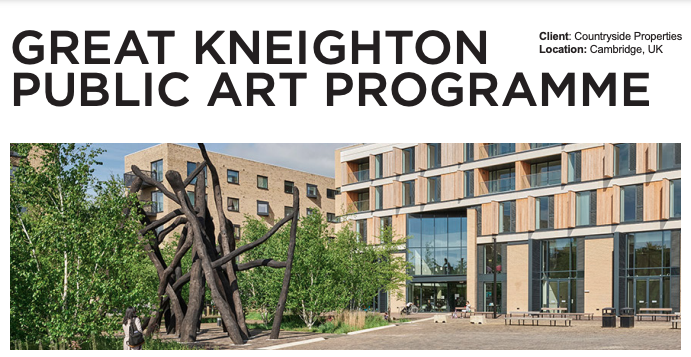
I hope that we can avoid future urban scenes that look like Great Kneighton.
Looking at the initial proposals for Cambourne’s Station Square, it doesn’t look like things have moved on much.
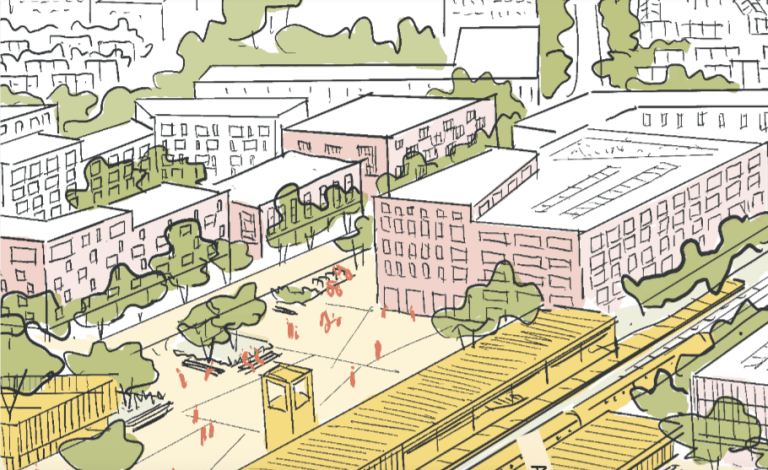
Above – I wrote that Cambourne’s residents deserve far better than this
I hope that the pioneering research in the field of neuroarchitecture can start having an impact soon so that the current proposals can be revamped for the better.
If you are interested in the longer term future of Cambridge, and on what happens at the local democracy meetings where decisions are made, feel free to:
- Follow me on BSky
- Spot me on LinkedIn
- Like my Facebook page
- Consider a small donation to help fund my continued research and reporting on local democracy in and around Cambridge.

 The Cambridge Town Owl