It will mean substantially fewer constabularies and a new ‘National Police Service’
…amongst many other things. Note that these proposals do not apply to Scotland and Northern Ireland as policing is a devolved competency.
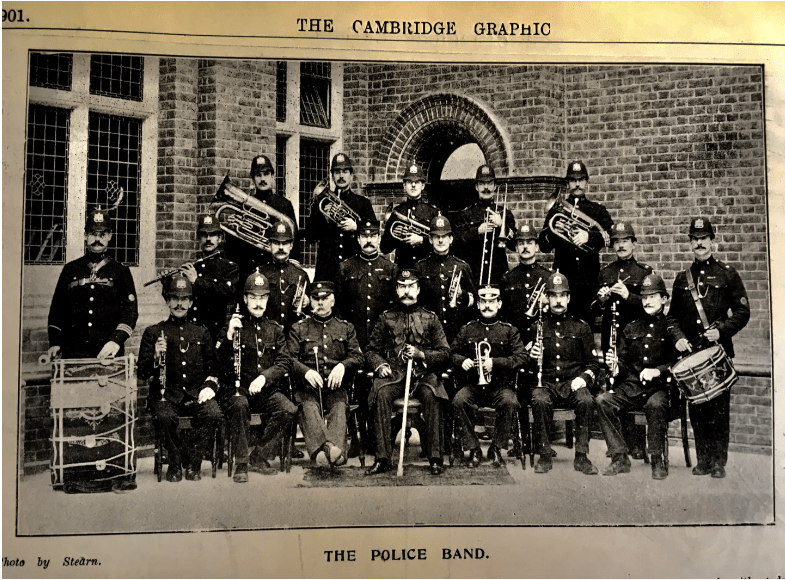
Image: The Cambridge Police Band from the old Cambridge Graphic Newspaper, 1901, Cambs Collection
The Policing White Paper (a formal statement of government policy) was published earlier. You can:
- Watch the Home Secretary take questions from MPs
- Read the White Paper
- Read the policing performance framework
For those of you interested in the history – which was referred to by the Home Secretary, see what her predecessor, Sir Robert Peel, said on 15 April 1829 making the case for establishing a new police force for London in the first instance, before rolling it out nationwide. That Bill had its second reading on 19th May 1829
Apart from the creation of a new national tier of policing – the National Police Service, there will be significant consolidation of the numbers of police force areas which in the 1960s were themselves rationalised to the county-based set up we are familiar with today to a much more regionalised structure that the Home Secretary proposes, neighbourhood policing is a major part of the White Paper, including
- “Deliver visible, accessible and community-focused policing, including delivering 13,000 additional neighbourhood policing personnel in police forces across England and Wales.
- Design new standards so that neighbourhood officers are not routinely abstracted to other areas.
- Ensure that shop theft and assaults on shop workers will no longer go unpunished by bringing in new powers and providing additional funding to policing, working with retailers, to take further action.
- Professionalise neighbourhood policing with every neighbourhood police officer and PCSOs completing enhanced additional training.
- Publish dashboard will be published to measure performance focused on the Neighbourhood Policing Guarantee commitments.“
The Home Secretary also states that the Government will review the police funding formula.
The huge structural changes compel this move – both the regionalisation and the creation of a new national tier in particular. It will be interesting to see how the detail works out between rural and urban areas, and also on a range of other variables beyond crime rates such as poverty indices and unemployment levels.
Again for me the acid test is whether Treasury ministers will enable police forces to draw financial resources through any new forms of local taxation or any new forms of income from the issuing of penalties or fines revenues that could be re-invested with local government tiers on preventative measures. For example motoring fines in improved road design/safety measures.
The focus on neighbourhood policing is in response to public concern about violent crime and also concern from retailers about the highly publicised shop thefts, videos of which pop up all over social media.
“We are bringing in a new offence of assaulting a retail worker to protect the hardworking and dedicated staff that work in store. This also includes the repeal of legislation which makes shop theft of £200 and below a summary-only offence, sending a clear message that any level of shop theft is illegal and will be taken seriously.”
Above – Policing White Paper (2026) HMSO, p26
As a former retail worker in a small convenience store during my late teens, one of the most frightening things to experience is your shop being robbed when there are only three of you in the store at the time. Fortunately I didn’t experience the worst of it. I do know of one former local supermarket manager who was forced to take medical retirement following an armed robbery of his shop – he never recovered from the shock.
What the above does not mean is ‘doing nothing’ on the issue of food poverty and the massive inequalities in our societies
Whatever your views on law enforcement – and they have been brought into sharp focus with the violence on the other side of the big pond, the almost annual police and crime-related pieces of legislation have more than demonstrated that passing ever-increasing amounts of legislation is not the answer. Neither is simply ‘throwing money’ at the issue. The reason why both of these are so prominent as Political responses is that those are the two main policy levers MPs (and/or perhaps those that lobby them frequently) think they have: pass new laws or vote for additional resources.
Ministers need to address a host of other issues – including the mess of the courts and probation systems – if their reforms to policing are to have any chance of success. Additionally, the less fashionable work of community development – often the first to get cut when public funds are tight, remains a critical part of local public policy that should not be forgotten. The problem with our over-centralised state is that such local policies cannot be managed effectively from the centre. (I found out the hard way during my civil service days of ‘the diseconomies of scale of community development policy-making’ in Gordon Brown’s Government).
Which is why I come back time-and-again to the proper funding and empowerment of the tier of local government to enable councils to have a much wider range of taxes and income streams independent of HM Treasury to ‘get on with it’ (while strengthening local systems of accountability such as the calibre of people putting themselves forward for election to local councils) without having central government there to micromanage things. For all their rhetoric on localism, the Coalition didn’t deliver much at all – mainly because any positives that could have come from it was crushed by austerity.
For all of the public policy challenges listed in the Policing White Paper (of which there are many), what are the ones that need input, support, and changes from the non-law-enforcement parts of the public sector? (And beyond?)
Food for thought?
If you are interested in the longer term future of Cambridge, and on what happens at the local democracy meetings where decisions are made, feel free to:
- Follow me on BSky
- Spot me on LinkedIn
- Like my Facebook page
- Consider a small donation to help fund my continued research and reporting on local democracy in and around Cambridge.

 The Cambridge Town Owl