You can table your public questions to the council for their meeting on 03 Feb 2026
I’ve been trying to find things to distract me from the catastrophic decision to recommend approval for the Kett House Carbuncle (See item 6 of the Planning Committee meeting on 04 Feb 2026) which means that unless Cambridge Past, Present and Future, and local residents’ groups have made a strong enough case, it will be rubber-stamped.
“Were they not interested in Dr Cleo Valentine’s research on the mental stress increases that such building designs cause?”

Above – I described this design from Bennetts’ Associates as one that shows contempt for the people of Cambridge
I’ve spent the past day living with the symptoms of the increase in mental stress – one of my neurodiverse / ADHD traits is to catastrophize and go through in my mind over-and-over again all sorts of distressing thought-spirals for which I’ll spare you the details. It’s only been in recent years that I discovered that such things a) were *not* normal, and b) were a feature of not having a neurotypical neurotype. Language that those of us who are neurodiverse are finding to be the words that we need to explain our day-to-day lived experience.
“A Health Impact Assessment has been submitted with the application. An informal discussion has taken place with the Preventative HealthProgramme Officer following this submission who has advised such assessments are scoped in at the beginning of the pre-application process. However, in this instance, the start of the pre-application process pre-dates the adoption of the Health Impact Assessment SPD.”
Above – Cambridge City Council Planning Committee 04 Feb 2026 item 6 p72
The planning officer states that because the Health Supplementary Planning Document was not approved until after the planning processes started, the mental stress impact of the outside of the building cannot be taken into account.
So it’ll be up to the planning committee councillors to decide whether the policy issues raised by Cambridge PPF are strong enough to reject this bulky over-massed spreadsheet-style design that more and more people are speaking out about.
“The proposed development for the Kett House site fundamentally fails to respect or respond positively to its immediate surroundings.”
Above – Cambridge PPF 17 Nov 2025 to GCSP
On the climate strategy survey
See the public engagement results at item 6 in the meeting papers here
There’s a question for any maths/statistics students out there on the design of this survey (Strengths and weaknesses), and how the results should be interpreted and used by the commissioning organisation.
It’s not just a city council – or local government issue. It’s a public-sector-wide issue – possibly one for any corporate institution that undertakes public consultations. For example at the time of writing The Government has **98 open consultations and calls for evidence** which almost anyone can respond to. What proportion of the public are even aware that such government consultations are a thing? Let alone a routine thing?
I’ll leave you to browse through the results here
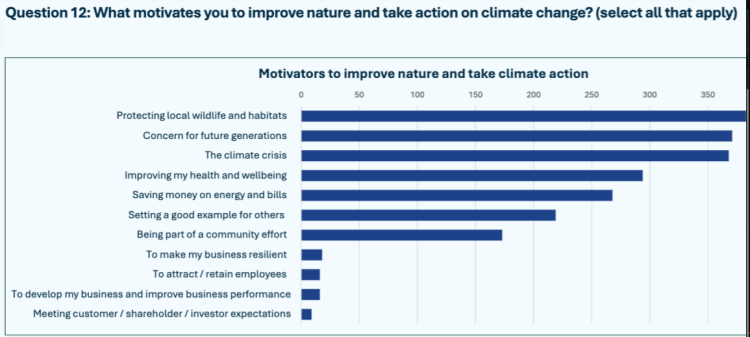
There were a few charts worth picking out – such as the things that motivated the almost 500 respondents (469 of whom identified as residents) that responded to the consultation.
…through to the barriers that stop them taking action.
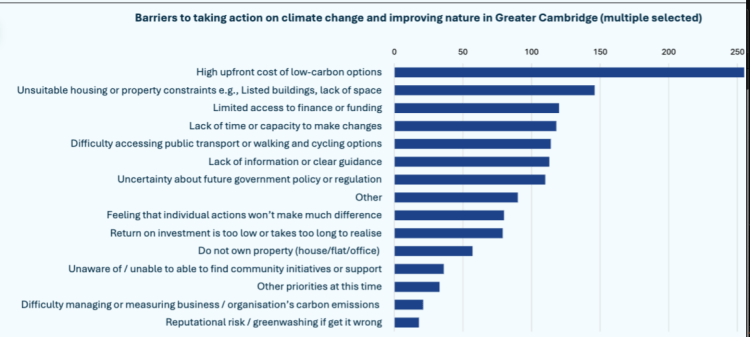
Above CamCitCo (2026) p22
The financial barriers perhaps not surprisingly are a huge barrier in a city with huge housing costs. In a close second, the limitations associated with our built environment and housing also stand out. I also wonder how much the ‘lack of time’ and ‘lack of capacity’ is related to the lack of trade skills we have individually to carry out some of the basic home improvements ourselves.
We don’t know enough about the people who responded
Given the predominantly online methods of consultation combined with consultation fatigue and lack of awareness in politics and local democracy more generally, I assume that most of the people responding to the consultation are people who have the motivation and connections enabling them to do so. Which means we cannot take the survey results as being ‘representative’ of the city. That would require a much more expensive ‘random controlled trial’ of residents with the sample selected being balanced/weighted to match the demographics of the city.
Why?
Because if the vast majority of the people responding happen to be people motivated by and concerned about climate issues, there is no guarantee that the economic and social backgrounds of those people will match those who perhaps are unaware of what the climate emergency is all about other than what they catch in the news headlines. The policy recommendations suggested by those motivated and concerned are not necessarily going to be the same as those with much lower levels of awareness.
Take for example the retired affluent academic with a secure pension and is an owner-occupier of their home (mortgage paid off) who is active in a local environmental group. Compare that with a single parent on a low income who lives in a council house. The recommendations that might have the biggest impact on the former (from downsizing to a smaller, more energy-efficient property or installing solar panels and heat pumps on their existing home instead of moving) won’t be the same for the resident living in a council house – where offering council-funded improvements through to offering a housing swap to one of the recently-completed energy-efficient council houses are more likely to be the top options.
Transport emissions
It’s worth doing a [Ctrl+F] search for the word ‘transport’ in the council’s report as this highlights some of the issues with trying to persuade people to switch modes of transport. I generally take the view that the public authorities need to build the infrastructure first before people will change behaviours.
With that in mind, have a browse through CamCycle’s response to the draft Greater Cambridge Local Plan 2024-45 here. Most of their responses are in the theme of building/improving networks of footpaths and cycleways (AKA ‘Active Travel’ in public policy spaces). Furthermore, they call for measures to ‘design out’ car dependent settlements. I remain of the view that:
- Light rail needs to form the core of a new public transport network to get people out of cars, and that the Connect Cambridge Light Rail proposals mark that starting point with an under-the-city line from Cambourne through the city centre to Addenbrooke’s and onto Haverhill being the main line at which new public transport hubs can be established, and around which higher density housing can be built.
- Leisure facilities and amenities (including essential public services) should be located in co-ordination with what the transport planners are drawing up – designing out the need for motor cars.
- Light rail and bus services should be designed to co-ordinate with each other, making ease of interchange a priority. (See proposals here for bus orbitals)
Our consultations are too fragmented
The climate emergency, the draft local plan, the draft local transport plan, can’t all of these be incorporated into something where we have pre-existing (or even new) public events both at city level (eg on Parker’s Piece) and at neighbourhood level where as with summer fairs, people can go from stall to stall to:
- find out the essentials on each issue
- give initial feedback on that initial issue without having to go into huge depth
- be given the option of exploring specific issues that are likely to interest/affect them in more detail without having to do the same for all
Especially for summer events, a rewards system could be used (tokens for free ice lollies?!?) to encourage children and adults to feed back. Especially for things that make use of colourful visuals on display boards through to things that introduce new ideas to people unaware of them.
Because in the current mood, it’s hard to get people to feel hopeful about the future – both at this time of year and also in the current environment where since the banking crash of 2008, it has been non-stop bad news for so many people, institutions, and in our built environments. That means nearly everyone under the age of 20 has no lived experience of ‘the good times’. (Similar to life from the late 1970s to the mid-1990s?)
No amount of gleaming sci-tech labs or self-congratulatory press releases are going to hide the potholes in the roads – a symptom of a chronically underfunded and broken system of local government.
If you are interested in the longer term future of Cambridge, and on what happens at the local democracy meetings where decisions are made, feel free to:
- Follow me on BSky
- Spot me on LinkedIn
- Like my Facebook page
- Consider a small donation to help fund my continued research and reporting on local democracy in and around Cambridge.

 The Cambridge Town Owl