
More for the benefit of those who don’t want to sit through a 3 hour meeting but who also want more detail than you get in a newspaper article, this may interest several of you
The minutes are here and also include my public question and the responses from Cllrs Holloway and Thornburrow. (If that doesn’t work, see item 3 here)
Additionally, In Case You Missed It (ICYMI) have a listen to Peter Freeman on Cambridge Radio on 11 Jan 2026 here.
The looming consultation
Coming hot on the heels of the Draft Local Plan which ends at 5pm on 30th Jan
“In terms of the Development Corporation consultation, the Government intends to consult in early 2026, on a centrally led Development Corporation. It was hoped a Development Corporation planning committee could be operational by the end of 2026, with local leaders sitting on the Board. These powers would be used collaboratively, respecting the Combined Authority Mayor’s role in spatial development strategies and building on the emerging Local Plan.”
Above – CamCitCo Item 3 p4, of Performance, Assets and Strategy Overview and Scrutiny Committee – Tuesday, 27th January, 2026
The pre-election period for local elections (where public bodies should refrain from making big statements) is normally around the end of March for elections in May. Which gives ministers 6-8 weeks to get that consultation launched. This is the point at which we should find out the boundaries of the development corporation, as well as the initial locations of where any *additional development* on top of the draft local plan should go.
Note the Combined Authority has two significant meetings related to that consultation – the Growth Committee and the CPCA Board. See the calendar here. I expect officers will have some views of what scale of expansion a future development corporation is looking at, along with the scale of infrastructure needed to sustain it.
Heritage – and how to go beyond sustaining it
“The Cambridge Growth Company acknowledged the importance of heritage to civic identity and community acceptance. There was a commitment to incorporating heritage considerations into engagement and planning.”
Above CamCitCo p5
It’s one of the reasons why I blogged about the experience of Yale in the US and the importance of the process they went through
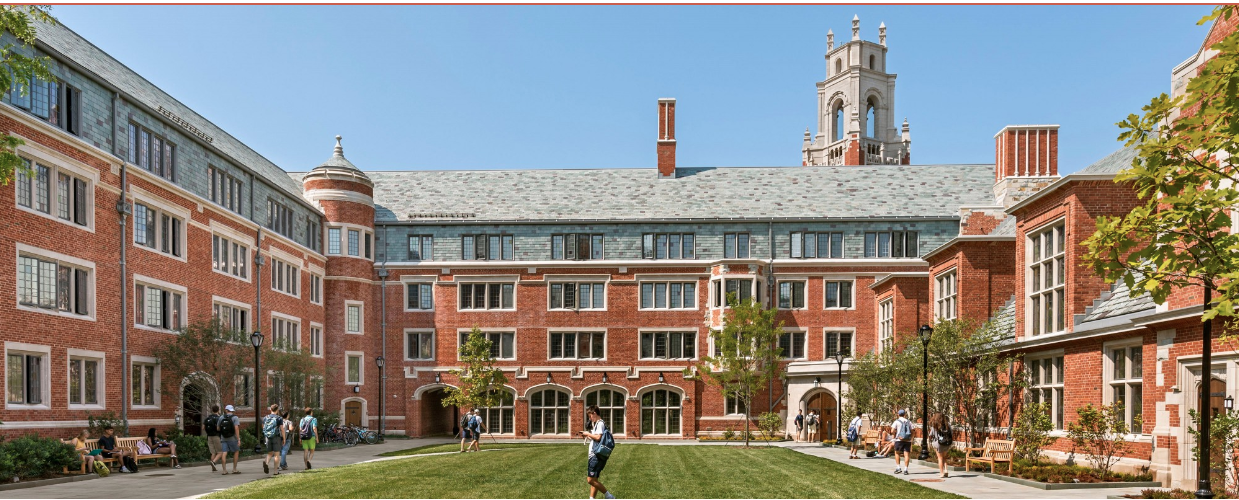
Above – Yale Residential Colleges RAMSA
That courtyard generally works for me – and I can imagine some of the older Cambridge colleges (and some of the Victorian ones too) that have red brick court yards (eg St John’s, Homerton, Selwyn) providing the sources that would result in something similar. Note the importance is on the process of detailed surveying of the existing older buildings and picking out the nice bits and the design features that work well.
Eddington doesn’t do any of that
Looking at the image below you could be forgiven for thinking that what is being constructed is some prison camp or ‘correction facility’
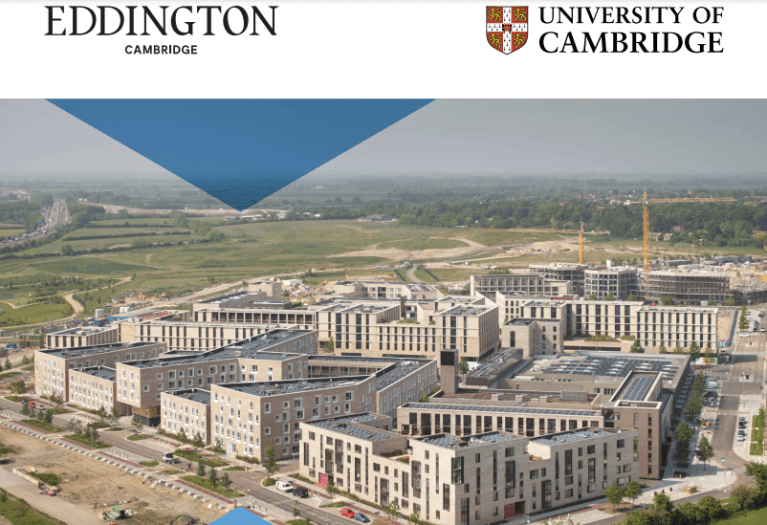
Above – Eddington which I wrote about their new planning applications here
One of the small mercies for me is that this bland, boring, and harsh piece of urban design is on the opposite side of the city, so unless I have to go to a meeting there, I don’t have a reason to go there. Which is probably what the University Dons were thinking when pondering how to keep us town people out. The site and the properties for sale on the site (mindful of the bond issue the University launched to help fund the development) can be marketed as that exclusive community – a vision that can be packaged up and sold to the highest bidder. And if we need reminding of that vision…
“Cambridge will be one of the key venues to come and be seen, and to rub shoulders with the global intellectual elite. If it sounds like an exclusive conference venue, then that may be about right.”
Sanders, J (2014) in Cambridge 2065, p48
I included the above in a blogpost about the tensions within the University of Cambridge’s institutions – some wanting to promote exclusivity (not least because of the financial benefits) with others wanting to promote inclusivity, mindful of the chronic inequalities in our city that are not going away anytime soon.
Talking of crises – the water crisis hasn’t gone away either
“The water infrastructure issue had now been escalated to a cross-Whitehall ministerial group. Ministers were scrutinising Anglian Water’s decision-making and seeking solutions.”
Above CamCitCo p6
I can’t help but wonder whether Anglian Water has the capacity to undertake the major upgrades to infrastructure for both Cambridge and also Bedfordshire’s Universal Studios development at the same time – the latter being in the news earlier.
“Arts and culture must be shaped through local engagement. Work was underway with CPCA to map current cultural provision and understand future needs.”
Above CamCitCo p6
Which will be interesting to see how the above aligns with parts 2 and 3 of the Cultural Infrastructure Strategy that I mentioned here.
The big challenge is with performing arts venues – note the huge distances that patrons are prepared to travel to get to the Cambridge Corn Exchange to see events there. (Which also speaks volumes about the state of the arts in market towns).
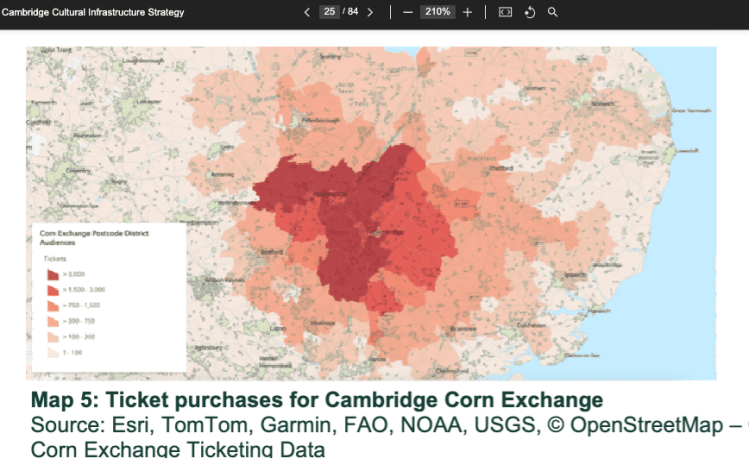
Above – GC Cultural Infrastructure Strategy (2025) p25
If Cambridge’s population is going to head towards the 200,000 mark (with further growth and new towns taking place combined with improved public transport access over greater distances), then the authorities need to consider seriously the merits of a performing arts venue that is at least double the capacity of the Corn Exchange *and* has the world class public transport facilities within walking distance to enable the public to disperse at the end of shows. Such design would also ensure that such public transport routes are more sustainable financially.
In the meantime, the water and sewage issues remain outstanding.
If you are interested in the longer term future of Cambridge, and on what happens at the local democracy meetings where decisions are made, feel free to:
- Follow me on BSky
- Spot me on LinkedIn
- Like my Facebook page
- Consider a small donation to help fund my continued research and reporting on local democracy in and around Cambridge.

 The Cambridge Town Owl