They demand far more clarity on the proposals being prepared by the Cambridge Growth Company, and ask detailed questions about lines of accountability
You can watch the video here and browse through the meeting papers here.
As with the Cambridge City Council cross-examination last month he began with a presentation.
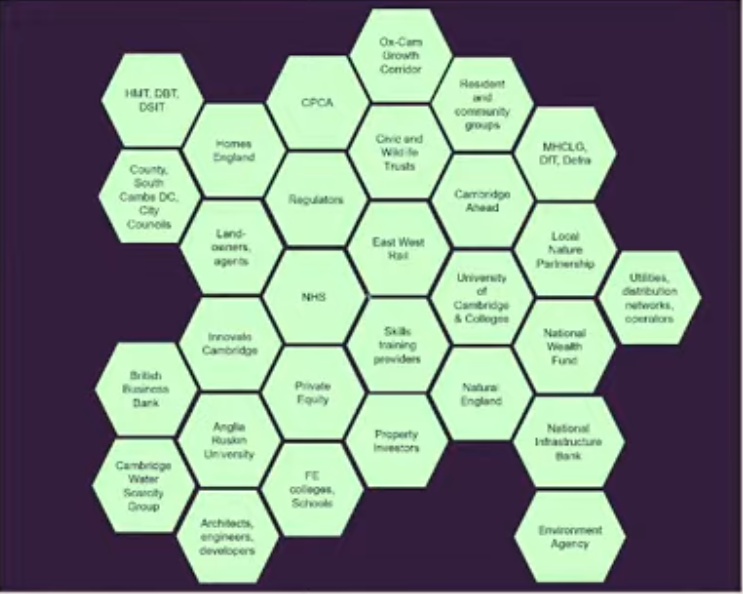
Above – Cambridge #Localgov Blockbusters (which TV themes can you remember?)
BBC Cambridgeshire says homes plan may include other counties
Phil Shepka picked up on some of the key soundbites from Mr Freeman in the extensive cross-examination.
“…if the government wants economic growth here, we’ve also got to have social justice, we’ve got to sort transport, we’ve got to sort water.”
Peter Freeman to South Cambridgeshire District Council, 29 Jan 2026 in BBC Cambs 30 Jan 2026
Greater Cambridge Draft Local Plan consultation has closed
Above – time’s up!
That said… …it does not mean the public is banned from submitting further comments. How many of you think the landowners and lobbyists are going to stop making representations? Exactly!
During my civil service days such things didn’t make any difference – the lobbyists still carried on lobbying, requesting meetings with civil servants and ministers. Furthermore, all of the evidence bases for the draft local plan have not been collected. Of those that have, eg the Cultural Infrastructure Strategy which I wrote about here, and the Infrastructure Delivery Plan which I wrote about here, are either incomplete (the former has two more parts come), or have so many holes in that the consultants need to go back and do more work on their submitted draft. (But then that’s the whole point of such consultations – to enable people to pick holes in them and point out the bits that need further work.
Other sections are yet to be published – we’re still waiting on some substantial documents on indoor sports facilities in Cambridge, especially some in-depth assessments on swimming pools and other facilities.
If you go to the main local plan consultation page here and scroll down to the small green rectangular button that says ‘show document contents’ it will give you a page full of hyperlinks that take you to the huge number of draft policies that council planners want to include in the plans.
Peter Freeman has stated that the Growth Company will be working with the council planners and also using and sharing the same evidence bases.
Which is essential. Because if they don’t lobbyists and developers will simply state that the proposals from the council planners are ‘unsound’ and thus they’ll have to go back to the drawing board. Hence Mr Freeman and his team are acutely aware of the need (and of the public interest) in maintaining a united front against those looking to undermine their proposals for commercial gain. Which is what happened in 2014 when developers lobbied hard to persuade the planning inspectors that Cambridge’s local plan was ‘unsound’. That resulted in an additional four years of work at huge expense before the current local plan was approved.
“What did the councillors ask?”
Far more probing questions (and more ‘hostile’ ones) compared with their city counterparts – which was understandable because for some of them it will be the permanent change from agricultural land to residential suburbia and urban centres that they will have to live with.
That was very much the case with Cllr Dr Richard Williams (Cons – Whittlesford) making the point that ‘South Cambridgeshire is not Cambridge City’, and therefore the responses that Mr Freeman and colleagues might give to a city-based audience may not necessarily satisfy a rural village-based audience. At the same time councillors were also made aware of the Political side to the Government’s plans.
“How do the residents get rid of you if they don’t like what you do?”
Cllr Drew to Peter Freeman
Mr Freeman replied that residents and councillors can make the case to the Secretary of State for Housing, Communities and Local Government (under whose powers delegated he was appointed by the Minister of State for Housing and planning).
And to be fair to Cllr Drew he wasn’t putting that question to Mr Freeman to be awkward or rude. Rather I think it was for the benefit of any watching persons who perhaps were not clear of the lines of democratic accountability are with Mr Freeman – which as Cllr Drew described are at the national tier of our democratic system (i.e. through local Members of Parliament) rather than at a local tier (i.e. through local ward councillors).
This is also a point I begin with very early on in my workshops (a new round will start with the next looming consultation sometime in February) by making it clear that:
- Democracy is not just turning up at election time to put a cross in the box of the candidate of your choice – contacting your local elected representatives to take up an issue with a decision-making institution (a council, an NHS trust, a department of state) on your behalf is another element of democracy.
- The scale of the proposals means that people with strong views or interests about them form groups in order to share the burden of scrutiny and take collective action in order to influence the final decisions – and that can be in the form of joining a local residents’ group, a local or national campaign group, or even a political party. Which is what has also influenced former Independent councillor Stephen Ferguson in St Neots in Huntingdonshire District who has now joined the Green Party, doubling the party’s presence in Cromwell county.
“He said he had taken Independent politics “as far as I possibly could” but argued that the national and local context had shifted.”
Above Cllr Stephen Ferguson to John Elworthy of CambsNews, 27 Jan 2026
Basically don’t do this stuff alone. It’s not fun. Even though I’m something of the last one standing who blogs regularly about local democracy in and around Cambridge. A decade ago there were half a dozen or more of us doing this. If anyone has any ideas on how to build up a new collective from scratch, shout!
‘Why does the University of Cambridge have so much power and influence?’
Asked Cllr Drew. Because none of us got to vote for them! (Spoken in similar lines about local people not getting to vote for Peter Freeman!)
One area of controversy with the Greater Cambridge Partnership which ministers gave a non-voting board seat to the University of Cambridge was over the choice between a workplace parking levy vs a congestion charge – discussed here by the old Smarter Cambridge Transport. The University of Cambridge lobbied against the former and came out in favour of the latter – supported by senior transport officers of the GCP and rubber-stamped by councillors on the GCP Assembly and Board with few dissenting. The problem was that for lots of reasons hardly any members of the public were keeping up with the decisions being made by the GCP on their behalf. People who had moved to the city in the years that followed the signing of the City Deal in 2014. While ‘the state’ assumed that the political and democratic legitimacy of the City Deal was still in place nearly a decade later, the electorate took a very different view. The 2023 local elections proved to be toxic. The Conservatives who lost their only board seat following the hammering at the 2021 county council and failure to recapture their former South Cambridgeshire District seats the following year relinquished their support for the policies put forward by the GCP. With the collapse of party political unity plus backbench rebellions from Labour in particular, the congestion charging proposals collapsed.
What are the decision-making processes for deciding the corporate policies of the University of Cambridge?
I’ve written lots about this over the years – dating back over a decade to the first City Deal Board meeting where I put a question to the Cambridge University representative Prof Jeremy Sanders in 2015. (See the embedded video in this blogpost about the University of Cambridge’s ambitions and the need for transparency).
The values of the Cambridge Growth Company
Cllr Helene Leeming (LibDems – Cambourne) tabled this question – it’s worth listening to and noting Peter Freeman’s response.
Other questions included calls for more clarity on modes of transport being proposed – will there be even more busways? Mass Rapid Transport came up in Cllr Anna Bradnam’s question. I moaned about the use of acronyms to hide what are really buses.
“We are assuming the corridors you [The GCP] have identified should be implemented”
Peter Freeman to Cllr Bradnam.
“Our view is that [the Growth Company] is technology-agnostic, and we are going out to tender for a consultant to help us with [assessing light rail].“
Beth Dugdale of the Cambridge Growth Company to Cllr Bradnam
To clarify, if they identify an affordable light rail solution *that can move more people more efficiently/safely/effectively than busways, they will consider seriously those options.
This was followed up by a question from Cllr Dr James Hobro (LibDems – Foxton) – note the number of councillors we have in/around our city with doctorate-level qualifications – asking whether ‘capital-intensive’ models eg building busways, were suitable for villages where the main realistic public transport improvements are in improving bus services. Which inevitably means subsidising loss-making services. For those of you interested in campaigning for better bus services, join Richard and the team at the Cambridge Area Bus Users Group
Will the Development Corporation that emerges from the Growth Company extend over county boundaries?
Cllr Leeming asked this question – raising the issue of the GCP’s limitations, especially with East Cambridgeshire villages close to Cambridge (Cllr Leeming mentioning Bottisham and Burwell), and also towns over the county boundaries such as Haverhill and Royston.
The Greater Cambridge Partnership can’t say I didn’t warn them. Here’s me at the old Shire Hall back in January 2015 (11 years ago!!!) asking what conversations the GCP would be having with their county counterparts in Suffolk and Essex. I followed that up in 2017 picking up on inconsistencies in the consultant’s report for the GCP on transport links to Haverhill in this public question here. The GCP only has itself to blame for not designing and delivering a heavy or light rail alternative from Haverhill to Cambridge serving the villages along that abandoned railway line. I hope that the Cambridge Growth Company will be able to make good on the ambitions of Rail Future East and Rail Haverhill in reconnecting the two settlements.
In the meantime, as one consultation closes, another one looms on the horizon…
No rest for the wicked eh?
If you are interested in the longer term future of Cambridge, and on what happens at the local democracy meetings where decisions are made, feel free to:
- Follow me on BSky
- Spot me on LinkedIn
- Like my Facebook page
- Consider a small donation to help fund my continued research and reporting on local democracy in and around Cambridge.

 The Cambridge Town Owl